Before I start this post I would like to apologize for my lack of recent posts, this is due in part to research and study for a print publication I am currently working on, and it is taking up the greater part of my spare time, so post might be few and far between I'm afraid, but I will try to put one up every now and then.
Currently British politics is dominated (with a slight exception of regional elections in Scotland, Wales and Northern Ireland) by the upcoming referendum on the United Kingdom's membership of the European Union. As usual I am not advocating any political opinion, but I was intrigued when I seen a hypothetical scenario. The scenario was the UK leaves and forms a free trade and movement zone, between the UK, Canada, Australia and New Zealand. with certain joint institutions, rather similar to the European Union but more anglocentric. I even seen a potential flag for such a union by Zach Elsbury:
It evokes the British ensign which not only includes the Union Flag but is the same style of flag used by Australia and New Zealand with a red field for Canada (the former flag of Canada was a red ensign). Its defaced with a shield quartered with the national plants of the four nations.
Inspired by this design I thought of having ago at a similar flag, with more emphasis of an international organisation rather than a colony. My first design was this:
Still inspired by an esign which has elements all of the four member states flags have in common,The Union Jack has official status in Canada and the UK, and appears on the Australian and New Zealand flags. it features the gold wreath and a globe. The roses form part of the cypher which is in the centre of all the commonwealth royal standards outside the UK, including those of Canada, New Zealand and Australia. The globe is from the flag of the Commonwealth of Nations. This flag is timeless as it has no direct symbolism to any individual state, meaning if a member leaves or other realms like Tuvalu or Jamacia join the flag doesn't require changing. However thinking the globe might look a little like a mock up British Empire flag, I decided to replace it with a crown, the symbol of the monarch which share:
I like this better as it is a simpler design and looks a little less cramped.
Showing posts with label New Zealand. Show all posts
Tuesday, 19 April 2016
Wednesday, 29 October 2014
New Zealand flag referendum
I have just saw on the BBC News (online article see here) that New Zealand will hold two separate referendums in 2015 and 2016 to possibly try to change their flag. So I think now is a good time to share my proposals. My first thought was a flag based on the flag of the United Tribes, regarded as the first NZ flag
Not an actual proposal but it did get me thinking about the United Tribes design, particularly the design in the canton. Perhaps a modified version of the flag:
It reflects the first New Zealand flag, with black representing the Maori people and blue those of European descent. White is neutral and represents peace and unity. The idea for a white cross rather than red came from the NZ Yacht ensign.
Likewise the red white and blue ensign system for use at sea would probably look like this:
![]() |
| Flag of the United Tribes of New Zealand 1834-1840 |
![]() |
| National flag and maritime Jack |
Likewise the red white and blue ensign system for use at sea would probably look like this:
![]() |
| Naval Ensign |
![]() |
| State ensign |
![]() |
| Civil Ensign |
![]() |
| Air Force flag |
![]() |
| Army Flag |
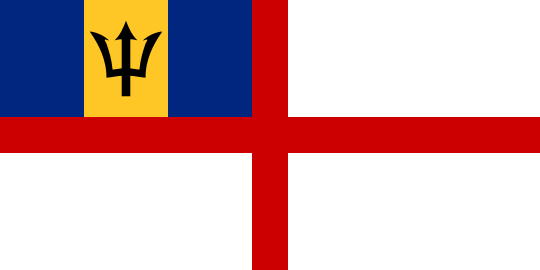
Most of the ensigns are relatively unchanged from the current one but have the white cross flag in the canton rather than a UK flag. The naval ensign is an altered Royal Navy ensign. Ships of the Royal New Zealand Navy (as did the Canadians and Australians) used an unaltered St George's ensign until the 1960s, So its another historical reference, The St George's ensign with the aproprate flag in the canto is not uncommon in Commonwealth navies and is used by India,Barbados and Jamaica. Undefaced versions of the state and civil ensigns still have the Southern Cross, as I think it looks nicer than a plain blank field. or alternatively the white cross could be used:
Flags of the territories in "Free Association" with New Zealand, are also based on UK ensigns, with Union Jacks in the canton, these may wish to change this to a NZ flag:
![]() |
| The Cook Islands |
![]() |
| Niue |
However the NZ Prime Minister, Mr John Key has said he would like a black flag witha silver fern similar to sport flags. So Mr Key these designs are for you:
Its distinct and a cross between the current flag and the silver fern one. The red, white and blue maritime ensign system can still be used:
Please feel free to comment and discus ideas or alternatives.
Tuesday, 1 April 2014
Allied Nations (WW2)
I don't know where I got this idea from but it occurred to me a while ago that the Allies of the Second World War, didn't really have a shared unified symbol. This is in contrast with most modern international organisations and alliances both military and non military alike, most of whom like the United Nations (UN), European Union (EU), North Atlantic Treaty Organisation (NATO) etc all of whom use their own flag.
Indeed this does seem odd as flags are prominent in both American and British Empire & Commonwealth propaganda posters from the period.
The real purpose of these posters are clearly to evoke national and patriotic pride.
Its not only in a national setting flags were used but also international, if you look at the fallowing posters:
For those interested some of the flags in these posters include: United States, United Kingdom, Soviet Union, China, Australia, Belgium, Brazil, Dominion of Canada, Costa Rica, Cuba, Czechoslovakia, Dominican Republic, El Salvador, Ethiopia, Greece, Guatemala, Haiti, Honduras, Empire of India, Luxemburg, Mexico, Netherlands, New Zealand, Nicaragua, Norway, Panama, Philippians, Poland, Union of South Africa and Yugoslavia. The absence of France is unusual!
After all the Allies did use shared symbols and insignia to easily identify each other such as the Invasion Stripes on aircraft, and by June 1944 all Allied vehicles in the North West Europe theatre had adopted the American style white star, sometimes in a broken or unbroken circle.
So taking this into account it does seem strange that no flag was ever adopted by the Allies. Well there were some flags used during the Allied occupations of Germany and Japan after the war, primarily to identify ships of the occupied country:
I decided to design an Allied Nations flag, as I think although it may not be physically needed, there still is potential for one, video games, documentaries, joint and international commemorations are but a few examples of how it could be used.
My first design features a white "V" separating a red and blue field with the white vehicle star.
The reasoning behind the colour scheme is that most of the Allied national flags have a red, white and blue colour scheme and most of the ones that don't have at least one of those colours on their flag. The "V" represents the V sign used to symbolise victory/freedom during WW2. The white star on green being used as a common symbol, as it was used by most of the Allies and was certainly recognisable to all of them.
The second design features a blue diamond on a red, white and black striped field with a circle of stars:
The red, white and black stripes reflect the United Nations Honours flag and the Invasion Stripes of Allied aircraft. the circle of stars represents unity (but not specific nations). The colour scheme and vehicles star have the same symbolism as the first flag.
Or alternatively the vehicle star could be replaced with a V symbol:
Please Feel Free to comment.
Indeed this does seem odd as flags are prominent in both American and British Empire & Commonwealth propaganda posters from the period.
The real purpose of these posters are clearly to evoke national and patriotic pride.
Its not only in a national setting flags were used but also international, if you look at the fallowing posters:
For those interested some of the flags in these posters include: United States, United Kingdom, Soviet Union, China, Australia, Belgium, Brazil, Dominion of Canada, Costa Rica, Cuba, Czechoslovakia, Dominican Republic, El Salvador, Ethiopia, Greece, Guatemala, Haiti, Honduras, Empire of India, Luxemburg, Mexico, Netherlands, New Zealand, Nicaragua, Norway, Panama, Philippians, Poland, Union of South Africa and Yugoslavia. The absence of France is unusual!
As can be seen from these posters the theme of unity and international friendship & cooperation seem to be key, and judging by the use of flags to demonstrate this, one wonders why an official flag wasn't adopted to demonstrate this?After all the Allies did use shared symbols and insignia to easily identify each other such as the Invasion Stripes on aircraft, and by June 1944 all Allied vehicles in the North West Europe theatre had adopted the American style white star, sometimes in a broken or unbroken circle.
So taking this into account it does seem strange that no flag was ever adopted by the Allies. Well there were some flags used during the Allied occupations of Germany and Japan after the war, primarily to identify ships of the occupied country:
Flags of occupied Japan (left) and Germany (right)
There also seems to have been celebration flags possibly used by liberated civilians that featured allied flags, however these cannot be considered flags of the alliance itself:
Perhaps the closest thing to an Allies flag is the United Nations Honours flag, that was primarily used unofficially/semi-officially by the victorious allies seeking universal peace and attempting to establish the modern United Nations (the Allies were already calling themselves the United Nation in WW2):
A design symbolising the "four freedoms" from a speech by US President Franklin D Roosevelt it seems to have actually had limited use by Britain and particularly America from 1943-48. It is also thought of as the first United Nations flag although it was never officially used in that role. I decided to design an Allied Nations flag, as I think although it may not be physically needed, there still is potential for one, video games, documentaries, joint and international commemorations are but a few examples of how it could be used.
My first design features a white "V" separating a red and blue field with the white vehicle star.
The reasoning behind the colour scheme is that most of the Allied national flags have a red, white and blue colour scheme and most of the ones that don't have at least one of those colours on their flag. The "V" represents the V sign used to symbolise victory/freedom during WW2. The white star on green being used as a common symbol, as it was used by most of the Allies and was certainly recognisable to all of them.
The second design features a blue diamond on a red, white and black striped field with a circle of stars:
The red, white and black stripes reflect the United Nations Honours flag and the Invasion Stripes of Allied aircraft. the circle of stars represents unity (but not specific nations). The colour scheme and vehicles star have the same symbolism as the first flag.
Or alternatively the vehicle star could be replaced with a V symbol:
Gold replaces white in this example but white could also be used.
Please Feel Free to comment.
Labels:
Allies,
Armed Forces,
Asia,
Australia,
Brazil,
Europe,
France,
Middle East,
Military,
New Zealand,
North America,
Pacific,
Portugal,
South America,
Uniformed organisations,
United Kingdom,
United States,
WW2
Wednesday, 12 December 2012
The Cook Islands
The Cook Islands (Kūki 'Āirani) is a self-governing parliamentary democracy in the South Pacific Ocean in free association with New Zealand. It is composed of 15 small islands whose total land area is 240 square kilometres (92.7 sq mi). The Cook Islands' Exclusive Economic Zone (EEZ), however, covers 1,800,000 square kilometres (690,000 sq mi) of ocean. Defence and foreign affairs are the responsibility of New Zealand, in consultation with the Cook Islands. In recent times, the Cook Islands have adopted an increasingly independent foreign policy. Although Cook Islanders are citizens of New Zealand, they have the status of Cook Islands nationals, which is not given to other New Zealand citizens.
The coat of arms of The Cook Islands is below:
These are my prefaced flags but encase NZ ensigns need to be used I still feel they should reflect the islands, for example for the merchant ensign use the NZ red ensign but with the Cook Stars below the union flag. The Government ensign would be the same but Blue. There is also a 'Queen's Representative on the islands, who have their own flag, currently the national flag but with a crown in the centre of the stars. If the National flag changes then the Queen's Representative flag should change, my idea is below:
It features the national colours and national stars in the Canton, the two stars in the fly represent the island's to villages.
Rakahanga:
The coat of arms of The Cook Islands is below:

The shield is blue with fifteen white stars (one for each island) arranged in a circle, as found on the national flag, and is supported by a flying fish (maroro) and a White Tern (kakaia). The helmet is an ariki head-dress (pare kura) of red feather, symbolising the importance of the traditional rank system, and the name of the nation is on a banner below the shield. The achievement is augmented by a cross and a Rarotongan club (momore taringavaru) used by orators during traditional discourses, respectively symbolizing Christianity and the richness of Cook Islands' tradition, placed in saltire behind the shield.
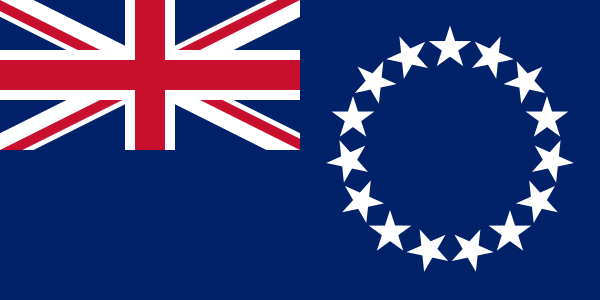
The current flag is below:
The flag is based on the traditional design for former British colonies in the Pacific region. It is a blue ensign containing the Union Flag in the upper left, and on the right, fifteen stars in a ring. The Union Flag is symbolic of the nation's historic ties to the United Kingdom and to the Commonwealth of Nations. The stars stand for the fifteen islands that make up the Cook Islands (Tongareva, Rakahanga, Manihiki, Pukapuka, Nassau, Suwarrow, Palmerston, Aitutaki, Manuae, Takutea, Aitu, Mitiaro, Mauke,Rarotonga and Mangaia). The blue represents the ocean and the peaceful nature of the inhabitants.
I am going to address two main flag related items about the Cook Islands, first are national flags. I think this flag can be misinterpreted suggesting that the islands are a British Overseas Territory rather than a (mostly) independent country, if it was going to relate to any other nation it should be New Zealand?
There have of course been varyous flags representing the Cook Islands see here.
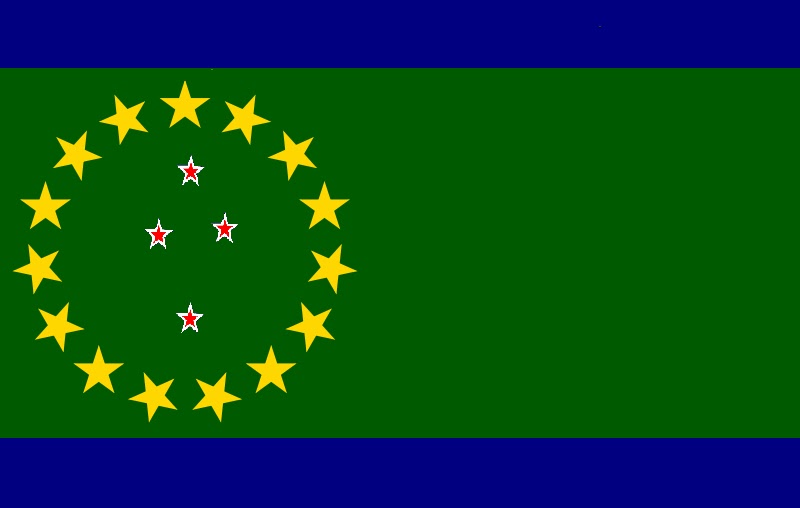
My first idea taking replacing the UK flag with something more NZ like:
I thought green and gold from the 1973 flag should be used, The green colour represented continuous growth and life; the yellow represented the faith, love, happiness, and commitment shown by the islanders. I kept some blue as I like the way its seen to represent the ocean and peaceful living, it also ties in with the current NZ flag. The red southern Cross of New Zealand is at the hoist. However as you might agree this is awful looking.
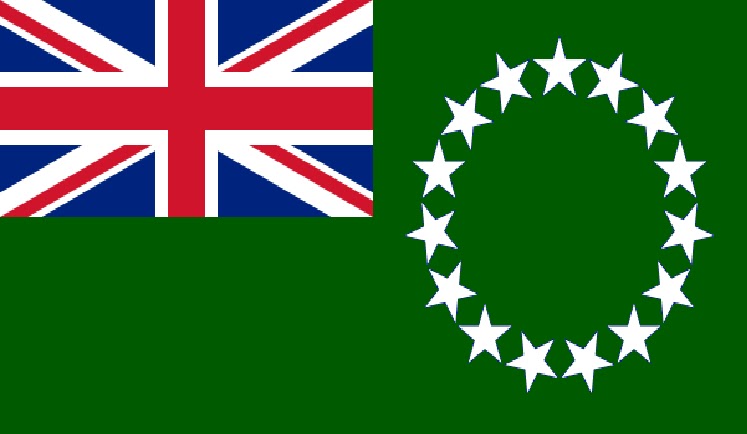
So I improved it by placing the Southern Cross inside the circle of stars:
However I would prefare no references to any other nation only the Cook Islands so the flag can be used no matter what the future holds:
My ideas for maritime ensigns are as fallows:
Like most Commonwealth Civil ensigns it is red, but still has the original blue and green layout.
The government ensign is below:
Again reflective of the Commonwealth its blue, I used white stars as I think they stand out more.
These are my prefaced flags but encase NZ ensigns need to be used I still feel they should reflect the islands, for example for the merchant ensign use the NZ red ensign but with the Cook Stars below the union flag. The Government ensign would be the same but Blue. There is also a 'Queen's Representative on the islands, who have their own flag, currently the national flag but with a crown in the centre of the stars. If the National flag changes then the Queen's Representative flag should change, my idea is below:
It is based on the current flag but with a Green Field, I decided to keep the UK flag in as its the monarch's representative. Although the Queen's Representative has a flag, I am not aware of a Royal Banner for the islands, so I based it on the above flag but with the Queen's Personal emblem on it which often appears on the Royal Banners of the Commonwealth:
That's national flags out of the way what about flags for the individual islands? I also made some suggestions. However not
all the islands are inhabited so I didn't make flags for all the islands, as I don't see the point of an uninhabited island having a flag.
First is Tongareva also called Penrhyn:
all the islands are inhabited so I didn't make flags for all the islands, as I don't see the point of an uninhabited island having a flag.
First is Tongareva also called Penrhyn:
It features the national colours and national stars in the Canton, the two stars in the fly represent the island's to villages.
Rakahanga:
This flag also features the national colours, and stars in the canton. The two big stars represents the two tribes, each tribe is divided into seven sub groups each represented by the smaller stars round the main two stars.
Manihiki:
The flag of Manihiki represents the same ethnic break up as Rakahanga, however the central blue bar is replaced with gold to distinguish it.
Pukapuka:
Pukapuka is a coral atoll, with three small islets, the three green star represent the islets they also represent the geographic positions of them.
Aitutaki:
The Atutaki flag is a simple green flag with eight stars representing the eight villages.
Mitiaro:
The flag features the national stars in the canton with four gold and blue bars representing the four inhabited villages.
Mauke:
A blue flag with four gold stars at the hoist representing the sub divisions and the national ring of stars at the fly.
Rarotonga:
The flag features three green and blue bars and three white stars representing the three sub divisions and three tribes on the island.
Last but not least is Mangaia:
The flag features six stars representing the sub divisions and a broke Union Jack. The reason there is a broken UK flag is down to one of the islands stories.
In the 19th Century during a trip to London,the Islands ruler Numangatini, or"King" John of Mangaia, received from Queen Victoria herself a Union Jack. The flag still exists, albeit in two pieces, half is supposed to be in Oneroa, and the other half in Tonga. The broken Union Jack in two pices is reflected on the flag. There is however an alternative without the Union Jack:
All Comments Welcome
All new designs by Samuel McKittrick some information from Wikipedia
Subscribe to:
Posts (Atom)


.bmp)