Showing posts with label WW2. Show all posts

Thursday, 14 May 2020

the Formal Surrender of Hitler's U-boats

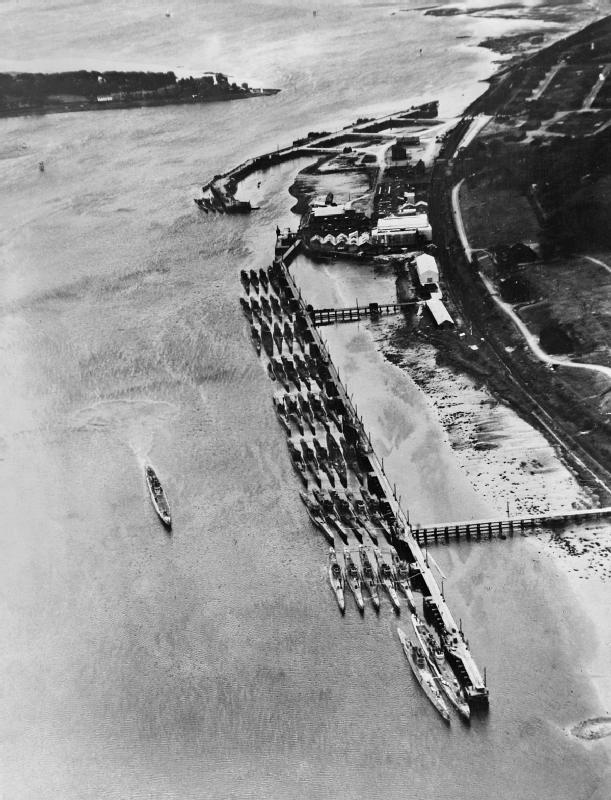
U-Boats moored at Lisahally, Londonderry.
 IWM Public Domain

The Battle of the Atlantic was the longest battle of the Second World War beginning with the sinking of the liner SS Athenia by German submarine U-30 a matter of hours after the British declaration of war on 3rd September 1939. German submarine or U-Boat activity continued until the VE Day on 7th May 1945. During this battle the German Navy the Kriegsmarine attempted to cut off the United Kingdom’s overseas supply lines most notably the transatlantic routes. The U-Boat was the Kriegsmarine’s workhorse in this regard. So critical was this battle to the survival of the United Kingdom that Britain’s wartime leader Winston Churchill described it as his greatest fear.
Though the command of Western Approaches was in Liverpool many of the escort vessels that protected Allied convoys were based in Northern Ireland ports most notably the port of Londonderry. Derry as the city is also commonly called is the UK’s most western port and a stone frigate (naval shore base) HMS Ferret was established there in 1940. Londonderry is Northern Ireland’s second city and is situated on a tidal section of the River Foyle just before it flows into Lough Foyle and into the North Atlantic. The importance of Derry to the battle is shown that by 1943 more ships were stationed there than Liverpool, the Clyde and Belfast. At its peak the city and its outlying port facilities at Lisahally just beyond the city limits catered to 139 ocean going vessels. Following the entry of the United States into the war the city hosted a strong American presence although the bulk of Allied naval personnel were British and Canadian.
On 4th May 1945 as Berlin fell Grand Admiral Karl Donitz who had following Hitler’s suicide three days earlier inherited the leadership of Nazi Germany ordered his U-Boats to ceasefire. The message he sent them read “Undefeated and Spotless, you lay down your arms after a heroic battle without equal.” From that date U-Boats began surrendering whenever they met an Allied ship although some commanders scuttled their submarine before it fell into Allied hands.

View of Londonderry with warships along the quay
While many of the crews did fight a heroic battle, Winston Churchill himself paying tribute to the ‘fortitude of the U-Boat Service’ they had quite decisively been beaten in the Battle of the Atlantic. The Commander in Chief of Western Approaches Admiral Sir Max Horton took issue with this statement. He was a veteran of the 1st World War (ironically as a submarine commander) and was aware that the Germany had blamed its defeat in that conflict on the stab in the back myth. This was the myth that the German armed forces in the field were undefeated and that Germany had lost the war because the civilians and politicians at home gave in and betrayed them. This was a myth but Horton was aware that the Nazis had used this belief to their advantage during their rise to power and it played into their rearmament and expansionist policies. Fearing that a similar myth regarding the German armed forces in the Second World War might lead to history repeating itself. Horton sought to dispel it before it could take hold so he planned a formal surrender ceremony.
Londonderry was chosen to be the place where this ceremony would take place due to the role it played but also probably for practical reasons regarding the range and seaworthiness of some of the U-boats. The first eight U-Boats sailed into Lough Foyle on Monday 14th May 1945 with a skeleton Kriegsmarine crew and under the Royal Navy command. The U-Boats flew the British white ensign and were escorted by the British, Canadian and American destroyers HMS Hesperus, HMCS Theford Mines and USS Robert I Paine. The U-Boats docked at Lisahally and their crews led by Oberleutnant Klaus Hilgendorf commander of U-1009 formally surrendered to Admiral Sir Max Horton, who had flown into nearby Royal Naval Air Station Eglington (HMS Gannet) that morning specifically for the occasion. Horton was joined by the Prime Minister of Northern Ireland Sir Basil Brook and Colonel Dan Bryan the Irish Free State’s Director of Military Intelligence. The event was also witnessed by many of the locally based Allied soldiers, sailors and airmen, most notably the WRNS from HMS Ferret and Fleet Air Arm personnel from HMS Gannet and HMS Shrike (RNAS Maydown).
Free Polish destroyer ORP Krakowaiak toes U-2337 out of Lough Foyle
for scuttling as part of Operation Deadlight 28th November 1945
Following the surrender more U-Boats found themselves moored on the Foyle from where they were towed of the coasts of Counties Londonderry and Donegal and systematically sank in what was known as Operation Deadlight. 116 boats were destroyed this way, being towed to three main zones where they were sunk either by scuttling, naval gunfire or aerial target practice depending on which zone they were towed to. This operation commenced on 17th November 1945 and completed on 11th February 1946.

Thus the end of Hitler’s U-Boat fleet happened in Northern Ireland. Winston Churchill said of Northern Ireland’s role

“By the grace of God Ulster stood a faithful sentinel”
“That was a dark and dangerous hour. We were alone, and had to face single-handed the full fury of the German attack raining down death and destruction on our cities and, still more deadly, seeking to strangle our life by cutting off the entry to our ports of the ships which brought us our food and the weapons we so sorely needed.
Only one great channel remained open. It remained open because loyal Ulster gave us the full use of Northern Irish ports and waters, and thus ensured the free working of the Clyde and the Mersey.
But for the loyalty of Northern Ireland we should have been confronted with slavery and death and the light which now shines so strongly throughout the world would have been quenched.
The bonds of affection between Great Britain and the people of Northern Ireland have been tempered by fire and are now, I believe, unbreakable.”
“We have traveled a hard and darksome road to victory in Europe, and at every turn in this memorable journey the loyalty and courage of Ulster have gleamed before the eyes of men.
The stand of the Government and People of Northern Ireland for the unity of the British Empire and Commonwealth and for the great cause of freedom, for which we all risked our survival will never be forgotten by Great Britain. A strong loyal Ulster will always be vital to the security and well-being of our whole Empire and Commonwealth”

Tuesday, 11 November 2014

Armoured Train Emblems

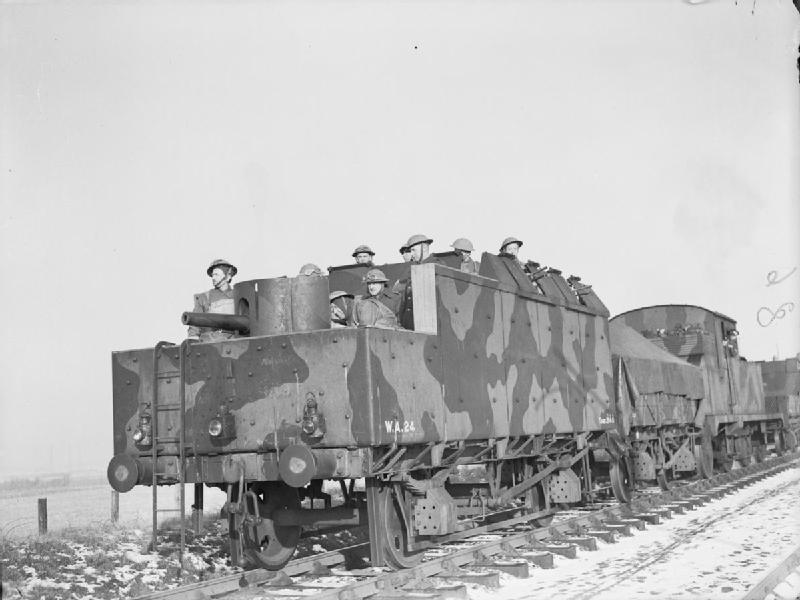
A fitting post for Armistice Day, the idea for this post came when reading an article about armoured UK trains in WWII. The article said that the trains were given a royal commision like ships, and as such had the abbreviation of HMT (literally His Majesty's Train) before their name. This got me thinking, what if they had a special insignia like a ships badge?  
There were two types of trains I thought of making badges for armoured trains and railway guns. Although railroads had been used to move, supply and support armies ever since their invention, It was not until the American Civil War when a group of Union Soldiers took control of a steam train, and used it to cause considerable damage up and down the rail line, that armoured trains came into existence. These trains became very specialised vehicles with specially built armoured wagons with small artillery pieces and machine gun emplacements. Armoured trains were used in the US Civil War, the British also used them in the Boar Wars, and both sides used them in WW1 and 2. Now they are perhaps more of a way of transporting VIPs in dangerous areas rather than a fighting machine. Railway guns also were first used in the US Civil War, by WW1 they had become quite specialised often with large naval guns. The bomber aircraft really made the obsolete by WW2 but the Germans still used them, in fact the largest gun ever made the German  Schwerer Gustav was a railway gun. Modern missiles have made this type of artillery redundant. 
Anyway to the heraldry:
I could only find one reference to a British armoured train in WW1, It was operated by the Royal Navy and used in support of the British Expeditionary Force in the first part of the Battle of Ypres in 1914. There was next to no information so the badge I designed was mostly left to the imagination:
This is the standard design for a train badge, a shield in the middle of a wheel, a railway themed nameplate topped by a railway crown. A similar idea to a ship's badge. The unit name is on the top part of the nameplate and a motto on the bottom. 
In this example the motto is that of the Navy, who operated it. The name is that of the Navy's greatest hero and is common one in the Royal Navy among ships, forts, shore establishments etc
The chief of the arms features aspects of the actual coat of arms of Nelson. Where the anchor and naval crown reflect it being operated by naval personnel.
There are quite a lot of references to railway guns, but not very many to specific guns. The specific guns that are referenced saw service in both world wars. In WW2 they were part of the home defences of the British Isles, were they were quite useful, being able to be kept safe from air attack by staying in railroad tunnels, and bombard ships and German positions across the English Channel! The guns were given the abbreviation HM Gun or HMG, and there names are typical more of wartime nicknames rather than official names but, the names were apparently commissioned. The first one is the Boche Buster(the actual name):
It features two crossed cannon, with an arrow splitting a German cross. The motto is that of the Royal Artillery, means "where right and glory lead."
 The shield features a Gladiator's helmet, pierced by an arrow. The motto is the classic gladiator salute from Roman legend. 
a laurel wreath with two crossed cannon, and the motto form the Roman proverb, "If you desire peace, prepare for war." 
Two crossed cannon flanked by the masks from ancient greek theater (reference to the name), topped with an anchor and a railway locomotive. The motto comes from old coins issued in the aftermath of the Spannish Armada and reads God (Jehovah) blew and they were scattered. 
There were 13 armoured trains that formed part of the British defences against the threat of German invasion these were given the letters between A and M. These varried in size and included the smallest ever armoured train which was on the Romney Hythe & Dymchurch Railway where the gauge between the rails is only 15 inches! Amazingly this tiny train is credited for shooting down attacking aircraft! At first these trains were operated by the Royal Engineers with soldiers of the Royal Armoured Corps. As the war progressed and these troops were needed elsewhere, this changed to a Polish crew (The Polish army had effectively used armoured trains during the German invasion of Poland) and weapons manned by the local Home Guard. I couldn't find reference to the names of these trains only their numbers so I had to use my imagination again, and make up names:
A figure of Britannia seated bearing her trident and shield, which is the crosses of Saints George, Andrew and Patrick in combination (a UK flag shield basically).the motto is a pun from the lyrics of the patriotic song Rule Britannia, which in the chorus include the lyrics "Britannia rules the waves,"
A burning bush with spears protruding from it, the motto translating to "to dare is to do."
 A stag rampant with a tudor crown in the chief, the Latin motto meaning "Fortune favours the bold."
A figure of an ancient greek warrior, with the motto Deeds, not Words.
An aniceant greek helmet on a crimson battle field. the Latin motto coming from the departen word Spartan mothers said to their sons before going to battle; "come back with you shield, or on it." The large shield was clumberson and thrown away in a retreat, and Spartan dead were borne home, useing the shield as a makeshift stretcher. Basically it means conquer of die. 
The shield depicts the symbols of the four suits in a classic deck of playing cards, a reference to the name, a trump card is one that has increased value. The motto is also a reference to winning at cards. 

A shield of two crossed swords canting the name. The swords are topped and tailed with two bows and flanked by railway lamps. The motto is also a pun.
The first of the trains to be a referance to one of the countries of the United Kingdom. It features a red welsh dragon, on the tudor colours of green and white. The motto in Welsh comes from the Royal Badge of Wales (as used by the Wales Office not the Welsh Assembly), and I belive it means "the red dragon inspires action."
A knight bearing the Cross of St George, emblem of the crusaders on his shield. The latin motto translates to inspired by the deeds of St George. 
A sky blue shield depicting Saint Andrew holding his cross, the border inspired by the Scottish coat of arms. The motto is that of the order of the thistle and means "No one attacks me with impunity" or in Scots "Wha daur meddle wi me." 
Named after the hound and guardian of Ulster in Irish mythology, it features the red hand on a gold and white field (the provincial colours). The motto is the Irish war cry meaning "Clear the Way" used as a motto by numerous Irish regiments. 
A tudor rose on the tudor colours of green and white, the motto is that of the order of the garter and means "shame on he who thinks evil of it"
An armoured train was also used by the British in the battle of Malaya. I also made a name and badge for this:
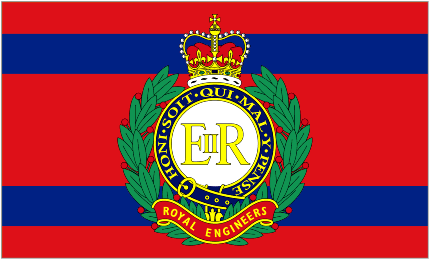
Although ment for trains, this type of badge could also be used for unit insignia. Such as the Royal Engineers WW1, Railway Operating Division, which operated standard and narrow gauge military railways on the western front.
Based on the Royal Engineers flag, with the two blue stripes made to look like rails.
The British Army does poses railway capabilities, however it sadly no longer has a specific railway unit, the last one 257 (Railway) Troop of the Royal Logistics Corps (Army Reserve) being disbanded this year. However here is a badge for them anyway:
It features a blue and gold field (Logistics Corps colours) with the crossed swords of the army, and four locomotive wheels. 
I hope you enjoyed this post as much as I did, I have three spare badges that I designed that don't have any historic attachment, but this post is long enough I think, so i might share them another time.  


Tuesday, 1 April 2014

Allied Nations (WW2)

I don't know where I got this idea from but it occurred to me a while ago that the Allies of the Second World War, didn't really have a shared unified symbol. This is in contrast with most modern international organisations and alliances both military and non military alike, most of whom like the United Nations (UN), European Union (EU), North Atlantic Treaty Organisation (NATO) etc all of whom use their own flag.
Indeed this does seem odd as flags are prominent in both American and British Empire & Commonwealth propaganda posters from the period.
 The real purpose of these posters are clearly to evoke national and patriotic pride.
Its not only in a national setting flags were used but also international, if you look at the fallowing posters:
 For those interested some of the flags in these posters include: United States, United Kingdom, Soviet Union, China, Australia, Belgium, Brazil, Dominion of Canada, Costa Rica, Cuba, Czechoslovakia, Dominican Republic, El Salvador, Ethiopia, Greece, Guatemala, Haiti,  Honduras, Empire of India, Luxemburg, Mexico, Netherlands, New Zealand, Nicaragua, Norway, Panama, Philippians, Poland, Union of South Africa and Yugoslavia. The absence of France is unusual!

 
As can be seen from these posters the theme of unity and international friendship & cooperation seem to be key, and judging by the use of flags to demonstrate this, one wonders why an official flag wasn't adopted to demonstrate this?
After all the Allies did use shared symbols and insignia to easily identify each other such as the Invasion Stripes on aircraft, and by June 1944 all Allied vehicles in the North West Europe theatre had adopted the American style white star, sometimes in a broken or unbroken circle.
So taking this into account it does seem strange that no flag was ever adopted by the Allies. Well there were some flags used during the Allied occupations of Germany and Japan after the war, primarily to identify ships of the occupied country:

Flags of occupied Japan (left) and Germany (right)
There also seems to have been celebration flags possibly used by liberated civilians that featured allied flags, however these cannot be considered flags of the alliance itself:
 

Perhaps the closest thing to an Allies flag is the United Nations Honours flag, that was primarily used unofficially/semi-officially by the victorious allies seeking universal peace and attempting to establish the modern United Nations (the Allies were already calling themselves the United Nation in WW2):

 A design symbolising the "four freedoms" from a speech by US President Franklin D Roosevelt it seems to have actually had limited use by Britain and particularly America from 1943-48. It is also thought of as the first United Nations flag although it was never officially used in that role.
I decided to design an Allied Nations flag, as I think although it may not be physically needed, there still is potential for one, video games, documentaries, joint and international commemorations are but a few examples of how it could be used.
My first design features a white "V" separating a red and blue field with the white vehicle star.

The reasoning behind the colour scheme is that most of the Allied national flags have a red, white and blue colour scheme and most of the ones that don't have at least one of those colours on their flag. The "V" represents the V sign used to symbolise victory/freedom during WW2. The white star on green being used as a common symbol, as it was used by most of the Allies and was certainly recognisable to all of them.

The second design features a blue diamond on a red, white and black striped field with a circle of stars:

The red, white and black stripes reflect the United Nations Honours flag and the Invasion Stripes of Allied aircraft. the circle of stars represents unity (but not specific nations). The colour scheme and vehicles star have the same symbolism as the first flag.
Or alternatively the vehicle star could be replaced with a V symbol:
Gold replaces white in this example but white could also be used. 

Please Feel Free to comment.