Before I start this post I would like to apologize for my lack of recent posts, this is due in part to research and study for a print publication I am currently working on, and it is taking up the greater part of my spare time, so post might be few and far between I'm afraid, but I will try to put one up every now and then.
Currently British politics is dominated (with a slight exception of regional elections in Scotland, Wales and Northern Ireland) by the upcoming referendum on the United Kingdom's membership of the European Union. As usual I am not advocating any political opinion, but I was intrigued when I seen a hypothetical scenario. The scenario was the UK leaves and forms a free trade and movement zone, between the UK, Canada, Australia and New Zealand. with certain joint institutions, rather similar to the European Union but more anglocentric. I even seen a potential flag for such a union by Zach Elsbury:
It evokes the British ensign which not only includes the Union Flag but is the same style of flag used by Australia and New Zealand with a red field for Canada (the former flag of Canada was a red ensign). Its defaced with a shield quartered with the national plants of the four nations.
Inspired by this design I thought of having ago at a similar flag, with more emphasis of an international organisation rather than a colony. My first design was this:
Still inspired by an esign which has elements all of the four member states flags have in common,The Union Jack has official status in Canada and the UK, and appears on the Australian and New Zealand flags. it features the gold wreath and a globe. The roses form part of the cypher which is in the centre of all the commonwealth royal standards outside the UK, including those of Canada, New Zealand and Australia. The globe is from the flag of the Commonwealth of Nations. This flag is timeless as it has no direct symbolism to any individual state, meaning if a member leaves or other realms like Tuvalu or Jamacia join the flag doesn't require changing. However thinking the globe might look a little like a mock up British Empire flag, I decided to replace it with a crown, the symbol of the monarch which share:
I like this better as it is a simpler design and looks a little less cramped.
Showing posts with label Australia. Show all posts
Tuesday, 19 April 2016
Friday, 20 February 2015
New South Wales
The flag of the Australian state of New South Wales is like most Australian state flags a blue ensign with a British Union Fag in the Canton, and a regional insignia in the fly.
Despite the name "New South Wales" there isn't any Welsh symbolism on it at all! The emblem in the fly is a cross of St George of England bearing a lion and Southern Cross.
I corrected this by changing the emblem just a little bit:
I replaced the St George's Cross with that of St David the patron saint of Wales, and the lion with the famous red dragon. The idea is really the same as the original flag but with Welsh symbols rather than English.
However if New South Wales wants to move away from British ensigns to something more original, i though of this flag:
Its an inverted Cross of St David defaced with the Southern Cross (in the same pattern as the Australian flag). The reason I inverted the colours of the Cross of St David are:
Despite the name "New South Wales" there isn't any Welsh symbolism on it at all! The emblem in the fly is a cross of St George of England bearing a lion and Southern Cross.
I corrected this by changing the emblem just a little bit:
I replaced the St George's Cross with that of St David the patron saint of Wales, and the lion with the famous red dragon. The idea is really the same as the original flag but with Welsh symbols rather than English.
However if New South Wales wants to move away from British ensigns to something more original, i though of this flag:
Its an inverted Cross of St David defaced with the Southern Cross (in the same pattern as the Australian flag). The reason I inverted the colours of the Cross of St David are:
- So it would be distinctive from the unofficial second flag of Wales
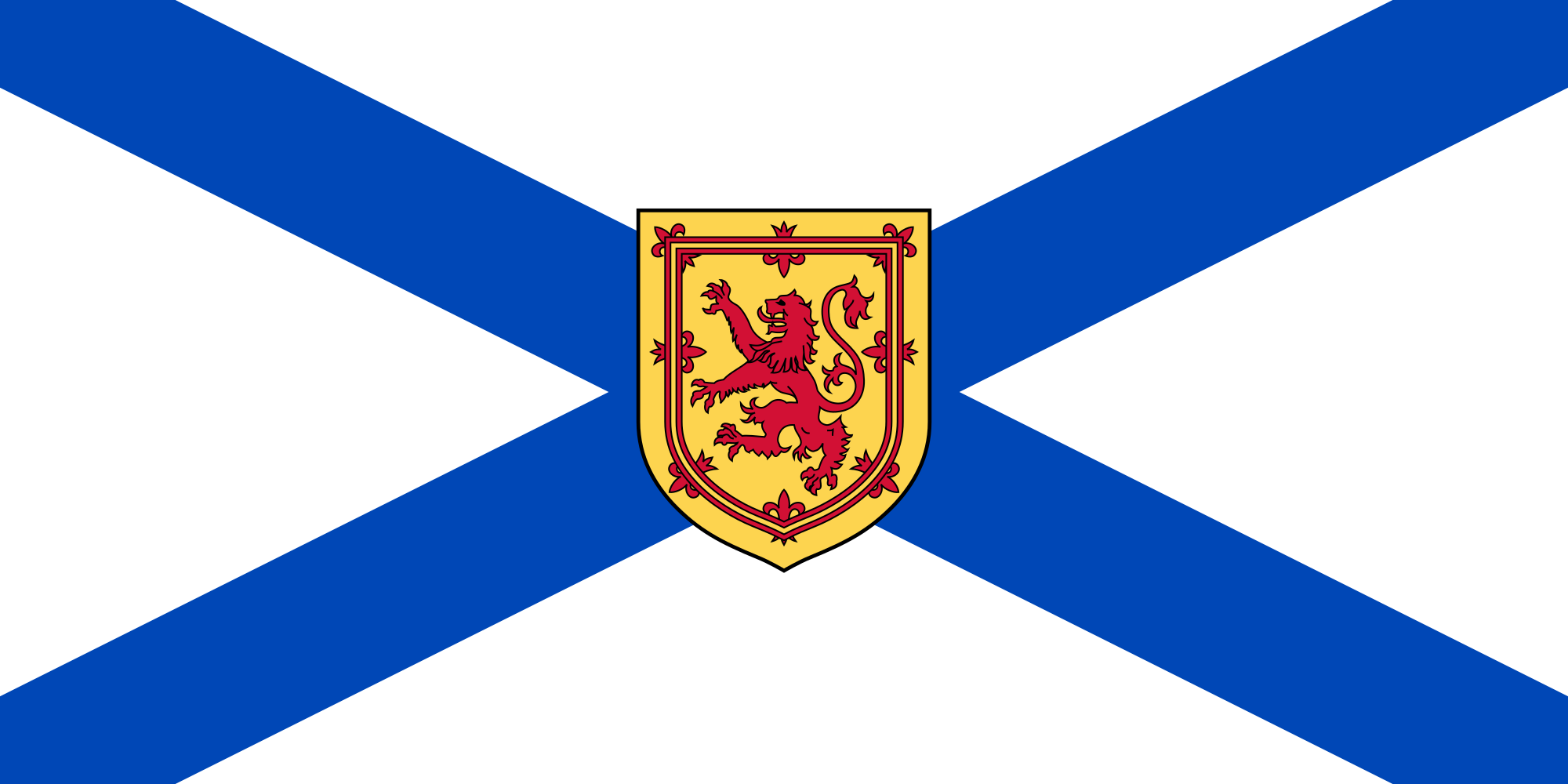
- I wanted to show a connection to Wales, but at the same time I wanted it to be Australian rather than Welsh. The same way the Nova Scotia flag symbolises a connection to Scotland but stands out as something Canadian rather than Scottish.
However I think this might empathise the Welsh connection too much, which might defeat the point of inverting the colours in the first place. On the other hand though dragons are cool.
Wednesday, 20 August 2014
International arms of Elizabeth II
This experiment really came as an idea from a discussion about the Royal Coat of arms. Some might remember reading my Heraldic Designs post, where one of my designs was a single coat of arms for HRH the Prince of Wales that represented all his titles. So what if the same could be said of HM the Queen? This is not a new idea, for example the Royal Arms of England before the 1707 Act of Union with Scotland were:
I only included the arms of sovereign states and not territories, dependencies or associated states, as they should be represented by (but perhaps not in) the arms of their sovereign state.
The most obvious change is the Union Flag replaced by the Queen's personal flag, which was originally designed to represent her as an individual rather than associate, so this seems appropriate.
Secondly I removed the crest, rather than add all the crests, which I might have done if there was only two or three, but there is far, to many and if I added them all, it would overwhelm the design.
So no crest but I did keep the St Edward's Crown as this is used in the heraldry of other Commonwealth realms, notably (but not only) Canada, Australia and New Zealand. (also of interest is on both versions the supporters are wearing their respective St Edwards and Scots crowns)
The Compartment also includes the plants of Australia and Canada. I also used a different motto to one that I think reflects the Queen's life.
Of course coats of arms were often historically used to make statements which I think this does. But If the shield is a little overwhelming, perhaps HM could only use the arms of nations, where she has a Royal Standard?
This reduces the quarters from 15 to 6, as only six countries use their own Royal Standard (there are seven Royal standards the UK has two):
This is perhaps a more practical design.
Thanks for reading, please feel free to comment.
Some posts that may also be of interest:
National flag of the UK
Heraldry guide
Heraldic Designs
Government Coat of Arms
Personal flags
This coat of arms is a personal coat of arms rather than a state coat of arms, which is what Royal Arms have turned into over time. Notice that it is quartered with the arms of England (itself quartered with arms of France,(English monarchs still claimed the throne of France in 1707)), Scotland and Ireland.
What if the same sort of thing happened with today's Royal coat of arms? The problem arises that the Queen is currently the constitional monarch of 16 different states, 15 of which have coats of arms. The Current arms of the United Kingdom (excluding Scotland) are:
I had an attempt at an international coat of arms, in an attempt to try make the Royal arms a personal coat of arms rather than a state one with mixed results. My first attempt was this:
Using the British coat of arms as a base I quartered the shield with the 15 coats of arms of the commonwealth realms. The supporters come from the UK Arms and the compartment(base) has the flowers of the British Isles for historical symbolism. The flags are the Union Flag and the flag of the Commonwealth of Nations. The Union Jack is used in a lot of commonwealth realms and appears in the flags of others. The Commonwealth flag represents the Queen's position as head of the Commonwealth (although its not a hereditary title). The motto doesn't appear on any current coat of arms, so is therefore more neutral.
The shield in detail is:
The nations represented on the shield are from left to right
- Top: United Kingdom (altered to include Wales) Canada, Australia and New Zealand.
- 2nd Row: Jamaica, Barbados, Bahamas, Grenada.
- Third row: Solomon Islands, Tuvalu, St Lucia, St Vincent and the Grenadines
- Bottom Row: Antigua and Barbuda, Belize, St Kitts and Nevis
I only included the arms of sovereign states and not territories, dependencies or associated states, as they should be represented by (but perhaps not in) the arms of their sovereign state.
The first coat of arms is perhaps not completely neutral so here is the second design with some of the elements (not the shield) changed:
Secondly I removed the crest, rather than add all the crests, which I might have done if there was only two or three, but there is far, to many and if I added them all, it would overwhelm the design.
So no crest but I did keep the St Edward's Crown as this is used in the heraldry of other Commonwealth realms, notably (but not only) Canada, Australia and New Zealand. (also of interest is on both versions the supporters are wearing their respective St Edwards and Scots crowns)
The Compartment also includes the plants of Australia and Canada. I also used a different motto to one that I think reflects the Queen's life.
Of course coats of arms were often historically used to make statements which I think this does. But If the shield is a little overwhelming, perhaps HM could only use the arms of nations, where she has a Royal Standard?
This reduces the quarters from 15 to 6, as only six countries use their own Royal Standard (there are seven Royal standards the UK has two):
This is perhaps a more practical design.
Thanks for reading, please feel free to comment.
Some posts that may also be of interest:
National flag of the UK
Heraldry guide
Heraldic Designs
Government Coat of Arms
Personal flags
Tuesday, 1 April 2014
Allied Nations (WW2)
I don't know where I got this idea from but it occurred to me a while ago that the Allies of the Second World War, didn't really have a shared unified symbol. This is in contrast with most modern international organisations and alliances both military and non military alike, most of whom like the United Nations (UN), European Union (EU), North Atlantic Treaty Organisation (NATO) etc all of whom use their own flag.
Indeed this does seem odd as flags are prominent in both American and British Empire & Commonwealth propaganda posters from the period.
The real purpose of these posters are clearly to evoke national and patriotic pride.
Its not only in a national setting flags were used but also international, if you look at the fallowing posters:
For those interested some of the flags in these posters include: United States, United Kingdom, Soviet Union, China, Australia, Belgium, Brazil, Dominion of Canada, Costa Rica, Cuba, Czechoslovakia, Dominican Republic, El Salvador, Ethiopia, Greece, Guatemala, Haiti, Honduras, Empire of India, Luxemburg, Mexico, Netherlands, New Zealand, Nicaragua, Norway, Panama, Philippians, Poland, Union of South Africa and Yugoslavia. The absence of France is unusual!
After all the Allies did use shared symbols and insignia to easily identify each other such as the Invasion Stripes on aircraft, and by June 1944 all Allied vehicles in the North West Europe theatre had adopted the American style white star, sometimes in a broken or unbroken circle.
So taking this into account it does seem strange that no flag was ever adopted by the Allies. Well there were some flags used during the Allied occupations of Germany and Japan after the war, primarily to identify ships of the occupied country:
I decided to design an Allied Nations flag, as I think although it may not be physically needed, there still is potential for one, video games, documentaries, joint and international commemorations are but a few examples of how it could be used.
My first design features a white "V" separating a red and blue field with the white vehicle star.
The reasoning behind the colour scheme is that most of the Allied national flags have a red, white and blue colour scheme and most of the ones that don't have at least one of those colours on their flag. The "V" represents the V sign used to symbolise victory/freedom during WW2. The white star on green being used as a common symbol, as it was used by most of the Allies and was certainly recognisable to all of them.
The second design features a blue diamond on a red, white and black striped field with a circle of stars:
The red, white and black stripes reflect the United Nations Honours flag and the Invasion Stripes of Allied aircraft. the circle of stars represents unity (but not specific nations). The colour scheme and vehicles star have the same symbolism as the first flag.
Or alternatively the vehicle star could be replaced with a V symbol:
Please Feel Free to comment.
Indeed this does seem odd as flags are prominent in both American and British Empire & Commonwealth propaganda posters from the period.
The real purpose of these posters are clearly to evoke national and patriotic pride.
Its not only in a national setting flags were used but also international, if you look at the fallowing posters:
For those interested some of the flags in these posters include: United States, United Kingdom, Soviet Union, China, Australia, Belgium, Brazil, Dominion of Canada, Costa Rica, Cuba, Czechoslovakia, Dominican Republic, El Salvador, Ethiopia, Greece, Guatemala, Haiti, Honduras, Empire of India, Luxemburg, Mexico, Netherlands, New Zealand, Nicaragua, Norway, Panama, Philippians, Poland, Union of South Africa and Yugoslavia. The absence of France is unusual!
As can be seen from these posters the theme of unity and international friendship & cooperation seem to be key, and judging by the use of flags to demonstrate this, one wonders why an official flag wasn't adopted to demonstrate this?After all the Allies did use shared symbols and insignia to easily identify each other such as the Invasion Stripes on aircraft, and by June 1944 all Allied vehicles in the North West Europe theatre had adopted the American style white star, sometimes in a broken or unbroken circle.
So taking this into account it does seem strange that no flag was ever adopted by the Allies. Well there were some flags used during the Allied occupations of Germany and Japan after the war, primarily to identify ships of the occupied country:
Flags of occupied Japan (left) and Germany (right)
There also seems to have been celebration flags possibly used by liberated civilians that featured allied flags, however these cannot be considered flags of the alliance itself:
Perhaps the closest thing to an Allies flag is the United Nations Honours flag, that was primarily used unofficially/semi-officially by the victorious allies seeking universal peace and attempting to establish the modern United Nations (the Allies were already calling themselves the United Nation in WW2):
A design symbolising the "four freedoms" from a speech by US President Franklin D Roosevelt it seems to have actually had limited use by Britain and particularly America from 1943-48. It is also thought of as the first United Nations flag although it was never officially used in that role. I decided to design an Allied Nations flag, as I think although it may not be physically needed, there still is potential for one, video games, documentaries, joint and international commemorations are but a few examples of how it could be used.
My first design features a white "V" separating a red and blue field with the white vehicle star.
The reasoning behind the colour scheme is that most of the Allied national flags have a red, white and blue colour scheme and most of the ones that don't have at least one of those colours on their flag. The "V" represents the V sign used to symbolise victory/freedom during WW2. The white star on green being used as a common symbol, as it was used by most of the Allies and was certainly recognisable to all of them.
The second design features a blue diamond on a red, white and black striped field with a circle of stars:
The red, white and black stripes reflect the United Nations Honours flag and the Invasion Stripes of Allied aircraft. the circle of stars represents unity (but not specific nations). The colour scheme and vehicles star have the same symbolism as the first flag.
Or alternatively the vehicle star could be replaced with a V symbol:
Gold replaces white in this example but white could also be used.
Please Feel Free to comment.
Labels:
Allies,
Armed Forces,
Asia,
Australia,
Brazil,
Europe,
France,
Middle East,
Military,
New Zealand,
North America,
Pacific,
Portugal,
South America,
Uniformed organisations,
United Kingdom,
United States,
WW2
Monday, 16 December 2013
CG3: Australia
As it is nearly Christmas and I don't think I'll be typing too much over the holidays and there are a few Commonwealth flags I want to write about before the Commonwealth Games begin, I think I should get a move on!
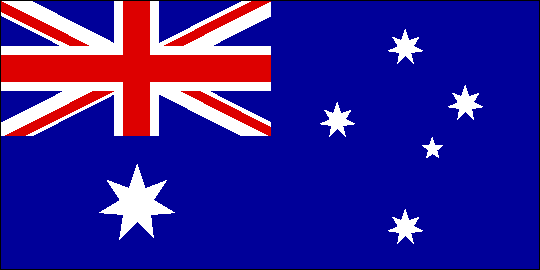
The next flag on my list is that of Australia:
In modern sport it is also not uncommon for the Australian fans to carry their own versions of the Australian flag, even if these are only in a fun sporting context, such as the boxing kangaroo flag that is easily available in flag shops:
The next flag on my list is that of Australia:
According to the Australian Government website, the flag became the flag of Australia 1 January, 1901, when the Australian states became federal parts of a new commonwealth of Australia. However it did not gain official Royal Assent until 1954. So unlike other flags and as some people think, it is not something left over from the "colonial Days" (there was no colony known as Australia, but six separate British colonies which became the federal states). However as the Union Flag was used collectively by the former colonies, and despite its commonwealth status, I think its fair to say in 1901 Australia was still a dominion of empire or at least still maintained strong British links and influence. Likewise most of the colonies would have used their own versions of British ensigns on sea if not on land, and the Australian flag was evidently the next stage from that.
There are some who want a new flag primarily without the Union Jack, while others wish to keep it for historical, ancestral or cultural reasons, I can understand and respect both sides in this. In the commonwealth games quite a few nations and territories taking part have Union Jacks in their flags and it is from the view point of avoiding confusion that I think a new flag could be used, for the games at least.
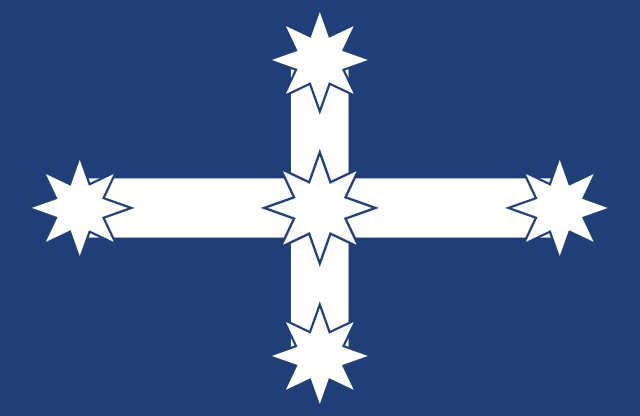
Alterative Australia flags are nothing new, even before 1901, people were designing flags for an Australian nation such as the national colonial flag and similar federation flag and Eureka flag (below):
Of course a flag like that couldn't be used in any formal or official context, however different flags are used in formal roles in sport. The Australian Football Federation has its own flag, although it is used alongside the Australian flag it does demonstrate the will of a formal 'sporting' flag:

I am not normally in favour of the use of coats of arms in flags however, I think the colour scheme makes a difference, If the text is removed and perhaps the complete coat of arms reduced to a shield, while not perfect I think this flag might have potential.
But the flag I would propose for the Commonwealth Games would be a simple flag in the green and gold sports colours with the Southern Cross and Commonwealth/Federal star:
However if you asked me to propose a new national flag then I would have to direct you to my favourite Australia flag proposal by Paul James on the Flags Forum:

Don't forget to look out for the "CG" in the title for more flag ideas and related posts in the count down to the 2014 Commonwealth Games. You can see past CG posts below
Saturday, 21 July 2012
New Australian Flag
The topic on weather or not Australia should change its flag form the traditional British Ensign is a hotly debated subject and political mine field in Australia. From what I have read most Aussies are content with their current flag for the mean time. Personally I like the Australian flag but if the Aussies ever voted to change it what would it be?
This was my original design. As you can see it has most if not all the characteristics of the current flag. The Southern Cross Star formation, Commonwealth star and a red cross similar to St George's Cross. It also has the Aussie Colours of Green and Gold. Native Aboriginal colours of red, yellow and black, and the British colours of red, white and blue. Two more aspects of this design is the boomerang shape with the aboriginal colours in the canton, and below that you can see part of the make up of the Union Jack, but not a whole one. These symbolise the two main Australian communities the ones descendent form Aboriginals and British Settlers.
Personally I thought this although interesting was very complicated. So I retired to studying the Australian flag.
This was my original design. As you can see it has most if not all the characteristics of the current flag. The Southern Cross Star formation, Commonwealth star and a red cross similar to St George's Cross. It also has the Aussie Colours of Green and Gold. Native Aboriginal colours of red, yellow and black, and the British colours of red, white and blue. Two more aspects of this design is the boomerang shape with the aboriginal colours in the canton, and below that you can see part of the make up of the Union Jack, but not a whole one. These symbolise the two main Australian communities the ones descendent form Aboriginals and British Settlers.
Personally I thought this although interesting was very complicated. So I retired to studying the Australian flag.
The three main consonants of this is the British Union Flag in the Canton, the Commonwealth Star under it. This symbolises six Australian states and the seventh point is for all the Australian territories that aren't part of the mainland. Towards the fly is the southern cross star formation which can also be seen on the similar flag of neighbouring New Zealand. The bit on this flag that the pro-new flag people don't want is the Union Jack as this symbolises British Sovereignty, this is probably not surprising as Australia was part of the British Empire when this flag came out. However today Australia is fully independent so some people say the flag is out dated. Others say it was the flag Australians have fought and died under and link to their ancestors and mention that the Queen is head of state of Australia and other countries in the Commonwealth.
I decided to remove the Union Jack if only to see what it would look like without it. I didn't think it looked too bad. I moved the Commonwealth star up to the centre and it looked better. Then I thought about changing the colour. Green and Gold seemed the most appropriate. This was the result:
It is clearly Australian and is based on the traditional flag. The other advantage for this flag is that in keeping with Australian tradition, the colour can change for sea. Currently the State Ensign is the current flag. The Civil Ensign is the Australian Red Ensign and the Naval Ensign is the the Australian White Ensign . For example the new ensign of the Royal Australian Navy might look like this:
Alternatively the stars could be blue.
My friend Leonardo Piccioni from the Flags Forum also designed a version shown below:
This is the civil version he had the idea that the government version should include the Commonwealth star and the Civil one only the Southern Cross. Me and another form user 26 May 1989 (who is Australian) think that although the Kangaroo is a great Aussie symbol it is rather Corporate which is not good for a national flag. Now the reason I included Leonardo's design is because I used it as a template for the next design:
State Flag
Civil Flag
As you can see I removed the Kangaroo. In terms of colour the only colour this would change is white for the Navy, as at sea both Gov and Civil ships will use either the State or Civil versions. Although the Civil flag looks a little plain I think after use it would 'grow on you' but I think there are lots of alternatives that should be considered. to see the flags forum discussions on the subject click HERE
Subscribe to:
Posts (Atom)


.svg.png)