Showing posts with label ensign. Show all posts

Wednesday, 15 March 2017

Irish Coast Guard

Something I thought before due to recent events reminded of, is what a bad flag the Irish Coast Guard have. It is a white flag with the logo of a stylised harp and anchor in the centre.
This is highlighted on Facebook in the last 24 hours or so following the tragic loss of one of their search & rescue helicopters, with this sympathetic image of support:
It is the Coast Guard flag with the black stripe of mourning and the helicopter's call sign. This highlights what a bad flag it is, and feeling that brave men and women of the Irish Coast Guard deserve better, I have three proposals:
The first is an ensign, which follows the same lines as the Republic of Ireland's yacht ensigns. A blue field with a tricolour canton and the cap badge of the coast Guard in the fly:
The badge is similar to that of the cap badge Irish Naval Service but with Defence Forces (which itself appears to be based on a Royal Navy officer's cap badge) emblem replaced with a harp.
Second is a jack, I did initially thought of putting an anchor on the Republic of Ireland flag, but as their flag protocol forbids defacing the flag, I designed a different flag based on the tricolour.
It is inspired by the tricolour but also the style of the stripes on rescue helicopters. This way a tricolour and anchor can still be used but the at the same time the flag protocol of the Republic of Ireland is observed.
Last but not least is a ceremonial flag.
It features the blue harp on a blue field from the state coat of arms, within a rope circle flanked by anchors:
Like the cap badge worn by the Irish Coast Guard the ceremonial flag has influences from the colour of the Naval Service.
 any one of these flags with a black stripe would make a better emblem of support than the current flag.
Thoughts and prayers for the family of the pilot of the Rescue 116 and those of the still missing crew members.

Tuesday, 31 May 2016

National Museum of the Royal Navy

This idea came to me after watching a BBC documentary about the restoration of HMS Caroline, which is a veteran of the 1st World War and currently being turned into a floating museum in Belfast's Titanic Quarter. Currently owned by the National Museum of the Royal Navy, seeing the shots of the ship it struck me that no flags were flying. In stark contrast to this 2006 photo from Wikipeadia which show Caroline in her glory;
When this photo was taken Caroline was still technically a serving warship! Although she hadn't put to sea since about 1930, she was used as a training ship and base for the Northern Ireland Royal Naval Reserve. (You may notice in this picture the flag of a Commodore of the Naval Reserve is flying from the mast). She was formally decommissioned about two years ago so no longer being a warship it would be inappropriate to continue to fly the white ensign and Union Jack. I am sure this is a situation found across most of the vessels owned by the National Museum of the Royal Navy across the country. Although some (including HMS Caroline I think) might be entitled to use the National Historic Fleet ensign, i though perhaps the National Museum of the Royal Navy should have its own ensign. This is my proposal:

A blue ensign as the National Museum is a public body. The badge in the fly features a shield with a Union Jack chief, with the cross of St George in the rest of the field. This is inspired by the White ensign, the national flag flown by British navy ships. It is of course topped by a Naval coronet/crown. 
A flag variant of the shield could be used as a jack:

The initials of the National Museum of the Royal Navy are on the white field. Although in the case of a jack the civil jack would probably be more appropriate as this is in effect the naval jack (Union Jack) with a white boarder. A variant of the ensign with letters:


Tuesday, 19 April 2016

Union of Commonwealth Realms

Before I start this post I would like to apologize for my lack of recent posts, this is due in part to research and study for a print publication I am currently working on, and it is taking up the greater part of my spare time, so post might be few and far between I'm afraid, but I will try to put one up every now and then.
Currently British politics is dominated (with a slight exception of regional elections in Scotland, Wales and Northern Ireland) by the upcoming referendum on the United Kingdom's membership of the European Union. As usual I am not advocating any political opinion, but I was intrigued when I seen a hypothetical scenario. The scenario was the UK leaves and forms a free trade and movement zone, between the UK, Canada, Australia and New Zealand. with certain joint institutions, rather similar to the European Union but more anglocentric. I even seen a potential flag for such a union by Zach Elsbury:
  It evokes the British ensign which not only includes the Union Flag but is the same style of flag used by Australia and New Zealand with a red field for Canada (the former flag of Canada was a red ensign). Its defaced with a shield quartered with the national plants of the four nations.
Inspired by this design I thought of having ago at a similar flag, with more emphasis of an international organisation rather than a colony. My first design was this:
Still inspired by an esign which has elements all of the four member states flags have in common,The Union Jack has official status in Canada and the UK, and appears on the Australian and New Zealand flags. it features the gold wreath and a globe. The roses form part of the cypher which is in the centre of all the commonwealth royal standards outside the UK, including those of Canada, New Zealand and Australia. The globe is from the flag of the Commonwealth of Nations. This flag is timeless as it has no direct symbolism to any individual state, meaning if a member leaves or other realms like Tuvalu or Jamacia join the flag doesn't require changing. However thinking the globe might look a little like a mock up British Empire flag, I decided to replace it with a crown, the symbol of the monarch which share:
I like this better as it is a simpler design and looks a little less cramped.

Sunday, 5 July 2015

Development & History of Irish Flags Pt15: Flags at Sea

Ireland is an island, and as such it has always had a close relationship with the sea. Coastal communities and fishing towns were once urban centres, shipbuilding was one of the main industries in the industrial north at one point boasting the biggest shipyard in the world. Even the RMS Titanic arguably the most famous ship in the world was built on the island. (and was it was Okay when it left us!) Many people over the years have left the island by sea, So the flags used at sea deserves a post to itself.

St George's Cross

The earliest known use of flags in Irish Waters is the cross of St George, patron saint of England. The use of flags at sea to distinguish a vessel's nationality roughly dates from the middle ages, a time when Ireland was a Lordship of England. You might remember the incident in 1537 from Part 4, when a Portuguese ship was captured by a local chieftain, and the government's response of attacking the village and castle, on which "St George's Standard" was put up. There can be little doubt what flag those government vessels flew. St George's Cross appeared on many other nautical flags, such as ensigns and jacks, including the former flag of the Commissioners of Irish Lights used until 1970 (right) and is still used on the House Flag of the Royal National Lifeboat Institution (RNLI), who operate all over the British Isles.The House Flag flown from Lifeboat Stations in the Republic of Ireland. is the same as that in the UK. 

 St Patrick's Saltire

The first flag of Ireland, the saltire known as St Patrick's Cross. One of the earliest references to the flag is a picture of of flying from a ship.(Hibernia 1576, John Goghe). The flag also appears on many flag charts, most of them naval, which suggest that this flag must have been used by Irish ships. One such book is Neptune Francois published in Amsterdam as early as 1693. This depicts a saltire on a white field, which in some hand coloured copies is red. Above and below are the French and Dutch words for Irish: Ieres and Irlandois.
Irish ensign according to 1785 newspaper
Further evidence to this flag being used by the Irish at sea comes from 1785 newspaper report from Waterford states about ships leaving for the colonies that:"Upwards of forty vessels are now in our harbour, victualling for Newfoundland, of which number thirteen are of our own nation, who wear the St Patrick's flag (the field of which is white, with a St Patrick's cross, and an harp in one quarter.)"
It was even adopted for the House Flag and jack of the Republic of Ireland's state shipping company, Irish Shipping until it was liquidated in 1984, it is still included in the house flag of the Commissioner of Irish Lights. For more on St Patrick's Saltire see Part 7.

Red Ensign

extract of Dutch painting depicting the
burning of the English Fleet
The British ensign system consisted of red, white and blue flags with the national flag in the canton (St George's/St Andrews Cross before 1707 and Union Flag post 1707). There is references to red and blue ensigns featuring harps being used by the various naval ships often with Irish connections. A Dutch Painting depicting the burning of the English fleet during their raid on the Medway in 1667, the worst defeat of the Royal Navy (something of which thankfully didn't happen often). In this painting the English ships are flying a red ensign depicting a harp. 
Irish Customs ensign 1768
With the establishment of modern customs, these vessels had to be distinguished from other ships. Ireland had its own Customs and as such Irish customs vessels fly a distinct ensign, which had a harp ensigned with a crown. There is evidence of this flag being used in 1768. 
When Ireland became integrated into the United Kingdom the red ensign without any insignia became the normal national flag at sea. This became official in the Merchant Shipping Act of 1854, which stated the red ensign should be the national colours of all British Civil ships. 
Irish Merchant ensign 1841-1939, Still used by NI and other
British registered vessels
Coincidentally after the Irish Free State was formed the red ensign remained the official civil ensign of the new state, as the Tricolour was reserved for naval and other state vessels. There are stories of dissatisfied skippers hauling down the red duster (which is what it is commonly called) as soon as they entered international waters, and flying the tricolour unofficially. It was not until the outbreak of World War two, during which the Irish Republic was neutral, that the tricolour was extended to all ships, to avoid them being mistakenly attacked by Axis navies. The red ensign is still used by vessels registered in Northern Ireland as its the UK's civil ensign.

Green Ensign 

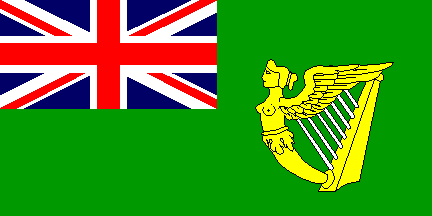
The Green Ensign is an interesting flag surrounded by myth and debate. Some speculate it might have had official status at some point, but others go as far to say it never existed at all despite it appearing in several historical references. It certainly had no official status after the Irish Act of Union, however there is evidence that it was still used regardless. One theory is that at some point naval ensigns like the ones mentioned above were adopted by civil ships who changed the colour to green. 
extract of Boal's Universal Display of the
 Naval flags of all the Nations in the World (1783)
There are various reports of "green ensigns" being used as the national colours of Irish vessels. The Royal United Service Institute produced a pamphlet on flags in 1895, written by a Rear Admiral Bloomfield. It depicts a green flag bearing a harp, with a St Patrick's Cross in the canton and states it was used in Irish waters between 1688 and 1694. However no source is given with it, so where the Admiral got his information from might be suspect. A better source depicting a green ensign from about the same time is the National Geographic Flag Book (1917), which depicts a green ensign with a harp, and St George's Cross in the canton. It states that this flag was the Irish ensign used at the beginning of the 18th Century. It also states that the author got their information from a book by John Beaumont published in 1701. 
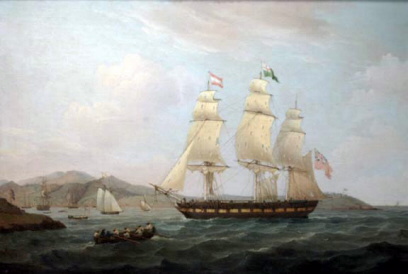
Ship flying the UK red ensign and what appears to be an
 Irish green ensign from her mainmast
The fact that the book states it was used at the beginning of the 18th Century suggests it might have been used in the late 17th Century and it is possibly this flag with the St George Cross that Admiral Brook intended rather than St Patrick's Cross. Also the fact that its mentioned at the beginning of the century suggests that the St George Cross was replaced with the Union Jack (1606) in following the Act of Union between England and Scotland in 1707. Despite the Act of Union (1707) St Georges Cross variant of the flag continues to appear in many flag charts, although some were quoting historical examples or using out of date sources. Of course another explanation could be that there was no official national merchant ensign (the first Merchant Shipping Act was not until 1786) so it could be possible that the St George's variant could have stayed in use. It could also be the case that it was used in conjunction with the British red ensign.
extract of National & Commercial Flags of All Nations
Published  G.W. & C.B. Colton & Co. in 1874
The St George Cross was all but phased out by 1800, being replaced by a Union Flag. There are records of ships flying variants of this flag throughout the 19th Century, One such example happened in Spain. in 1846 the Governor of Gibraltar forwarded a report from the Admiralty Agent of the British Steam Packet 'Royal Tar' to William Gladstone, Colonial Secretary. The Agent had reported that while at anchor at Cadiz, a small trading brig belonging to Harding & Co. of Dublin had hoisted a green Ensign with a Harp and Crown in the fly and a Union Jack in the corner of it. He added that as there was no recognised flag of that colour and pattern belonging to the United Kingdom, he had expressed his intention of hauling it down as had been done on two other occasions in Ireland on board of the same vessel. The captain of the brig was reported to have said that he hoisted the flag in compliment to H.M. Pendant.
In the covering letter the Governor wrote that in his opinion such a Flag ought not to be allowed to fly in any port where there was a British Consul and that if met with on the High Seas might be dealt with as the emblems of a piratical vessel. The British Consul at Cadiz certainly would be authorised to hold from it, all Consular aid and make a protest to the Spanish Authorities in the name of the Queen's Government against its display.
The report was passed on to the Admiralty via the Home Office. The Admiralty Secretary replied that, "My Lords have no observation to make on the subject."
The suggestion of withholding consular assistance is most interesting as one of the possible reasons why the green ensign was used instead of a red ensign or indeed a nationalist flag, was to express an Irish identity, but keep the protection and influence of Britain, who had the biggest navy in the world. It continues to appear in flag charts throughout the Victorian period, it also appears in encyclopedias and atlases, possibly to fulfill the vexillologists need for a flag, and the green ensign being similar to other British colonial flags, (although Ireland was strictly speaking an integral part of the United Kingdom rather than a colony or dominion). 
It may have continued to be used as an alternative to the red ensign right up until 1939.

The White Ensign

The White ensign is used by UK warships, however it is also flown by the Royal Yacht Squadron, the Irish version, the Royal Irish Yacht Club also flew a white ensign, however the third quarter of the flag depicted a harp on blue field:
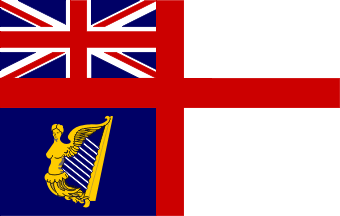
Historical RIYC ensign
The white ensign is still traditionally used by the RIYC, however it is not defaced with a red cross, displays a crowned harp in the fly and has an Irish tricolour in the canton. Interestingly the crown is the Tudor crown which is not currently used in Commonwealth heraldry, suggesting a historical use of the title "royal" rather than a connection to the UK or Royal Family.
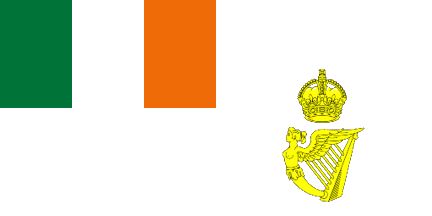
Current RIYC ensign 

Blue Ensign

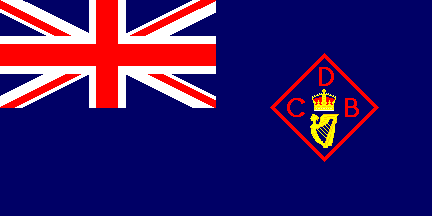
There are very few references to Irish blue ensigns, those were ensigns used by the government but there are some notable examples, such as the Congested Districts Board ensign, which featured a crowned harp and the letters "CDB"
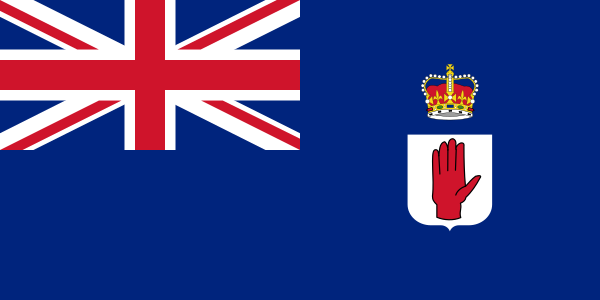
The ensign of the Department of Agriculture, Dublin also flew a blue ensign, this had a white disk with a wreath of shamrock, inside was a blue disk with a gold Irish harp. Vessels of the Northern Ireland Government flew a blue ensign, with a white disk featuring the letters "GNI" between 1929 and 73. 
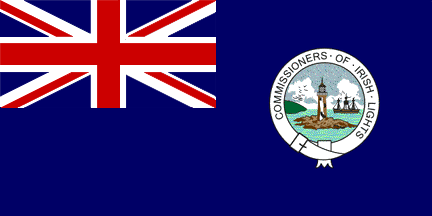
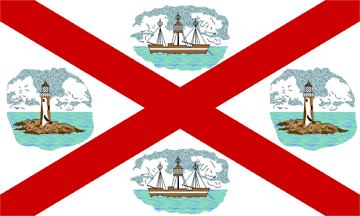
 The Commissioners of Irish Lights flew a blue ensign defaced with its badge featuring a light house, this is still used by CIL vessels registered in the United Kingdom, although the modern use of helicopters has seen the use and number of CIL vessels and ensigns as a result decrease. 
In the waters around modern Ireland however blue ensigns are mostly associated with yacht clubs. In Northern Ireland both the Royal Ulster Yacht Club and Royal North of Ireland Yacht Club fly UK blue ensigns featuring their club badge:
Yacht Clubs in the Republic of Ireland also use Blue ensigns with a club badge in the fly, but tricolour in the hoist, like the national yacht club ensign:

The Green Flag

Never used officially but there are various examples of green harp flags being flown by vessels often in protest, often a warship was despatched to request the vessel to fly the correct colours. The most notable example of a green harp flag being flown at sea, is the first recorded use of the flag. From the mast of the Frigate St Francis which was a ship of the Confederation of Kilkenny in 1642 mentioned in part 10.  To this flag is appropriately the Irish Naval Jack.
Irish Defence Forces, Naval Jack

The Tricolour

The Irish tricolour was the state ensign from the country's inception, it was not officially used by merchant and civil shipping to begin with though, as already stated the British red ensign was used. The only reason it was extended to all ships registered in the Republic of Ireland was when war broke out in Europe in 1939. Eire was officially neutral throughout the entire conflict (although many Irishmen left to serve in the Allied forces) where as the United Kingdom was not. Therefore Irish ships needed to distinguish themselves as neutral, therefore the use of tricolour was extended to all ships, and remains the case today (with the exception of certain yacht clubs who use their own special ensigns, with a tricolour in the canton). In fact many ships painted large tricolours to their hulls with the word "Eire" (Ireland) in large white colours, so as not to be mistaken. This did not however help the SS Irish Oak when she was torpedoed and sank by German submarine U-607 in 1943.
SS Irish Oak listing to port after being torpedoed by a German Submarine in 1943

RMS Titanic 

I suppose this post wouldn't be complete without mentioning the flags flown from the most famous vessel in the world (even if it is famous for all the wrong reasons), built in Belfast. This is based on photographs I have seen. Here are the flags from bow to stern:

Jack Staff - British Civil Jack

The use of the Union Jack at sea has been restricted to warships since the 1600s, therefore civilian vessels used a version with a white boarder to distinguish it from the Naval Jack.This flag probably wouldn't have been used at sea. 

Foremast - USA flag


Although built and registered in the United Kingdom, the company that owned Titanic, the White Star Line was American. It therefore flew the flag of the United States from the foremast as this was the nationality of the company if not the ship, this was a common practice of the time. The flag Titanic flew had 46 stars, and was only used for four years before two other stars were added in July 1912. 

Aftmast- House flag


House flags were and are common with most ship companies, and come in all shapes and sizes. The flag of the White star line was a red swallow tailed flag bearing a white five pointed star.

Ensign- British Blue Ensign

This flag flown from the stern represented the ship's nationality. The red ensign is used by civil ships and the blue by government vessels. As Titanic was registered as a "Royal Mail Steamer (RMS)" and carried "His Majesty's Mail" she had a warrant to use the blue ensign. 

Mail Pennants

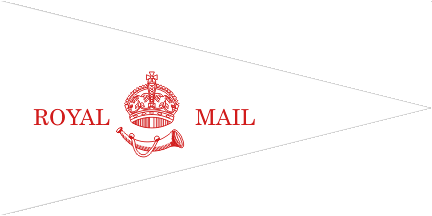
I havn't seen this flag in any photographs but as Titanic was an RMS it is likely that she flew the Royal Mail pennant.
Here is a great wee guide to flags used by White Star Line.

Thursday, 16 October 2014

Russian Empire (Micronation)

The Russian Empire is a micronation created by Anton Bakov chairman of the Russian Monarchist party. It was proclaimed on 20th July 2011, and claims about 18 different places as its territory, including Suwarrowatoll in the Pacific Ocean, and Antarctica, places originally discovered or claimed by Russian sailors but later abandoned by the Empire due to the Russian Revolution.   It styles itself as a federal constitutional monarchy, the historical successor to the Empire founded by Peter I. It proclaims Karl Emich of Leiningen as its head of state as he is descended from  Russian Romanov Royal Family, with the title Tsar Nicolas III.
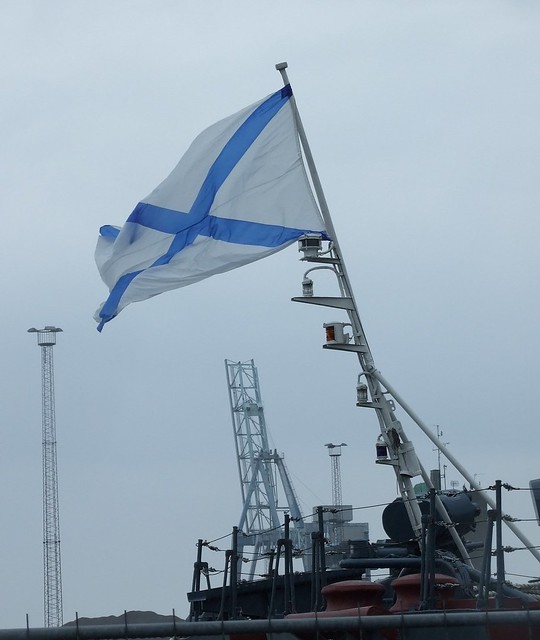
At present the flag of this micronation is the old Russian Navy ensign:

The problem I have this flag is that it is practically the same as the current naval ensign of the Russian Federation:

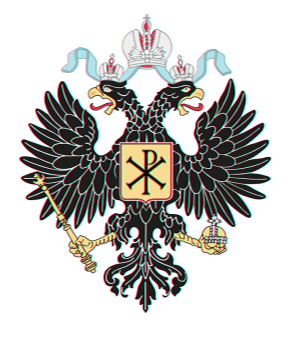
similar problem existed with the "royal" coat of arms, until it was changed when Nicolas III was proclaimed Tsar in 2014. Its current coat of arms are unique if perhaps a little distasteful:
Compared to the previous arms, which were almost the same as the Russian Federation's with the exception of the hammer and sickle:

My idea was to use a Russian Flag, but with the "St Andrews Flag" (presumably a reference to the sailors who discovered these places) in the canton. This way the flag keeps the Russian connections and symbolism but at the same time is something quite distinctive. 
Or alternatively they could use the black, gold and white design of the old Russian Empire's "Romanov dynastic flag" the official flag of the Empire from 1858 - 1883,as that is more associated with the Russian monarchists, with the saltier in the hoist:

All Comment Welcome

Thursday, 9 October 2014

Jolly Roger


I recently added a Jolly Roger flag to my collection. It is arguably the most recognisable and possibly most used flag in the world today. But I as I opened it I asked myself what is it that i have bought? What's its history and what does it represent?


Origins

The Jolly Roger was designed to cause a panicked
 surrenderrather than keep calm
The exact origin of the pirate flag known as the Jolly Roger is unknown, most experts seem to think its original colouring was red rather than black. This seems to suggest that it evolved out of a signal flag. In historic naval warfare a red flag was used to signal that no quarter would be given in a battle. As pirates were hung when caught they had nothing to gain by being captured alive, and nothing to lose by murdering an entire ships crew.  The French Navy described this red flag as the Joli Rouge (pretty red), and it is thought that the English mishearing or mispronouncing joli rouge came up with Jolly Roger. This flag was used more to intimidate a ship's crew to surrender without a fight, rather than an excuse to massacre them. Pirates would sail up to the target vessel possibly flying a friendly flag, and at the last moment hoist their jolly roger, causing panic in the other ship which generally surrendered without a fight.
As an attempt to increase the effectiveness of these flags symbols of death would be painted or sewed on it. The skull and crossbones is symbol in popular culture but they varied from ship to ship depending on the individual tastes of the pirates. Other prominent symbols were hourglasses (symbol of death in 17th-18th century Europe) the devil and a stabbed heart. Black flags probably became the prime colour rather than red because of its association with death, and so the jolly roger as we know it began to take shape. 
A little bit of US comedy, but this was how the Jolly Roger probably was used, although the British "car" would normally surrender, also of note Peter is flying the Union Jack upside-down 

Historic Use of the flag

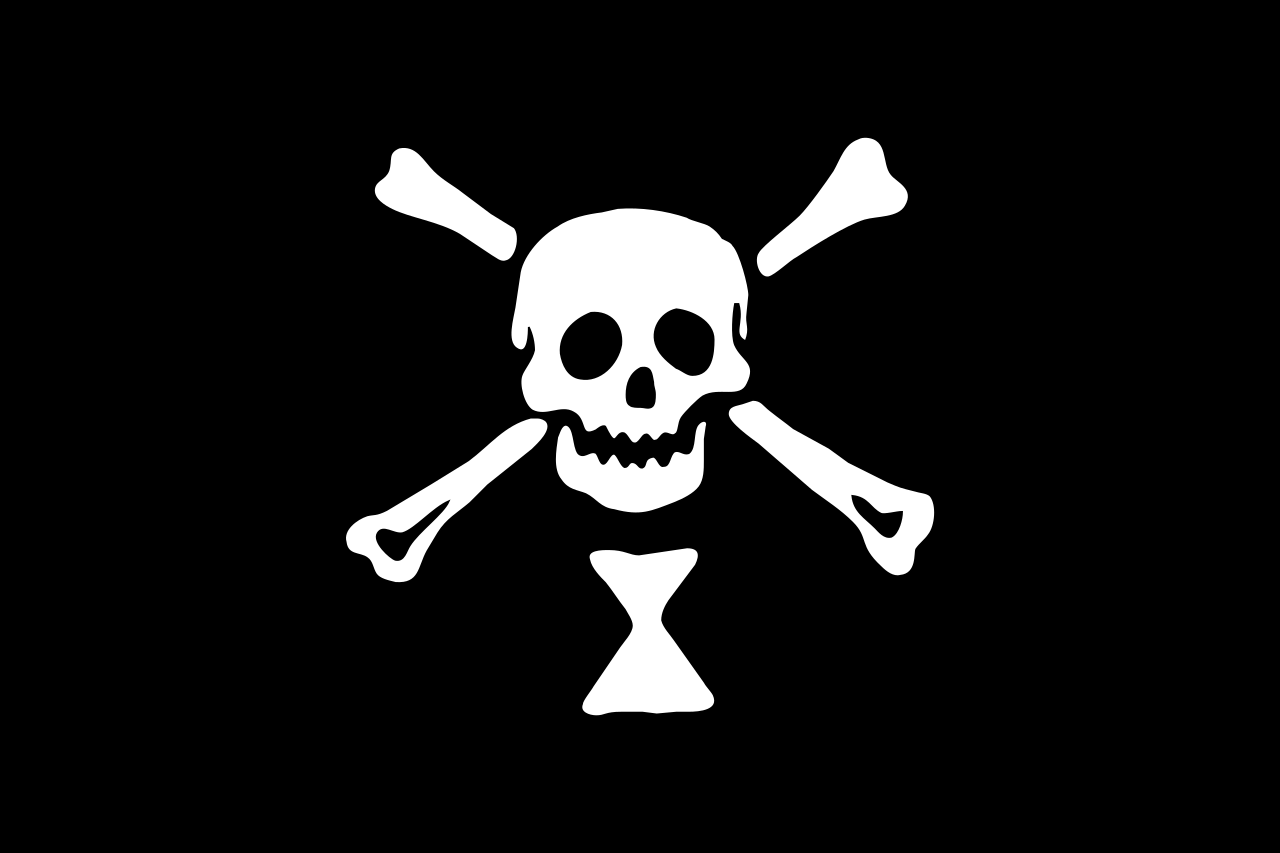
Probably the earliest record of a Jolly Roger being used is in a ships log book held in the national library of France. The entry into the log is dated December 6, 1687, and describes pirates using a Jolly Roger, on land rather than a ship. It states  "(we) raised a red flag with a Skull head on it and two crossed bones, and then we marched on." The oldest known reference of the flag being called the Jolly Roger is in a book called the General History of Pyrates, which was published in Britain in 1724.The mentions that both The book mentions that both Bartholomew Roberts and Francis Spriggs both called their flag the Jolly Roger, although both flags were different and not the popular skull and crossbones There is evidence Pirates used black flags before the term jolly roger became popular, accounts of the pirate Peter Easton describe the use of a plain black flag. Black flags were used by various pirates throughout the 1700s.Captain Emanuel Wynn is credited by the accounts of the captain of British warship, for flying a black flag with a skull and crossbones and an hourglass on it in 1700. Many people see this as the first use of the popular skull and crossbones Jolly Roger flag from a pirate ship. 
With an increase in piracy fallowing the end of the War of the Spanish Succession(possibly because of out of work privateers turning pirate) the flag seems to have become more popular. Pirates began to chose to decorate their black flag with various symbols. The pirate Edward England is credited with flying a black skull and crossbones flag from his mainmast and a red one from his lower mast. These flags appear to have been in the role of jack or pennant as he also apparently used the English National Flag as his ensign. (this could also be an example of using a friendly flag to get close, then hoisting a pirate flag to scare the opponent into surrender as stated above). he Jolly Roger quickly became an almost personal flag that could identify a ship or pirate captain. Films are not always the best way to express this but for example, in Pirates of the Caribbean the Curse of the Black Pearl. Their is a scene where Jack Sparrow is secretly betraying the HMS Dauntless to Captain Barbosa. Jack says "you take the Dauntless as your flag ship and I'll take the Pearl, I'll sail under your colours and give you 10% of my plunder."
Similarly in the third film of the Pirates of the Caribbean series At Worlds End, there is a fantastic scene where the pirate fleet all hoist their jolly rogers after a speech by the newly elected Pirate King Elizabeth Swan. It depicts the many different flags excellently, many of which are based on Jolly Rogers used by actual pirates: 
Unfortunately the last film, On Stranger Tides didn't keep up a good record of accurate flags, and depicts British Ships using Union Jacks rather than red, white or blue ensigns, which is rather disappointing as that was the case in the first film!
Here are some historic Jolly Rogers:
Accredited to Blackbeard but similar flags were used by other pirates 
John Quelch or John Phillips flag 
 One of two flags used by Bartholomew Roberts (the first flag depicted a figure of him and death holding an hourglass, and can be seen in the above clip). The two heads he is standing on represent two islands he didn't like Barbados (ABH) and Martinique(AMH).
 Flag used by Samuel Bellamy and from Edward England's mainmast.
Popular version of Henry Every's flag he might have also used a black version.  
Emanuel Wynn's jolly roger already mentioned above
Captain Jack Sparrow (fictional) 
as seen at the end of Pirates of Caribbean 3 At Worlds End

Of course the Jolly Roger was not flying at all times but wasn't used until the pirates were close to their target. It was often raised simultaneously with a warning shot.
The flag was probably intended as communication of the pirates' identity, which may have given target ships an opportunity to change their mind and surrender without a fight. For example in June 1720 when Bartholomew Roberts sailed into the harbour at Trepassey, Newfoundland with black flags flying, the crews of all 22 vessels in the harbour abandoned them in panic. If a ship then decided to resist, the Jolly Roger was taken down and a red flag was flown, indicating that the pirates intended to take the ship by force and without mercy. Richard Hawkins reports that "When they fight under Jolly Roger, they give quarter, which they do not when they fight under the red or bloody flag."
In view of these models, it was important for a prey ship to know that its assailant was a pirate, and not a privateer or government vessel, as the latter two generally had to abide by a rule that if a crew resisted, but then surrendered, it could not be executed. Possessing or using a Jolly Roger until quite recently was itself considered an act of piracy.

Modern Military Use 

the Jolly Roger is used by the Royal Navy Submarine Service as a type of victory flag. When a submarine returned or returns from a successful mission it flies a jolly roger, normally with markings on it depicting its achievements. It should be noted that the white ensign is still worn when the jolly roger is in use, in this way fulfils the role of a pennant. 
This tradition is as old as the Submarine Service itself and has its origins from the early days of submarine warfare. Following the introduction of submarines in several navies, Admiral Sir Arthur Wilson, the First Sea Lord of the British Navy, stated that submarines were "underhanded, unfair, and damned un-English", and that he would convince the British Admiralty to have the crews of enemy submarines captured during wartime be hanged as pirates.
In September 1914, the British submarine HMS E9 successfully torpedoed the German cruiser SMS Hela. Remembering Wilson's statements, commanding officer Max Horton (who would ironically lead the fight against Nazi subs n WWII) instructed his sailors to manufacture a Jolly Roger, which was flown from the submarine as she entered port. Each successful patrol saw Horton's submarine fly an additional Jolly Roger until there was no more room for flags, at which point Horton then had a large Jolly Roger manufactured, onto which symbols indicating E9's achievements were sewn. This was copied by a number of other submarines and a way of protesting against the comments of one's superiors became a tradition. 
This practice was repeated in World War II, where it spread to other Commonwealth and Allied submarines that often sailed with and as part of the British fleet. 
Free Polish submarine ORP Sokół returning to base in 1944. A Jolly Roger flag displaying the boat's achievements and two captured Nazi flags are flying.

Although the symbols on each Jolly Roger were often unique to each Submarine some symbols were in common use.
A white bar denotes the torpedoing of a merchant ship
A red bar indicated the torpedoing of a warship.
A black bar with a 'U' stood for sinking a German submarine.
A dagger indicated a 'cloak and dagger' mission, such as secretly putting Commandos or spies on enemy shores.
A star or a cannon stood for firing the deck gun at the enemy, (obviously when on the surface).
Mine laying was depicted with he figure of a sea mine and a number indicating how many.
Rescue operations of downed air crew or shipwrecked sailors was often depicted with a lifebuoy.
The Jolly roger of HMS Proteus included a can-opener, referencing an incident where an Italian destroyer attempted to ram the submarine, but ended up worse off because of damaging it hull.
Crew of HMS Utmost displaying their Jolly Roger in 1942. All the symbols on it are mentioned above.
Royal Navy submarines continue to use the Jolly Roger flag in the modern navy. Returning home after the Falklands War of 1982, the submarine HMS Conqueror raised a flag with the silhouette of a cruiser on it, denoting the controversial sinking of the ARA General Belgrano. In 1999 HMS Splendid fired Tomahawk cruise missiles during the Kosovo conflict. On returning home to Scotland she flew a jolly roger with a tomahawk on it, (representing the type of missile used). HMS Turbulent flew a jolly roger depicting two crossed Tomahawks after firing cruise missiles  during the invasion of Iraq in 2003, her sister boat HMS Triumph flew a Jolly Roger with six tomahawk axes on it in 2011. The boat had fired six cruise missiles during the campaign to enforce a UN no fly zone over Libya. Its not just British submarines either. In 1980 the Australian sub HMAS Onslow flew a jolly roger with seven ships on it. The Onslow was acting as the enemy in a submarine hunting exercise with seven other ships, all of which she (not literally) sank. A great achievement considering it was supposed to be the other way around.
The Jolly Roger is popular with the US Air Force and fleet air arm with some squadrons like the 90th Bomber group having it painted on the tail of their air craft. The skull and crossbones has been adapted as military insignia by various militaries all around the world.

Popular Use

Because of books like the Pirates of Penzance and Treasure Island, and films like Pirates of the Caribbean, historic pirates have been romanticized and so has the Jolly Roger. The pirate ship with the jolly roger has become the emblem of the glory days of sailing, despite the fact that they pillaged, plundered and murdered. The Jolly Roger has become the international flag of the mariner, a sort of fun flag, being used by yachts, cruise ships and pleasure craft the world over, sometimes even in place of an ensign!  The Sea Shepard Conservation Society even designed their own version and  defiantly flew it from their ships as the went through a region of ocean where pirates are known to operate, its now become the popular flag of the organisation. Its been adopted by the Pirate party Movement, and other political groups and movements. Because of it historic symbolism of death it is perhaps inevitable that its been adopted by criminal gangs and terrorist groups. Perhaps those who use it get a feel like they are reliving (for want of a better word) the romance of the golden age of sailing, or perhaps it encourages a sense of adventure or a sense of fun, or perhaps even a sense of defiance, to a government/authority or as is the case of the sea shepherds pirates themselves?
Pleasure Boat, MV Maid of Antrim flying the Jolly Roger on the River Foyle.NI
 In conclusion the Jolly Roger is a fascinating flag or rather type of flag as it comes in many forms. Its use and its role has evolved and changed throughout history. Its terrifying origins as a pirate flag means it has almost been made into a legend by writers and film makers. It use has changed throughout history. As a warning flag, a type of personal flag, a military flag, and a fun flag. It has even been adopted by Sports teams, protest and political groups and even fashion. Ironically enough today it seems the only people who don't use it are modern day pirates.
Feel free to leave a comment.