 |
| The "Farewell" flag of the French Army's Irish Brigade |
This post is a break in the series so far. The last post has is set at the beginning of the last century, the next will look at period of the Great War (WW1) and Easter Rising. But before the series dives into the 20th Century, which I am sure will be seen as one of the most important centuries in Irish history, I think its important to take breaks. This first break will look at the flags used by Irishmen in the service of foreign nations outside the British Isles, and those used by the Irish diasporas around the world and throughout the centuries. This is a topic we briefly touched on in
Part 6, where the colours of the Irish Brigade of the Royal Army of France were described and depicted. The
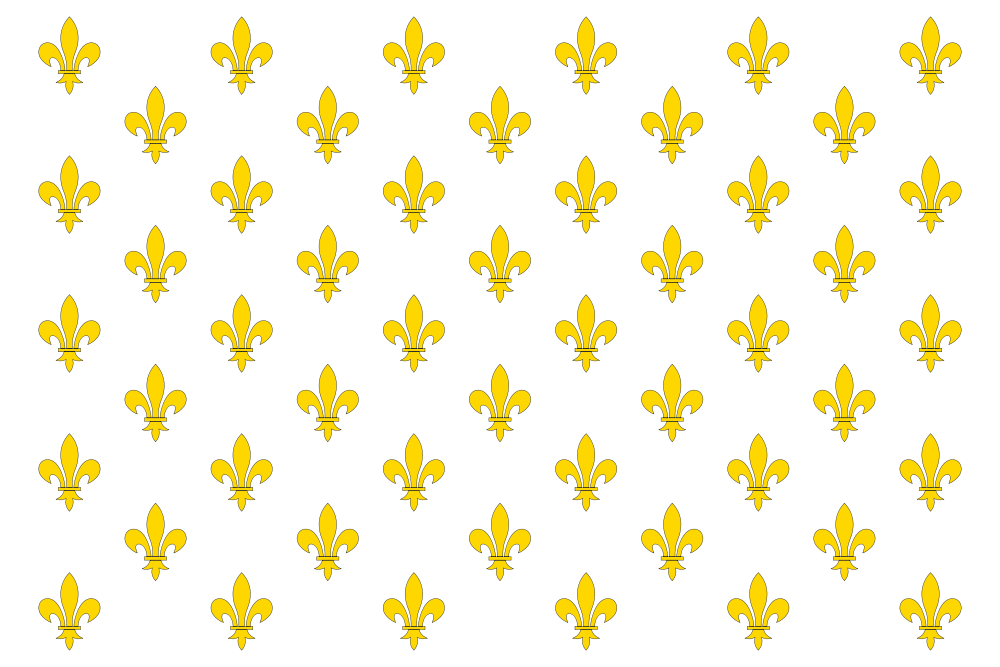
Brigade Irlandaise ceased to be a specialist unit of the French Army in a military restructuring project in 1791. It was absorbed into the regular French Army and lost many of its historic titles, flags and its Irish identity (although most of those in the Brigade were French born or other foreigners at this point.) However many of the soldiers originally swore loyalty to the King of France, and many of the regiments of the former brigade rallied to the Royalist cause when the French Republic was proclaimed in 1792. These units were presented with a "farewell banner." This was a white flag with Fleur de Lees in the corners, (based on the
royal banner of France) In the centre was a blue diamond bearing a harp, flanked by two gold shamrocks. Above was the dates the regiments served as part of the Irish Brigade (1692-1792) and the brigade motto "Semper Et Ubique Fidelis" (Always and Everywhere faithfull). A last flourish and acknowledgement of their Irish history. It wasn't just Royalist France that used Irish troops the following countries also had/have Irish regiments and brigades:
Spain 1688-1818
 |
| depiction of the Irlanda Regiment flag |
There has been a long tradition of Irishmen serving in the Spanish Army, that dates as far back as the 1580s! The story of most of these Irishmen is basically the same, in that they were Roman Catholic exiles who fought for Spain because of Spain's hostility to England and hers support for Irish insurrections. There are examples of various Irish regiments between the 1580s and 1680s. From the flag viewpoint though the Irish Brigade formed of former Jacobite troops is most notable as there are records of their flags. After France; Spain was the biggest employer of Irish Jacobite expatriates in the 18th Century. Like their countrymen in French service they kept their red coats to begin with, however they didn't keep their Jacobite style flags as we will see. There were five Irish infantry regiments in the Spanish Army at the beginning of the century. These were the regiments of Irlanda raised in 1688; Regiment of Hibernia and the Regiment of Ultonia (Ulster) raised in 1709, and the Waterford and Limerick regiments. As stated all these regiments wore red coats. The Irlanda and Ultonia regiments had blue facings on their coats, the others had green.
 |
Uniform, badge and colours of the Ultonia Regiment
19th Century |
All infantry regiments carried two colours, a King's Colour and a regimental colour. The King's Colour was certainly the Spanish Cross of Burgundy. The above left picture appears to be an early example with a harp and (Spanish) crown in the canton. For most of the Brigade's existence it appears that in each corner were crowned coats of arms alternating between the historic kingdoms of Castile and Leon. The regimental colour was the same colour as the regiment facings (blue for Irlanda and Ultonia, green for the others. The centre bore the figure of a harp. By the time of the late 18th and early 19th Century, the flags had changed. The King's colour featured the Royal Coat of arms, and the regimental colour was a cross of burgundy. In the corners of each of these flags was the regimental badge.
While the Waterford and Limerick regiments had a short existence the others served all over the world, the last Irish regiment being disbanded in 1818. Like the Franco-Irish regiments as time went on the number of Irish born soldiers in the regiments decreased, and by the time of their disbandment most only a small percentage was Irish the rest were Spanish, but of Irish decent or from other foreign countries. The Spanish Irish Brigade served the Spanish Empire in the war of Austrian Succession fro 1745 onward. As well as Europe they saw action in the Americas notably in Florida. They fought alongside their countrymen in the British Army (
87th Regiment the Royal Irish Fusiliers) at the Siege of Tarifa in 1812. Irish soldiers in Spanish service are depicted in the Sharps Battle episode of the Sharp series of British TV, when British officer Major Sharp (played by Sean Bean) and his Irish Sergeant Pat Harper (played by
Daragh O'Malley) train and fight alongside an Irish unit of the King of Spain's Guard.
episode can be Seen here.(Yes I am a Sharp fan). Irish soldiers also served in German and Austrian Armies in the 18th Century, however it is not know what flags if any were used by the few all Irish regiments.
 |
| reenactors of Spanish-Irish infantry recreating the Siege of Tarifa |
French Republic 1803-1815
 |
| Imperial Eagle of the Legion Irlandaise |
The Legion Irlandaise (Irish Legion) was formed in 1803 as a light Infantry battalion of the French Army. It was later upgraded to a regiment of five battalions. It was initially formed to take part in Napoleon Bonaparte's planed invasion of the United Kingdom. The legion was to form an indigenous part the
Corps d'Irlande which was a 20,000 strong Corps of the invasion army tasked with conquering Ireland. It was initially made up of former rebels who took part in the rising of 1798, and irish deserters from the Royal Navy, although as time went on like the other Irish units mentioned its numbers were made up of other nationalities notably German and Polish. In 1805 Napoleon presented the legion with an
imperial eagle standard, the only foreign unit in French service to receive such an honor. The flag that flew from this standard is reported as being green, with a harp in each corner.On one side was a Circleular French tricolour within a gold laurel wreath, the tricolour was horizontal rather than vertical, and bore the text "Le Premire consul aux Irlandais unis" The reverse was the same but had a solid red circle with the text "Liberte de Conscience, L'idependance de l'Irlande"

This seems to be a little different from the original proposal as described by Thomas Emmet brother of Robert Emmet. Emmet describes the original proposal is a green flag with a circular French tricolour in the centre defaced with the letters "RI." Around the top of which was the inscription "L'independance De L'Irlande" and at the bottom "Liberte De Conscience." There is no referance to a harp or the reverse, so the original proposal was presumably the same on both sides. The legion's uniform was also described as a green tunic, waist coat and trousers, the cuffs, collar and facings of which was to be yellow, which seems an odd colour to chose. Presumably yellow was chosen as the harp is always depicted as golden, and this is reflected by the yellow.
A completely different description of the Legion's flag is given Miles Byrne who was an insurgent in 1798 and an officer in the legion. He describes a green flag, one side of which had a gold harp and the inscription, "L'independance d'Irlande" and on the reverse side the inscription "Napoleon I, empereur des Francais a la legion Irlandaise."
 |
| Eagle of the Irish Legion according to Byrne |
Why these descriptions are so different is unclear. It could be that after battle the flags of the Eagle Standard were so damaged that it was deemed they needed replaced and that the flag described by Byrne was such a replacement. Alternatively Byrne may simply have been describing a battalion colour rather than the Imperial Eagle of the legion. However the lack of any battalion number seems to make this theory unlikely. After the victory of the Royal Navy at the Battle of Trafalgar in 1805, Napoleon postponed his invasion of the UK and turned his attentions elsewhere. The Irish Legion saw action in the Iberian Peninsula and the German Campaign of 1813. 11 of its members received the Legion d'Honneur the highest decoration in the French military. It was formally disbanded by King Louis XVIII on 28 September 1815. Its flags were burned and its eagle destroyed.
Gran Columbia 1819-1830

In 1819
Simon Bolivar the liberator of Spanish America recruited many British citizens (many of whom were Napoleonic wars veterans) into a brigade of foreigners, known as the British Legion; to fight in the war of independence from Spain. There were three battalions in the British Legion including an Irish one,(1st British Legion, 2nd British Legion and Irish Legion). As well as marching under the national tricolour of red, blue and yellow the British Legion is reported to have used the Union Jack alongside this in the campaign to liberate New Grenada 1819-1820. However the Irish legion used a different flag. The Irish commander General D'Evereux flew a flag from his Dublin hotel when he was recruiting. This flag which was to be the unit flag, was described as green with the device of a harp around which were the "stars of Colombia" possibly the seven stars that later appeared on the Venezuelan flag. The Irish Legion was short lived and was eventually absorbed into the other British Legion and foreign volunteer units. What happened to the flag is unknown.
Mexico 1846-1848

The St Patrick's Battalion was a unit of the Mexican Army led by
John Riley, and made up primarily of Irish deserters from the American Army. As well as Irishmen it was made up of various nationalities most of whom were practicing Roman Catholics. The exact role of the battalion seems to have been a mix of things. There was an infantry company, artillery battery and reconnaissance troop, all under the title of St Patrick's Battalion.
There are numerous descriptions of the flag of the battalion, a lot of which varied greatly. According to Riley's own account of the deeds of the battalion he described the flag as having "St Patrick, the Harp of Erin and Shamrock on a green field."
According to an American Journalist the battalion flag was:
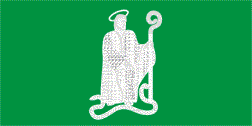
"of green silk, and on one side is a harp, surmounted by the Mexican coat of arms, with a scroll on which is painted Libertad por la Republica Mexicana ["Liberty for the Mexican Republic"]. Under the harp is the motto of Erin go Bragh! On the other side is a painting... made to represent St. Patrick, in his left hand a key and in his right a crook or staff resting upon a serpent."
Two American soldiers described the flag as:
".a beautiful green silk banner [which] waved over their heads; on it glittered a silver cross and a golden harp, embroidered by the hands of the fair nuns of San Luis Potosí."
the other simply described the flag as
"aloft in high disgrace the holy banner of St. Patrick."
A Mexican source gives a very different description of the flag:
"white flag/standard, on which were found the shields of Ireland and Mexico, and the name of their captain, John O'Reilly embroidered in green"
One possible explanation for so many different designs is that different flags were used by the infantry, artillery and reconisence branches of the battalion.
A flag that was captured by the US forces was hung up in the chapel of the US Military Academy of West Point but was subsequently lost or stolen.
Confederate States of America 1861-1865

Irish-Americans fought on both sides in the American Civil War, in some cases like at the Battle Fredericksburg, Irish regiment was pitted against Irish regiment. In fact this is one of the great tragedies of Irish soldiers in foreign service throughout the centuries, most of the time the sooner or later face their own countrymen on the other side.
While the Irish regiments on both sides of the civil war are rightfully celebrated, the flags used by those in Confederate service are less well known than those of their Union rivals. Partly because while many Confederate regiments had Irish companies and Irish platoons, there were rather few Irish regiments that used Irish flags and symbols, unlike in the US Army. But those that were used were just as elaborate as their 'Yankee' kinsmen.
 |
| reported flag of the 24th Georgia Regiment |
One of the more unique Irish flags from the conflict was that of the 24th Georgia Volunteer Infantry Regiment. Their flag is said to have been the national flag of the CSA the 'stars and bars,' with the canton containing 10 stars in a circle and one in the centre, representing the state of and claimed by the Confederacy, in a similar way to the USA flag. In the fly on the white bar it had a gold Irish harp. it may also of had the text "14th Georgia Vols" (no thats not a typing error) on the rd bar above. Personally I would have made a flag more like
this.
The colour of the 10th Tennessee Infantry Regiment is probably the most celebrated Irish Confederate flag. There was no doubt it could be anything but an Irish regiment it was even nicknamed the Confederate Irish Brigade despite being only one regiment. (the term "Irish Brigade" seems to have been adopted by various units numbering far less than brigade strength possibly trying to compare themselves with the celebrated French Irish Brigade), The 10th's colour was a green flag which depicted a harp decorated with white lilies as its badge. On a scroll above this was the text "Sons of Erin" and below the motto "Go where Glory Waits You."
Unusually for the period and rank in question, the regiment carried a colonel's colour. This was a much smaller flag than the regimental colours, and probably served in the role of a personal flag of the officer which is suggested by the presence of his name on the flag.
This flag is also green, with a harp in its centre surrounded by a circlet of shamrocks. Around the edge is the text "Col R W McGavock, 10th Tenn Regt CSA."
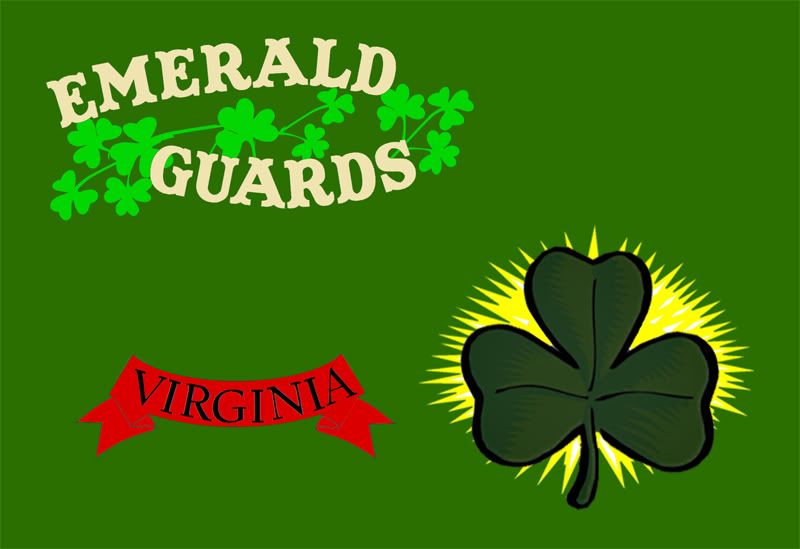
The flag of the 33rd Virginia Volunteer Infantry was also a green flag. It the text "Emerald Guards" entwined with shamrocks in the canton. Below this was a scroll with the name "Virginia" after the regiment's home state. This flag is interesting as it does not have a harp as its main badge, instead it had a shamrock.
Another example of a green harp flag used by CSA forces is that of the 8th Alabama Regiment, who used a green flag with a gold boarder. In the centre was a harp device within a wreath of shamrocks. Above this was the Ireland forever motto "Eirn Go Bragh!" and below was the Irish battle cry "Faugh a Ballagh!" (Clear the Way!).
That concludes the Irish flags of the Confederacy the flags of the Union continued the use of green harp and other flags as well as the adoption of Irish Battle cries.
United States of America 1861-1865
The Union Army was the only army in the civil war to have an Irish Brigade (although other units called themselves "Irish Brigades" they were often only regiments), and as such the regimental colours of the US Irish Brigade featured a standard design. The flags of the Brigade are notable due to their close relationship with the Fenian flags mentioned in
Part 11, with the inclusion of the Sunburst appearing from clouds. Each regiment in the Federal Army carried two flags a national colour which was usually a variant of the Stars and Stripes and a regimental colour, many of which followed common patterns, which for Irish regiments was generally a green harp flag.
The most famous Irish regiment of both sides during the civil war was the 69th Regiment of New York State Volunteers. The first flag presented to the regiment was a green harp flag which was made when the regiment mutinied rather than parade for the then Prince of Wales who was visiting the USA. Its national colour was presented just before the regiment marched out of New York to the fighting in Virginia. The regiment was heavily involved in the first Battle of Bull Run and acquitted themselves well, however their colours were captured by the Confederates, however not before three successive bearers of the regimental colour were shot down and the national colour was retrieved. The regiments commander held aloft the national colour, to rally the federal troops, but was captured along with the flag in the process.

The 69th would join three other regiments; the 63rd New York Volunteer Infantry and the 88th New York Volunteer Infantry (numbered out of sequence after the 88th Regiment of Foot (Connaught Rangers) of the British Army) to form the Irish Brigade. Although other regiments and battalions (some of which were not Irish) served in the brigade temporarily, these were the core regiments. These three regiments adopted a standard design of regimental colour that was used throughout the brigade.
The field of each flag was green, the central badge was the device of a harp in a wreath of shamrock, above which was the sunburst used by the Fenian Movement. Above and below were red scrolls, the top one bore the regiment name (eg 69th, 63rd or 88th Regiment) and the words "Irish Brigade". The bottom scroll had the regiments motto in Gaelic
"Riamh Nar Dhruid O Sbairn Lann" (who never retreated from the clash of spears).

The National colours were of course Stars and Stripes but in the canton (that is the blue square with the 34 stars of the period) appeared a crimson stripe with the unit name. These colours were presented to the brigade in 1861 by a committee of Irish ladies.These colours were carried by the brigade in many engagement. In 1862 during the battle for Richmond (capital of the CSA) the Brigade's Commander ordered that if their was a danger of the flags being captured, they were to be burnt to prevent them falling into enemy hands, no doubt he remembered the disgrace of the first colours of the 69th being captured at Bull Run. Fortunately for them this didn't happen, and the colours became icons of the Brigade's bravery and heroism so much so, that on the 1st July that year at Malvern Hill, a confederate colonel is said to have remarked "Here's that damned green flag again" upon witnessing a fresh advance from the 88th! Such remarks from the enemy are perhaps the greatest compliments to a soldier (well for an Irish soldier at least). At various battles the iconic colours became a target and many were shot down carrying it, in fact to carry it almost meant certain death, but whenever the order "raise the colours" was given there was always somebody willing to take the risk for the honor of carrying it. Even when the pole was broken by a bullet when carried by a Cpt McGee, he picked up the flag and draped himself in it. The flags like the brigade had taken a heavy toll and by the end of 1862 were laid up for safe keeping in the New York Chamber of Commerce, where it was hoped they would inspire "interest and pride in every patriotic citizen"
The brigade was temporarily without flags and unlike the picture above did not carry in colours in the battle of Fredericksburg, wearing sprigs of green in their caps as an alternative expression of their identity.
The New Colours were presented after the battle, these were also green flags, with the 'badge' used on the previous flags in the canton, however the top scroll reads "number (69th 63rd or 88th) Regiment NYSV" (New York State Volunteers, and the bottom simply reads "Irish Brigade" In the fly between two laurels were the battle honors of 1861, other battles were added later. Below the badge was an inscription of the presentation. The 69th's reads "Presented by the Citizens of New York to the 69th NYSV, (1st Regiment of the Irish Brigade) Brigadier Gen Thomas Francis Meagher Commanding In grateful appreciation of their gallant and brilliant conduct on the battle fields of Virginia and Maryland in the War to maintain the National Dominion of the American Union. Nov 1862"
 The other flags were identical except 69th was replaced with the appropriate number. At least Two of these flags survive, and one (the 69th) was given by President Kennedy to the Irish Republic in 1964, and is in the care of the National Museum of Ireland, the other 63rd is i believe at the University of Notre Dame in Indiana. In the later part of the war these three units numbering only 220 fit men, were grouped into a single battalion who marched under the colours of the 88th. The Irish Brigade and it's colours are among the most celebrated flags of the American Civil War, becoming a symbol of Irish-America. Reproductions of the "fighting 69" flag are waved proudly by Irish-Americans today, The 69th Infantry linage continues as a unit of the New York National Guard, although they no longer carry green harp flags as colours, they do use the flags of their predecessors in an unofficial capacity.
 Another regiment that used a green harp flag was the 17th Wisconsin Volunteer Infantry Regiment. The had quite an elaborate green flag, which bore a harp, flanked by shamrocks and ensigned with the coat of arms of the USA. This central badge was flanked by gold "mantling" with the American and state shields in the centre. Above and below were two red scrolls, the top reading "Faugh a Ballagh" and the bottom "Wisconsin Irish Brigade." (another example of the nostalgic use of the word "brigade") I am not sure if this flag had any official status, the use of the word brigade for a regiment suggests not, on the other hand the US War Department had other things to worry about in a civil war than flags.
Other "yankee" Irish units adopted the more standard design of
US regimental colour, (that is a blue field with US coat of arms, with a scroll with the regiment name at the bottom) but added an Irish shield to it, The 9th Connecticut Regiment did this.
Some of the American Civil War flags mentioned here appear in the opening titles of the film God's and Generals:
South Africa 1880-1902, WW1 & WW2
 |
Members of what is believed to be McBride's Irish Brigade in Boar service
with a green harp flag a rare photo indeed |
Many Irish regiments had seen service in South Africa throughout the colonial period, it is not until the Anglo-Boar conflict that we see Irish units in Colonial South African service, These include the Cape Town Irish Volunteer Rifles and Driscoll's Scouts. Unfortunately these units don't come into this blog as the Cape Town Volunteers were a rifles regiment (in commonwealth military tradition rifle regiment never carried and still don't carry regimental colours) and it is unsure if Driscoll's Scouts carried or used flags as they were irregulars. On the side of the Boar Republics there was however an Irish 'Brigade' (Like in the American Civil War the term Irish Brigade is used to describe any Irish unit whatever size, Only about 500 Irishmen fought for the Boars at any one time, the size of a small battalion, In fact the only group of Irishmen to fight in Brigade strength in the Boar Wars was the British 5th Brigade aka Hart's Irish Brigade, which included 1st Battalion Royal Inniskilling Fusiliers, 1st Battalion Connaught Rangers and 2nd Battalion Royal Dublin Fusiliers).
There are many units of the Boar Irish using green harp flags, A homemade 'Fenian' flag was taken to South Africa by John McBride a major in the "Irish Brigade," there is at least one reference to this flag being carried into battle, for most part however in what was a guerrilla war this flag was wrapped around one of the soldiers rather than flown. It was buried to prevent it's capture when the 'brigade' thought it was surrounded. A green flag with a Brian Boru harp in the cetre surrounded by shamrocks possibly the latter flag was flown beside the Boar
Vierkleur flag in their camp at Modderspruit during a sports event on Christmas Day 1899.

A green harp flag was also used to taunt their fellow countrymen on the opposite side during fighting at Ladysmith in 1900. Two Companies of the Royal Irish Fusiliers who had managed to escape after the rest of their battalion were forced to surrender on 30 October 1899, were in the besieged British garrison, A Michael Dannit said the Boar Irish sent challenges to the "Anglo -Irish" to come out and attack them. He says that the "Royal Irish" were stationed on a hill, the Boars charged up with a green flag fired on them and fled, teasing the British who gave chase calling on "the fenians to stand and face them" but were ambushed by the Boars. This could be the flag in the above photo.
A green flag with harp and antique crown was captured by the Boarder Regiment in 1900 and can be seen at their museum in Carlisle Castle.
Another interesting and unique flag was sent to the Boar-Irish in South Africa but didn't arrive untill the war was over. This was made by the Women's nationalist movement Inghinidhe na hEirann (Daughters of Ireland) and Arrived in Africa just as the 'brigade' was disbanded, it travelled back to Ireland, and is owned by the descendants of an IRB member who have given it to the National Museum of Ireland on a long term loan. This flag is made of green poplin with a gild braid boarder and fringe. Had it arrived in time it almost certainly wouldn't have survived the fighting. It bears a harp, and uniquely the cloth is cut away on the inside of the harp. At the top in the lettering "Transvaal Irish Brigade" and on the bottom "Ar dTur Ar Muintear Ar dTeanga" (Our country, Our People, Our Language).

On the outbreak of the 1st World War a group of ex British officers in the Johannesburg Irish Club decided to form a regiment in the South African Army for the citizens of the region who were Irish or of Irish descent. This regiment known as the South African Irish Regiment served in the Allied armies in both the first and second world wars, it is still a regiment in the South African National Defence Force consisting mostly of reservists. Although like most Irish regiments in this post as time went on the actual number of Irish people in its ranks is questionable. Any South African can join this regiment, being of Irish descent no longer being a requirement, however it retains it's Irish identity, traditions, and symbols, is regimental march
Killaloe (courtesy of SA Irish pipes and drums) is the same as the Royal Irish Regiment's . Its colour is a green flag, featuring a harp with the motto "Faugh A Ballagh" This is in a wreath of Shamrock joined at the bottom by a King Protea the national flower of South Africa, Below this are the regiment's five battle honours from the World Wars .
Canada WW1, WW2
 |
| regimental colour 2nd btn The Irish Reg of Canada |
On the outbreak of the great war in 1914 the Irish communities of Montreal, Toronto and Vancouver were quick to get permission to raise regiments from the Department of the Militia. It was hoped that these regiments would serve with the Canadian Expeditionary Force (CEF). However they were used to provide draft replacements for the CEF battalions.
The Canadian Irish Rangers sent a detachment to the 60th Overseas Battalion CEF. It was amalgamated with the 22nd and 23rd Canadian Reserve Battalions in 1917, and ceased to exist as an independent unit. The Canadian Irish Fusiliers sent detachments to join the 121st (Western Irish) Battalion CEF. After the war they amalgamated with the Vancouver Regiment to form the Irish Fusiliers of Canada. The Irish Regiment of Canada was raised in 1915 and sent numerous battalions overseas including the 110th Canadian Overseas Battalion and 208th Irish Battalion CEF. The Irish Regiment of Canada is unique among all the Irish units, as it is the only kilted Irish regiment, with it's own unique
"O'Saffron " tartan. (In most Irish regiments in Commonwealth armies and the Irish Defence Forces, solid coloured saffron kilts are
worn only by pipers). They adopted this in 1931. The practice of carrying regimental colours into battle was abandoned in the Boar War for operational reason, they are now only symbolic and ceremonial. The Canadian Irish colours followed the basic Canadian Army pattern which is itself based on the British one. In days of old the field of the flag is the colour of the facings on the regiment's uniform, for most Irish regiments green is adopted. The central badge is a red disc with a badge (usually the regiment's badge but other symbols may be used). Around this was a wreath of shamrocks, roses and thistles, this was later replaced with maple leafs (and other relevant plants, like shamrocks in Irish colours.) This design is usually ensigned with a crown. Around this is a wreath bearing the battle honours of the regiment. Historic badges are often displayed in the corners, older regiments might also display battle honours that are badges in the corners. The King's/Queen's colour was a Union Jack (this has been replaced with the modern flag of Canada). The badges of the historic Canadian Irish regiments were:
a crowned shamrock with the motto "Quis Separabit?" for the Irish Rangers
The Irish fusiliers had a heraldic flaming grenade common for fusilier regiments, and a historic crown, inside the grenade was an irish harp ensigned with a maple leaf.
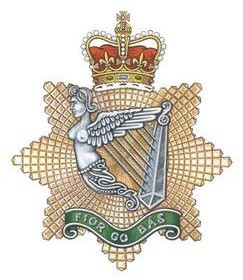
The Irish Regiment have a crowned eight pointed star, which bears an irish harp and the motto "Fior Go Bas" All these would have been used in the colours.
The Irish Regiment of Canada's second battalion still exists of the Canadian order of battle, as one of it's primary reserve units, it is the only sole irish regiment in the Canadian armed forces (although most of its members are Canadian born)
If you know of any relevant flags not mentioned in this post please do not hesitate to share them with me, by either commenting or posting them to my wall.
For more in this series see the links below or click the label History of Irish flags:
Also in the Series


.png)







.svg.png)


.svg.png)






.svg)


