Showing posts with label Londonderry. Show all posts

Thursday, 14 May 2020

the Formal Surrender of Hitler's U-boats

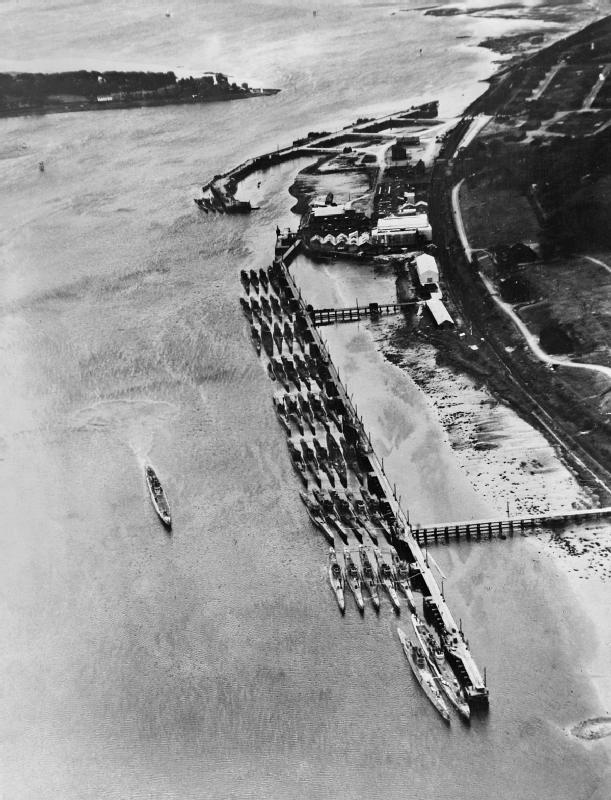
U-Boats moored at Lisahally, Londonderry.
 IWM Public Domain

The Battle of the Atlantic was the longest battle of the Second World War beginning with the sinking of the liner SS Athenia by German submarine U-30 a matter of hours after the British declaration of war on 3rd September 1939. German submarine or U-Boat activity continued until the VE Day on 7th May 1945. During this battle the German Navy the Kriegsmarine attempted to cut off the United Kingdom’s overseas supply lines most notably the transatlantic routes. The U-Boat was the Kriegsmarine’s workhorse in this regard. So critical was this battle to the survival of the United Kingdom that Britain’s wartime leader Winston Churchill described it as his greatest fear.
Though the command of Western Approaches was in Liverpool many of the escort vessels that protected Allied convoys were based in Northern Ireland ports most notably the port of Londonderry. Derry as the city is also commonly called is the UK’s most western port and a stone frigate (naval shore base) HMS Ferret was established there in 1940. Londonderry is Northern Ireland’s second city and is situated on a tidal section of the River Foyle just before it flows into Lough Foyle and into the North Atlantic. The importance of Derry to the battle is shown that by 1943 more ships were stationed there than Liverpool, the Clyde and Belfast. At its peak the city and its outlying port facilities at Lisahally just beyond the city limits catered to 139 ocean going vessels. Following the entry of the United States into the war the city hosted a strong American presence although the bulk of Allied naval personnel were British and Canadian.
On 4th May 1945 as Berlin fell Grand Admiral Karl Donitz who had following Hitler’s suicide three days earlier inherited the leadership of Nazi Germany ordered his U-Boats to ceasefire. The message he sent them read “Undefeated and Spotless, you lay down your arms after a heroic battle without equal.” From that date U-Boats began surrendering whenever they met an Allied ship although some commanders scuttled their submarine before it fell into Allied hands.

View of Londonderry with warships along the quay
While many of the crews did fight a heroic battle, Winston Churchill himself paying tribute to the ‘fortitude of the U-Boat Service’ they had quite decisively been beaten in the Battle of the Atlantic. The Commander in Chief of Western Approaches Admiral Sir Max Horton took issue with this statement. He was a veteran of the 1st World War (ironically as a submarine commander) and was aware that the Germany had blamed its defeat in that conflict on the stab in the back myth. This was the myth that the German armed forces in the field were undefeated and that Germany had lost the war because the civilians and politicians at home gave in and betrayed them. This was a myth but Horton was aware that the Nazis had used this belief to their advantage during their rise to power and it played into their rearmament and expansionist policies. Fearing that a similar myth regarding the German armed forces in the Second World War might lead to history repeating itself. Horton sought to dispel it before it could take hold so he planned a formal surrender ceremony.
Londonderry was chosen to be the place where this ceremony would take place due to the role it played but also probably for practical reasons regarding the range and seaworthiness of some of the U-boats. The first eight U-Boats sailed into Lough Foyle on Monday 14th May 1945 with a skeleton Kriegsmarine crew and under the Royal Navy command. The U-Boats flew the British white ensign and were escorted by the British, Canadian and American destroyers HMS Hesperus, HMCS Theford Mines and USS Robert I Paine. The U-Boats docked at Lisahally and their crews led by Oberleutnant Klaus Hilgendorf commander of U-1009 formally surrendered to Admiral Sir Max Horton, who had flown into nearby Royal Naval Air Station Eglington (HMS Gannet) that morning specifically for the occasion. Horton was joined by the Prime Minister of Northern Ireland Sir Basil Brook and Colonel Dan Bryan the Irish Free State’s Director of Military Intelligence. The event was also witnessed by many of the locally based Allied soldiers, sailors and airmen, most notably the WRNS from HMS Ferret and Fleet Air Arm personnel from HMS Gannet and HMS Shrike (RNAS Maydown).
Free Polish destroyer ORP Krakowaiak toes U-2337 out of Lough Foyle
for scuttling as part of Operation Deadlight 28th November 1945
Following the surrender more U-Boats found themselves moored on the Foyle from where they were towed of the coasts of Counties Londonderry and Donegal and systematically sank in what was known as Operation Deadlight. 116 boats were destroyed this way, being towed to three main zones where they were sunk either by scuttling, naval gunfire or aerial target practice depending on which zone they were towed to. This operation commenced on 17th November 1945 and completed on 11th February 1946.

Thus the end of Hitler’s U-Boat fleet happened in Northern Ireland. Winston Churchill said of Northern Ireland’s role

“By the grace of God Ulster stood a faithful sentinel”
“That was a dark and dangerous hour. We were alone, and had to face single-handed the full fury of the German attack raining down death and destruction on our cities and, still more deadly, seeking to strangle our life by cutting off the entry to our ports of the ships which brought us our food and the weapons we so sorely needed.
Only one great channel remained open. It remained open because loyal Ulster gave us the full use of Northern Irish ports and waters, and thus ensured the free working of the Clyde and the Mersey.
But for the loyalty of Northern Ireland we should have been confronted with slavery and death and the light which now shines so strongly throughout the world would have been quenched.
The bonds of affection between Great Britain and the people of Northern Ireland have been tempered by fire and are now, I believe, unbreakable.”
“We have traveled a hard and darksome road to victory in Europe, and at every turn in this memorable journey the loyalty and courage of Ulster have gleamed before the eyes of men.
The stand of the Government and People of Northern Ireland for the unity of the British Empire and Commonwealth and for the great cause of freedom, for which we all risked our survival will never be forgotten by Great Britain. A strong loyal Ulster will always be vital to the security and well-being of our whole Empire and Commonwealth”

Friday, 25 October 2019

New/Old station in Londonderry

The long awaited new railway station in Londonderry has arrived. I say new station however that new station in in the Victorian building which housed the station that was replaced by the station which the new station has replaced. Confused yet? Then I'll briefly explain the history.
The railway history of Londonderry is quite long as you would expect for a city that once boasted four termini plus extensive docks railways, so I am only focusing in on one station.

Seal of the L&CR
featuring the arms of Coleraine
The Londonderry & Coleraine Railway Company (L&CR) opened its first station in Londonderry's waterside area in December 1852, although the line would no be completed until July the following year (until then trains from Derry terminated at Limavady Junction).
 Around this time there were other railway lines being founded in Ulster. The Ballymena, Ballymoney, Coleraine & Portrush Junction (BBC&PJ) Railway being the  L&CR's closest neighbour at the Coleraine end, who in 1859 built a bridge over the River Bann to link to the L&CR station in Coleraine. in 1860 The Belfast & Ballymena Railway merged with the BBC&PJ to form the Belfast & Northern Counties Railway (BNCR). By 1871 the BNCR had bought the L&CR giving trains from Londonderry the ability to run to Belfast and Portrush as well as the places in between which is more or less the system operated today. The BNCR rebuilt the L&CR Londonderry Waterside terminus in 1874 commissioning John Lanyon to build an impressive dressed Sandstone structure and that company's initials are still carved into the clock tower. No known records of the original L&CR station survive
Initials of the Belfast & Northern Counties Railway in the clock tower
The station included a booking hall, waiting rooms and offices with a large indoor platform area with two platforms and a "run around" in the centre. There was also a goods yard, turntable and water crane facilities to top up the tenders and tanks of steam locomotives (in later years diesel storage tanks would also be include). The station also included living accommodation for staff. Plus a duel gauge railway that linked it to the city's other three termini and the docks via the lower deck of the Carlise Bridge over the River Foyle. It was quite an extensive site considering it was at the bottom of a hill sandwiched between the buildings of the waterside and river.
View down platforms showing the extensive space to the right for sideings and
where the link to Craigavon Bridge was. It also gives a good impression of how
the station sat between the raised urban environment on the left of the picture and
the river to the right. This picture is of a steam excursion on 1 September 1979 after
the closure of Londonderry's other stations hence no 'Waterside' suffix on the sign. The
Loco No 186 is a Railway Preservation Society of Ireland engine
Copyright William Adams shared under Creative Commons Licence
The station and the railway it served would change ownership many times. Operating under the titile of Northern Counties Committee under the Midland Railway, London Midland & Scottish Railway and UK Railway Executive, until the Northern Ireland government purchased the NCC in 1948 and running it through the Ulster Transport Authority and from 1967 through Northern Ireland Railways which is currently a subsidiarity of  the government owned Northern Ireland Transport Holding Company which trades under the brand of Translink.
Another Platform view on a miserable June day in 1979 showing better the actual
station canopy. Damage from the 1975 bomb visible on the windows. 80 class DMU
number 94 awaits departure with the 1440 service to Belfast Central
Copyright The Carlisle Kid shared under Creative Commons Licence 
Another photo from 23 June 1979. Looking north down the platform from under
the canopy. This picture gives an excellent view of the canopy and how one side of
it was open. This would later be enclosed.
The DMU in the distance is 94 from the previous picture.
The train to the right is an old UTA Multi Purpose Diesel (MPD) Railcar.
Copyright The Carlisle Kid shared under Creative Commons Licence
The station continued in use as Londonderry Waterside station. It was at a somewhat disadvantage to Derry's other stations as it was on the Waterside (east bank of the river), whereas the other mainline terminus Londonderry Foyle Road was on the City Side (west bank of the river) and was hence more convenient to both the city centre and the docks.  The narrow gauge station of Londonderry Victoria Raod was also on the waterside but even this was right beside the rail wagon exchange of the Craigavon Bridge (which replaced the Carlise Bridge in 1933, and is still in use although the lower deck is now used by road vehicles) However despite this it managed to out live the other termini in Londonderry to become the city's sole railway station. Although after the closures of the other stations the Waterside suffix was dropped from the station's name it continues to be known locally as the Waterside Station, other local names for it have been the Midland Station and the Northern Counties Station in reference to the companies which operated it.
Turn around from the previous picture and we see MPD  units 539 & 61. These
were built bu the UTA in 1959 reusing the bodies of 1933 built coaches. This waste not
want not attitude was an Ulster railway tradition and helped prolonged the lives of many lines
Another view of the canopy and the wall. Sadly the booking hall was destroyed in the 1975 bomb
the shed behind the train serving as the ticket office
Copyright The Carlisle Kid shared under Creative Commons Licence
The station was targeted twice by terrorists during the troubles being bombed in 1972 and again in 1975. While damage suffered from the first bomb was relatively light although it destroyed the tea room, the station was not so lucky after the second bomb. It would eventually prompt its abandonment and closure. It destroyed much of the entrance and centre of the building including the staff accommodation and Ticket Office and Waiting Rooms following this tickets had to be purchased from a shed at the end of the platform. The last resident of the accommodation at waterside station was North West Manager Alec Esdale, living quarters would never again feature in any of Derry's railway stations.
View of the station May 1979 showing the extent of the bomb damage
Copyright Albert Bridge shared under Creative Commons Licence
The make shift ticket office used from 1975 to 1980
Copyright The Carlisle Kid shared under Creative Commons Licence

A new station was opened next to the old in 1980. The old station was fully enclosed and used for storage for some years before being sold by the railway. Since then it mostly lay empty although it did have brief periods of use. I remember it being used as a furniture shop. During this time the platforms were filled in with concrete.
The new station featured an island platform at the end of a square building which included a ticket office and small waiting room. It was very much a station built to reflect the decline of the railway and although there were a couple of sidings the track capacity was very much reduced. The people of Londonderry were never really satisfied with the station. Although it might have been apt for the dwindling passenger numbers when it was built, it was very much a cold looking and functional building, with next to no attractive features, with many saying the platform canopy resembled an upside down egg box. Hardly a befitting way to enter Northern Ireland's Second City!
The 1980s built station
Although unattractive as it was it served the city and the railway as well as it was designed to until traffic on the line once again began to pick up with the dawn of the new millennium. With growing public, political and infrastructure pressure Translink upgraded the line, some sections of track were upgraded with continuous welded rail in 2013, later a passing loop was added at Bellarena the next station from Derry to enable an hourly service in each direction. Before that at Londonderry if you missed the train you would have to wait at least two hours.
view from the platform of the 1980s built station.
The clock tower of the old station can be seen to the right
The net phase was a station refurbishment. Translink gave the public a choice. They could refurbish the 1980s building, repurchase and renovate the old Victorian station or build a new station further up the line by the relatively new foot bridge over the Foyle known as the peace bridge. In fairness from an operational view the latter might have been preferable giving closer and more convenient access to the city centre and the Translink bus depot via the Peace Bridge.
However in the consultation the people of Londonderry (myself included) voted by about 60% to renovate the old waterside station. That renovation began in 2018 and as well as renovating the Victorian building included track and signalling work and building new platforms. There are two platforms which unlike the original station are completely outside one running down the side of the building. They are much longer than the previous station with the intention to cater to longer trains not just NI Railways trains but also steam train excursions and rail tours like the Belmond Grand Hibernian. The track includes a run around which should help facilitate these trains. A tea room has returned to the building as well as a shop. The waiting area is spacious and artistic, with reminders of the city's railway heritage and local points of interest.
A clock that tells the time

the renovated frontage

view of the ticket office on the left with waiting area beyond

where the opening for the track and platforms once was, there
is now a window gazing onto the platforms

One of the installations celebrating the rail heritage
Note the Great Northern did not owned the Foyle Road station
Not mentioned is the company that did, the Northern Counties Committee! 

Looking South. Platform entrance on the right.
This photo offers a view of the canopy and brickwork

The tea room to the left of the south entrance

A 4000 class DMU stabled in the sideing

The old 1980s station is set to be demolished and form part of the road area of the station which is not only to serve as a train station but a regional "Transport Hub" with bus connections too.
While it might not be a restoration it is certainly a new lease of life and one that sees the building serving as a railway station which is the function it was built for

Wednesday, 10 April 2019

A heraldic walk in Derry

As yesterday was a nice day I decided to take a walk around the city centre of Londonderry, Northern Ireland's second city but in my opinion its capital in terms of history.
It might be useful to read this post before from 2012 before reading here as I will reference a few points in it. Starting in the waterside I walked over the double deck blue and white Craigavon Bridge, the top deck features the city coat of arms every few feet.
Towards the end of the bridge is the plaque commemorating its opening
On this plaque is old arms of Northern Ireland and those of the city:

Moving into the old walled city I passed the courthouse featuring the Royal coat of arms from 1801-1816.
Next to the building you can see behind, St Columb's Cathedral

Before the gates of the Cathedral's main drive and on the gate itself (the pic here was taken from inside the gate in order to avoid the sun) are the arms of the former Church of Ireland diocese of Derry (currently paired with Raphoe) on either side of the gate are the city's arms
 and the arms of the Honourable the Irish Society who originally built the church
Inside the gate is the notice board with times for both worshipers and visitors again featuring the diacoses arms
aswell as the Cathedral's seal still in use:
a quick walk in some of the adjourning streets of the walled city and we notice the street name signs feature the city arms.

Onto the city walls themselves, and you will notice a fine collection of 17th & 18th century cannon. Most of these were at various stages provided by the City of London livery companies who financed the plantation city. while the later guns of this period were simply inscribed with the company name the earlier ones bore the London coat of arms, which is still recognisable.

Nxt stop along the walls is the Apprentice Boys Memorial Hall. Here there are two versions of the city arms. One on the balcony with the date of the hall's extension
And higher up the arms appear in a roundel with the text "Apprentice Boys of Derry - No Surrender" around it. Note that on this variant of the arms only half of the St George Cross is used.

heading down the walls to between Magazine Gate and Shipquay Gate overlooking the Guildhall are more cannon with the London arms, however two here are significantly older dating from around 1590 and are distinguished by the Tudor rose and crown, although on both this badge is much faded and worn, however the outline of it can still be traced.

The next and last great building we come to is the Guildhall where the council meets and where civic functions are held. From the walls we see that the building is crested with a crowned lion holding the shield of the Kingdom of Ireland. Below this side by side are the city arms and those of the Irish Society
At the base of the adjoining clock tower is the main entrance featuring a very ornate version of the city coat of arms

I confess to not really knowing what the other shields are. The very top one appears to be the arms of the City of London impaled with the Carpenters Guild, the bottom left looks like a variant of the Sherwood arms of which I am not entirely clear on the city connection. The far right is either a cross of St George possibly from the London arms but with the sword worn away or the De Burgh arms who were the Norman Earls of Ulster. 
Along the top of the ground floor windows is a ring of carved oak leaves with three shields, bearing the arms of Ireland, Londonderry and Ulster. 
arms of the city

arms of the kingdom


arms of the province 
I didn't go into any of the buildings mentioned here maybe I'll do that another time as I know they all have heraldry and other symbols on the inside too

Sunday, 28 September 2014

New Council Logo

As of April next year (2015) my local council along with several councils in Northern Ireland, will merge with neighbouring councils. This is part of a program of reducing the twenty six district councils in the province to about eleven so called super councils. Derry City Council will merge with Strabane District Council.
There will of course be the political winners and losers as a result of this, however my concern is that the Londonderry coat of arms, which in its current form date from the modern city established in 1613, (but elements are possibly much older) may officially become defunct.
The Londonderry coat of arms are:
City coat of arms carving in the Guildhall
I think that the city coats of arms belong to the city rather than council, it is certainly used by various organisations from the city, It was not until 1952 that letters potent gave the Londonderry Corporation, the predecessor of the current city council,  the legal right to use the arms (which it already was doing) and linked to the city, On all documents the arms are referred to as the city coat of arms rather than council or corporation arms. So no doubt the historic arms will legally survive in some form.
For those interested the city arms feature: Sable, a human skeleton Or seated upon a mossy stone proper and in dexter chief a castle triple towered argent on a chief also argent a cross gules thereon a harp or and in the first quarter a sword erect gules
The cross and sword in the chief come from the arms of the City of London, which was added to the original Derry arms of "ye picture of death (or a skeleton) on a moissy stone & in ye dexter point a castle." when the new city was granted its charter and London prefix in 1613. 
The symbolism of figure of death and the castle is debateable, as the exact origins are unknown. The most popular theory is that the castle represents a 14th century castle near Greencastle north of the city, belonging to the Norman Earl of Ulster Richard de Burgh. The Skeleton representing a Norman knight who starved to death in the castle dungeon on the order of the above mentioned Earl of Ulster. 
An official report in 1979 stated that there is no evidence that the figure of death represented any individual but was only "symbolic."
The most recent document in reference to the city arms is in 2002 when the College of Arms and Norroy & Ulster King of Arms issued letters potent restoring the harp to the arms (which appears to have been accidently dropped and forgotten about). 
To stop the coat of arms from disappearing completely from the local government of the city I designed a new logo for this new "super council."

The logo is primarily based on the current Derry City Council logo. The name of the new council hasn't yet been decided, it is currently being called Derry and Strabane District Council. I used Foyle (&) District Council for two reasons. 

  1. It avoids using Derry or Londonderry which have sadly become politicised, where Foyle (as in the River Foyle) is used as a neutral alternative. The electoral constituency is officially called Foyle. the local BBC radio station is called Radio Foyle and the Londonderry Port & Harbour Commissioners use the corporate brand of Foyle Port, although its official name has not changed.  The River Foyle also begins at Strabane with the merging of two other rivers. 
  2. Derry & Strabane District Council is a lot of words to play with in a logo. Especially if one uses the politically correct (or rather equally offensive lol) Derry/Londonderry rather than one or the other.
The coat of arms features the impaling of the above mentioned Londonderry coat of arms, with a coat of arms for Strabane. The coat of arms of Strabane District Council are:
 This isn't very good to work with so I used an older coat of arms from 1906, that was similar. It featured a boat on a river, below three towers.
The supporters are oak barchs, taken from another heraldic design I did, and reference to the supposed meaning of the word Derry. 
The crest, something I am particularly proud of features a mural coronet, which could reference Londonderry's walls, or symbolise a settlement, which is what it is normally used for in heraldry. Out of this coronet is a red hand of Ulster grasping a fish, reference to the wild life in the Foyle river basin, which is home to wild salmon amongst other species and top spot for fishing. The motto is a new motto neutral to the Vita Veritas Victoria (life, truth, victory) of Londonderry or the Con Cordia Crescit (Let Goodwill Increase) of Strabane. Duos Quasi Unum a Latin motto meaning "two as one" referencing the two councils coming together.