Monday, 9 March 2020

Personal Flags of the Government (Part 1)

insignia generally used on government podiums  
One of the things I like about how things are done in the United States is how every government department has its own seal. While a few ministries of the United Kingdom government do have their own insignia most do not simply using a variant of the Royal Coat of Arms which is usually in a black & white format. There are currently 24 ministerial departments, and as can be seen here only 8 have an insignia separate from that used by HM Government as a whole and of that eight 3 insignia are shared by another department and two are another variant of the Royal Coat of Arms. So the idea behind this post started off as a project to design some form of heraldic insignia for each ministry of the British government. However it went further as I thought heraldic insignia can be used on flags, and then I thought why not have a flag for every minister. Now the thinking behind these designs are not necessarily flags that would be flown from buildings but flags that would be flown from ministerial cars or that you might see behind podiums at speeches or press conferences.
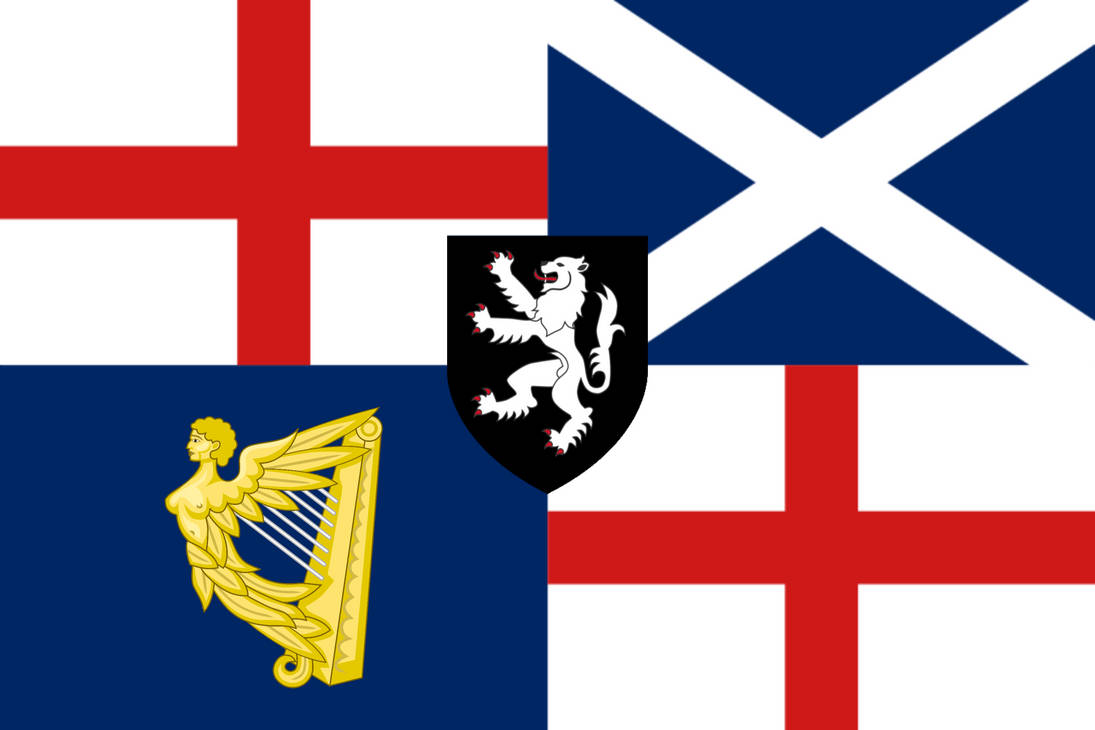
Starting at the top with the Prime Minister I immediately ruled out a defaced Union Jack for two reasons. Firstly if such a flag is to be able to be used behind podiums then I think it would work better if it could be used alongside the Union Flag rather than be a variant of it. Secondly it would mean I could not use the above arms as the Union Jack with the royal arms in the centre is already a flag used by British ambassadors. So looking at history for some sort of base I came across the standard of Oliver Cromwell as the Lord Protector of England, Scotland and Ireland (1653-1658):
Like the Royal Standard it is quartered however it features for the most part the national symbols of the constituent countries rather than the royal arms, with a personal coat of arms in the centre. As Cromwell was a member of parliament and lead that faction in the English Civil Wars (1642-1651) I think a flag along similar lines would make a good start for the Prime Minister and cabinet.

Prime Minister, First Lord of the Treasury, Minister for the Civil Service, Minister for the Union.

The proposed standard of the Prime Minister is simply a banner that has the arms attributed to the patron saints of the United kingdom; St George, St Andrew, St Patrick and St David.
standard of the Prime Minister of the United Kingdom of Great Britain & Northern Ireland
Key thing to point out here is that rather than the flags of the constituent countries it features the arms attributed to their national saints (although in the case of England and Scotland the arms of the patron saint are used as the national flag). When you compare it in with the Lord Protector standard there is a historic precedent for this approach. There are also advantages to this approach over a defaced Union Jack which will become evident.

Secretaries of State and Members of the Cabinet (executive)

The cabinet is made up of  the Prime Minister most of the leaders of the 24 ministerial departments who are known as Secretaries of State plus any other Member of Parliament (MP) appointed to it by the Prime Minister. The idea for these is that they will use the above design but with the badge of their department in the centre. The order of the crosses might also change if the department is region specific. In these cases the relative arms will be moved to the 1st quarter and the others continues as normal, for example in the flag of the Secretary of State for Wales the arms of St David occupy the 1st quarter, then it continues with those of St George in the 2nd, St Andrew in the 3rd and St Patrick in the 4th. 
For the other MPs appointed to the cabinet without being assigned a role (minister without a portfolio) they can use the same flag as the PM but with a label.
flag for a cabinet member without a portfolio 
Currently there is only one member in the cabinet who would warrant such a flag but the system of labels I propose allows the theoretical possibility of eight cabinet members without portfolios to have an individual flag. This is because the labels are colour coded with points between two and five. After a labels with five points the colour changes from gold to silver and reverts back to two points, then three, four and five.
As well as the Secretaries of State in each department there are usually junior ministers (some of whom receive no pay in addition to their MP's salary) who answer to their relative Secretary of State. These are in two categories which are Ministers of State and Parliamentary Under Secretaries of State. The proposal here is that these junior ministers use the flag of their Secretary of State but with a label (gold for a minister of state and silver for a parliamentary secretary).

HM Treasury

The insignia I designed for the treasury is simply the traditional portcullis symbol ensigned with the crown. The portcullis is a historic emblem of parliament and government and has been used in the past by customs and excise for which the treasury was responsible. Added to that the symbol implies guardianship and safe keeping I think it is an appropriate emblem for the treasury. 
Flag of the Chancellor of the Exchequer
The Treasury is headed by the Chancellor of the Exchequer with three ministers of state and two parliamentary sectaries under him at present. Their flags are:
Chief Secretary to the Treasury
Financial Secretary to the Treasury
Minister of State without a title
Economic Secretary to the Treasury 
Exchequer Secretary to the Treasury 

Foreign & Commonwealth Office

The insignia of the Foreign & Commonwealth Office who oversee the UK's foreign policy and relations is simply a globe inside a garter belt with the crown, the symbolism being obvious.
Flag of the Secretary of State for Foreign & Commonwealth Affairs
The Foreign Office is one of the biggest ministries as under the Foreign Secretary there are seven junior ministers (four ministers of state and three parliamentary under secretaries) each of whom is responsible for a region of the world:
Minister for the Middle East & North Africa

Minister for the Pacific and the Environment


Minister for Asia

Minister for South Asia & the Commonwealth

Minister for Africa

Minister for European Neighbourhood & the Americas

Minister for the Overseas Territories and Sustainable Development

Home Office 

The UK equivalent of the Ministry of the Interior the Home Office is one of those ministerial departments that already has its own insignia, all be it a variant of the Royal Coat of Arms. I actually think using different variants of the arms is a good idea for government departments which is why I have kept elements of the arms on a lot of these badges (like the garter on the Home Office badge), however the problem is you can only get so many variations. The Home Office however I think is one of those departments I think should continue to use the shield garter and crown from the arms:
Flag of the Secretary of State for the Home Department
The Home Secretary has six junior ministers under her; two ministers of state, a lords minister (which I have considered the same as a minister of state) and three Parliamentary Under Secretaries:

Minister for Security

Minister for Crime and Policing

Lords Minister
Minister for Safeguarding

Minister for Immigration Compliance and the Courts

Minister for Future Borders & Immigration

Ministry of Justice

The badge for the Ministry of Justice is the symbolic sword of justice and scales of equality being supported by the supporters of the Royal Coat of Arms with the royal motto.
Flag of the Secretary of State for Justice
The Secretary of State for Justice has five junior ministers under him. However here we start to see some double jobbing, as an MP can be a junior minister in more than one department. For example the minister for Immigration Compliance and the Courts is also a member of the Home Office (I actually think thats two offices the minister for Courts part being answerable to the Justice Secretary and the immigration part to the Home Secretary) and Ministry of Justice spokesperson to the House of Lords is the Advocate General for Scotland which is a separate Office in its own right!
Flag of Her Majesty's Advocate General for Scotland
The I didn't design a Ministry of Justice flag for the Advocate General who uses a variant of the standard with St Andrew's Cross in the first quarter as it is a region specific title, and uses a badge of the sword and scales of Justice behind the shield of the Scottish variant of the Royal Arms. The othe MOJ flags follow the standard pattern:

Minister for Crime & Policing

Minister of State without a title

Minister for Immigration Compliance and the Courts

Parliamentary Under Secretary of State without a title
I am not sure how to treat ministers with two jobs, perhaps they could only use the flag on which they are most senior. For example in the Ministry of Justice the Minister for Immigration Compliance and the Courts has two labels whereas in the Home Office he has three so could be considered more senior in the Ministry of Justice. Either way I will include both flags in cases like this to provide a sense of continuity.

Ministry of Defence

The Secretary of State for Defence is perhaps the only member of the government to currently have a flag. This is a flag of the Tri-service colours with the Royal Crest on it.
Military flag of the Secretary of State for Defence
However for the purpose of consistency and to provide a base for the junior ministers, I have included a MOD variant of current pattern that uses the badge of HM Armed Forces.
Flag of the Secretary of State for Defence
There are four junior ministers who serve under the Secretary of State for Defence, two ministers of state and two parliamentary under secretaries of state .
Minister for Defence Procurement

Minister of State without a title
Minister for the Armed Forces

Minister for Defence People and Veterans

Department of Health & Social Care

The badge of the Health & Social Care Department is the crown and garter with the Rod of Asclepius inside and on a burgundy field to help make it more distinct.
Flag of the Secretary of State for Health & Social Care
Under the Secretary of State for Health & Social Care are four junior ministers.
Minister for Health

Minister for Care

Minister for Prevention, Public Health & Primary Care

Minister for Patient Safety, Suicide Prevention & Mental Health

Department for Business, Energy & Industrial Strategy 

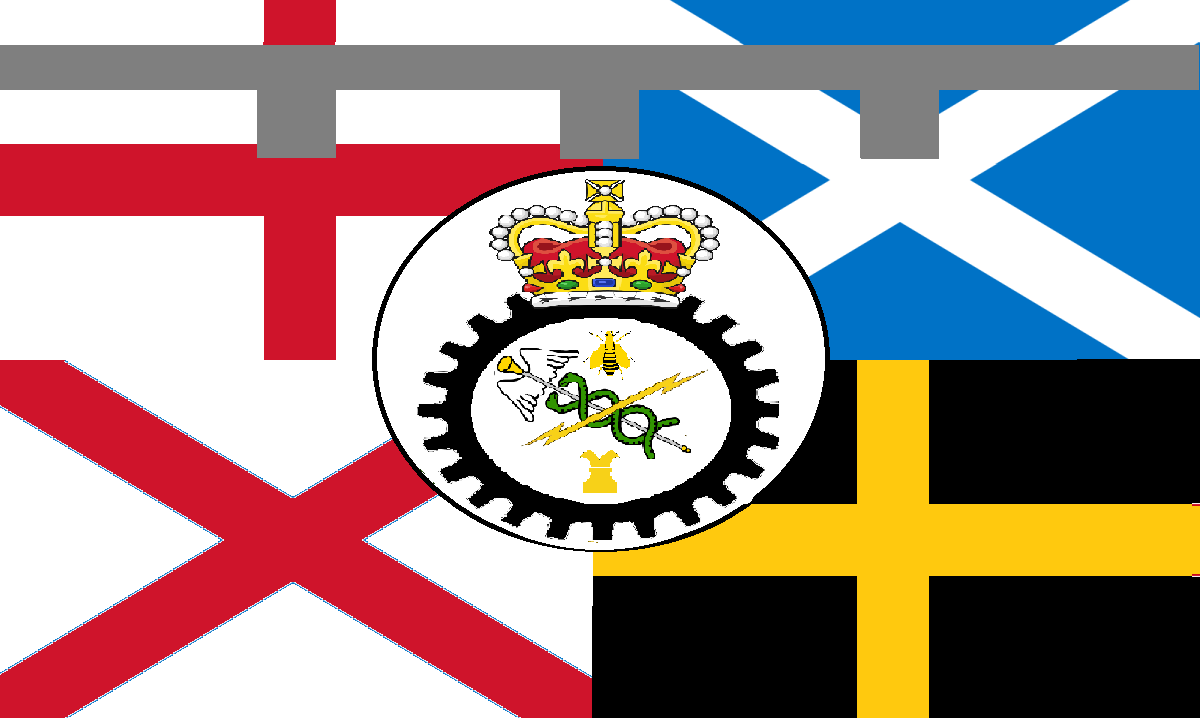
The badge for this department is quite complex but I have managed to make one in which every word in the name is represented. The badge is a crowned gear/cog wheel a reference to industry in which is a caduceus crossed with a lightning bolt representing commerce/business and energy respectfully. Above this is a bee which in heraldry often represents industry and as the department is also about future strategy there is a chess rook/castle.
Flag of the Secretary of State for Business, Energy & Industrial Strategy
There are five junior ministers in this department all of whom except one are Parliamentary Under Secretaries of State

Minister for Business, Energy & Clean Growth
Minister for Business & Industry
Minister for Science, Research & Innovation

Minister for Small Business, Consumers & Labour Markets

Minister for Climate Change and Corporate Responsibility

There are only a few of the ministerial departments covered here, the rest is covered in post 2 which is available here.

Friday, 25 October 2019

New/Old station in Londonderry

The long awaited new railway station in Londonderry has arrived. I say new station however that new station in in the Victorian building which housed the station that was replaced by the station which the new station has replaced. Confused yet? Then I'll briefly explain the history.
The railway history of Londonderry is quite long as you would expect for a city that once boasted four termini plus extensive docks railways, so I am only focusing in on one station.

Seal of the L&CR
featuring the arms of Coleraine
The Londonderry & Coleraine Railway Company (L&CR) opened its first station in Londonderry's waterside area in December 1852, although the line would no be completed until July the following year (until then trains from Derry terminated at Limavady Junction).
 Around this time there were other railway lines being founded in Ulster. The Ballymena, Ballymoney, Coleraine & Portrush Junction (BBC&PJ) Railway being the  L&CR's closest neighbour at the Coleraine end, who in 1859 built a bridge over the River Bann to link to the L&CR station in Coleraine. in 1860 The Belfast & Ballymena Railway merged with the BBC&PJ to form the Belfast & Northern Counties Railway (BNCR). By 1871 the BNCR had bought the L&CR giving trains from Londonderry the ability to run to Belfast and Portrush as well as the places in between which is more or less the system operated today. The BNCR rebuilt the L&CR Londonderry Waterside terminus in 1874 commissioning John Lanyon to build an impressive dressed Sandstone structure and that company's initials are still carved into the clock tower. No known records of the original L&CR station survive
Initials of the Belfast & Northern Counties Railway in the clock tower
The station included a booking hall, waiting rooms and offices with a large indoor platform area with two platforms and a "run around" in the centre. There was also a goods yard, turntable and water crane facilities to top up the tenders and tanks of steam locomotives (in later years diesel storage tanks would also be include). The station also included living accommodation for staff. Plus a duel gauge railway that linked it to the city's other three termini and the docks via the lower deck of the Carlise Bridge over the River Foyle. It was quite an extensive site considering it was at the bottom of a hill sandwiched between the buildings of the waterside and river.
View down platforms showing the extensive space to the right for sideings and
where the link to Craigavon Bridge was. It also gives a good impression of how
the station sat between the raised urban environment on the left of the picture and
the river to the right. This picture is of a steam excursion on 1 September 1979 after
the closure of Londonderry's other stations hence no 'Waterside' suffix on the sign. The
Loco No 186 is a Railway Preservation Society of Ireland engine
Copyright William Adams shared under Creative Commons Licence
The station and the railway it served would change ownership many times. Operating under the titile of Northern Counties Committee under the Midland Railway, London Midland & Scottish Railway and UK Railway Executive, until the Northern Ireland government purchased the NCC in 1948 and running it through the Ulster Transport Authority and from 1967 through Northern Ireland Railways which is currently a subsidiarity of  the government owned Northern Ireland Transport Holding Company which trades under the brand of Translink.
Another Platform view on a miserable June day in 1979 showing better the actual
station canopy. Damage from the 1975 bomb visible on the windows. 80 class DMU
number 94 awaits departure with the 1440 service to Belfast Central
Copyright The Carlisle Kid shared under Creative Commons Licence 
Another photo from 23 June 1979. Looking north down the platform from under
the canopy. This picture gives an excellent view of the canopy and how one side of
it was open. This would later be enclosed.
The DMU in the distance is 94 from the previous picture.
The train to the right is an old UTA Multi Purpose Diesel (MPD) Railcar.
Copyright The Carlisle Kid shared under Creative Commons Licence
The station continued in use as Londonderry Waterside station. It was at a somewhat disadvantage to Derry's other stations as it was on the Waterside (east bank of the river), whereas the other mainline terminus Londonderry Foyle Road was on the City Side (west bank of the river) and was hence more convenient to both the city centre and the docks.  The narrow gauge station of Londonderry Victoria Raod was also on the waterside but even this was right beside the rail wagon exchange of the Craigavon Bridge (which replaced the Carlise Bridge in 1933, and is still in use although the lower deck is now used by road vehicles) However despite this it managed to out live the other termini in Londonderry to become the city's sole railway station. Although after the closures of the other stations the Waterside suffix was dropped from the station's name it continues to be known locally as the Waterside Station, other local names for it have been the Midland Station and the Northern Counties Station in reference to the companies which operated it.
Turn around from the previous picture and we see MPD  units 539 & 61. These
were built bu the UTA in 1959 reusing the bodies of 1933 built coaches. This waste not
want not attitude was an Ulster railway tradition and helped prolonged the lives of many lines
Another view of the canopy and the wall. Sadly the booking hall was destroyed in the 1975 bomb
the shed behind the train serving as the ticket office
Copyright The Carlisle Kid shared under Creative Commons Licence
The station was targeted twice by terrorists during the troubles being bombed in 1972 and again in 1975. While damage suffered from the first bomb was relatively light although it destroyed the tea room, the station was not so lucky after the second bomb. It would eventually prompt its abandonment and closure. It destroyed much of the entrance and centre of the building including the staff accommodation and Ticket Office and Waiting Rooms following this tickets had to be purchased from a shed at the end of the platform. The last resident of the accommodation at waterside station was North West Manager Alec Esdale, living quarters would never again feature in any of Derry's railway stations.
View of the station May 1979 showing the extent of the bomb damage
Copyright Albert Bridge shared under Creative Commons Licence
The make shift ticket office used from 1975 to 1980
Copyright The Carlisle Kid shared under Creative Commons Licence

A new station was opened next to the old in 1980. The old station was fully enclosed and used for storage for some years before being sold by the railway. Since then it mostly lay empty although it did have brief periods of use. I remember it being used as a furniture shop. During this time the platforms were filled in with concrete.
The new station featured an island platform at the end of a square building which included a ticket office and small waiting room. It was very much a station built to reflect the decline of the railway and although there were a couple of sidings the track capacity was very much reduced. The people of Londonderry were never really satisfied with the station. Although it might have been apt for the dwindling passenger numbers when it was built, it was very much a cold looking and functional building, with next to no attractive features, with many saying the platform canopy resembled an upside down egg box. Hardly a befitting way to enter Northern Ireland's Second City!
The 1980s built station
Although unattractive as it was it served the city and the railway as well as it was designed to until traffic on the line once again began to pick up with the dawn of the new millennium. With growing public, political and infrastructure pressure Translink upgraded the line, some sections of track were upgraded with continuous welded rail in 2013, later a passing loop was added at Bellarena the next station from Derry to enable an hourly service in each direction. Before that at Londonderry if you missed the train you would have to wait at least two hours.
view from the platform of the 1980s built station.
The clock tower of the old station can be seen to the right
The net phase was a station refurbishment. Translink gave the public a choice. They could refurbish the 1980s building, repurchase and renovate the old Victorian station or build a new station further up the line by the relatively new foot bridge over the Foyle known as the peace bridge. In fairness from an operational view the latter might have been preferable giving closer and more convenient access to the city centre and the Translink bus depot via the Peace Bridge.
However in the consultation the people of Londonderry (myself included) voted by about 60% to renovate the old waterside station. That renovation began in 2018 and as well as renovating the Victorian building included track and signalling work and building new platforms. There are two platforms which unlike the original station are completely outside one running down the side of the building. They are much longer than the previous station with the intention to cater to longer trains not just NI Railways trains but also steam train excursions and rail tours like the Belmond Grand Hibernian. The track includes a run around which should help facilitate these trains. A tea room has returned to the building as well as a shop. The waiting area is spacious and artistic, with reminders of the city's railway heritage and local points of interest.
A clock that tells the time

the renovated frontage

view of the ticket office on the left with waiting area beyond

where the opening for the track and platforms once was, there
is now a window gazing onto the platforms

One of the installations celebrating the rail heritage
Note the Great Northern did not owned the Foyle Road station
Not mentioned is the company that did, the Northern Counties Committee! 

Looking South. Platform entrance on the right.
This photo offers a view of the canopy and brickwork

The tea room to the left of the south entrance

A 4000 class DMU stabled in the sideing

The old 1980s station is set to be demolished and form part of the road area of the station which is not only to serve as a train station but a regional "Transport Hub" with bus connections too.
While it might not be a restoration it is certainly a new lease of life and one that sees the building serving as a railway station which is the function it was built for