Showing posts with label Scotland. Show all posts

Sunday, 29 November 2020

What is the oldest regiment in the British Army? Part Two

  If you read some of the post of this blog you might have gathered I have an interest in military history. British military history is an interesting series of subjects and while doing a bit of reading a thought came to me. What is the oldest regiment in the British Army? The Army prides itself on its history and every regiment has a proud history, one of the things that makes the British Army interesting is the different identities, traditions, music. and uniforms & insignia of individual regiments. Thus the question which regiment is the oldest? There are actually quite a few claimants to that title, which I will examine here in Part Two, if you haven't already I suggest you read Part One before reading any further here.

Household Cavalry
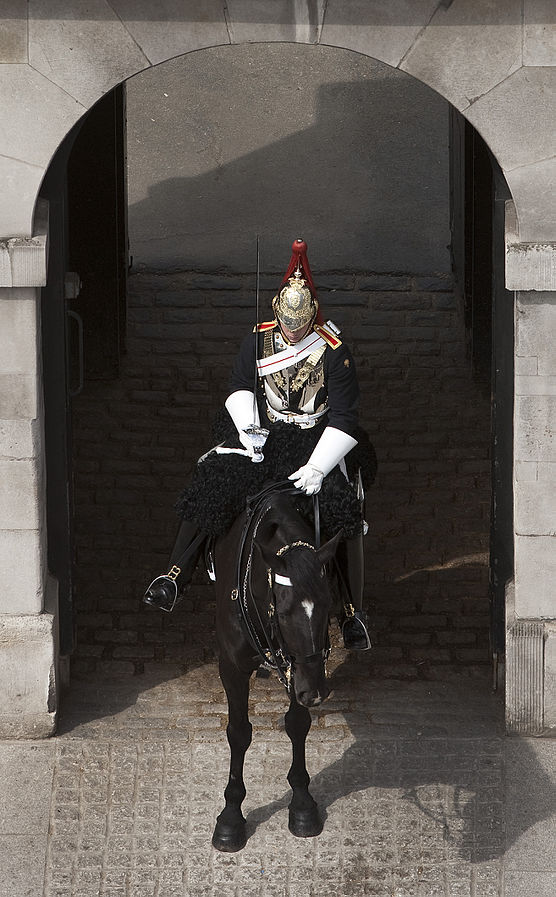
Trooper of the Blues & Royals mounting Queen's Life Guard 
Picture Credit: Harland Quarrington/MOD/OGL v1.0
The Household Cavalry is the most senior regiment in the Army specifically the Life Guards which is one of the two distinct regimental identities that form the Household Cavalry. But does that make it the oldest?
The regiment is about as old as the Coldstream Guards mentioned in part one. Although it does not trace this history through the Life Guards but through its other regimental identity the Blues and Royals.

The Blues & Royals trace their linage back to the Civil War to a regiment of Horse raised by Sir Arthur Haselrig (who we have already mentioned in Part One in relation to the Coldstream Guards)  for the Parliamentarian Army (perhaps one of the little ironies of history the regiment now part of the Household Division that guards the Monarch). Haselrig's regiment became known as the London Lobsters or simply the Lobsters. It was one of the few regiments raised as a cuirassiers and equipped with armour, so it is probably somewhat appropriate that the Household Cavalry today wear armour as part of their mounted full dress uniform. However unlike the modern cuirass which dates from the 19th Century the armour worn by the lobsters reached from the head to the knee. This is possibly where their nickname came from as the wearing of such extensive armour had become uncommon by the Civil War period due to its cost (although helmets and breastplates were still common). However Haselrig raised and equipped the regiment with his own money.
Cuirassier's armour Savoyard Style made 1600-1610
Similar to that worn by the Lobsters. Morges Museum
Rama/Wikimedia Commons/CC-by-sa-2.0-Fr

Following the restoration the regiment was disbanded along with the New Model Army in December 1660. However as a result of the rioting in early 1661 which sparked fears of an uprising the regiment was re-raised. However unlike the Coldstream Guards who took up arms for the King the same day they severed their links with the New Model Army, Haselrig's regiment wasn't re-raised until 26th January 1661, leaving a one month gap in the history of their otherwise continuous service. 

In February 1661 Charles II placed the Earl of Oxford in command and due to their blue coats the regiment was re nicknamed the 'Oxford Blues,' which would eventually be shortened to 'The Blues.'
The regiment was formally named the 'Royal Horse Guards' in 1750 however they continued to wear their blue coats and so continued to be known as 'The Blues.' To this day the Blues and Royals wear a dark blue tunic with their Full Dress Uniform. The regiment would serve with distinction both at home and abroad until it was amalgamated with the Royal Dragoons (1st Dragoons) in 1969 to form the Blues and Royals (Royal Horse Guards & 1st Dragoons). The Blues and Royals would join with the Life Guards in 1992 to form the Household Cavalry. Although as the Household Cavalry is a corps, both regiments would retain their identity and status as regiments in their own right even if they work together operationally. 

Although they missed out on being the oldest continuously oldest regiment by a month, the Household Cavalry is the oldest serving cavalry regiment. 
So far we haven't looked at any regiment outside of the Household Division. But what's the oldest regiment of the line?

Royal Regiment of Scotland

Drum Majors of the Regimental Band (right) and Pipes & Drums of 1 Scots (left)
note the wearing of trews rather than the kilt by the1 Scots drum major
Picture from the band's Facebook

The current Royal Regiment of Scotland was formed in 2006 through the amalgamation of the Scottish line regiments. The Royal Scots Borderers 1st Battalion Royal Regiment of Scotland (1 Scots) was formed through the amalgamation of the Royal Scots and the King's Own Scottish Borderers. The 2nd to 5th battalions each carried the title of their antecedent regiment with reserve 6th and 7th battalions carrying on the name of the 52nd lowland and 51st Highland Volunteers.  
The Royal Scots is the oldest of the Royal Regiment of Scotland's antecedents. It was often said that the Royal Scots was the oldest regiment in the army. By the rank and numbering system of regiments used throughout the 18th and well into the 19th century the Royal Scots was the 1st Regiment of Foot, which certainly makes them the most senior among the infantry of the line. This is doubly impressive when one takes into account that the number of seniority denotes not when they were raised but when they were listed on the English Establishment an anomaly that saw the Scots Guards listed as the 3rd Regiment of Foot Guards despite the fact they were older than the 1st and 2nd Foot Guards. This testifies to the age of the Royal Scots a regiment so ancient that it was nicknamed 'Pontius Pilot's Bodyguard.'  

The Royal Scots trace their origins to 1633 when Sir John Hepburn was granted a warrant by Charles I to recruit a Scottish force of 1200 men to aid the French in the Thirty Years War. Many of its ranks had previously served with Hepburn in a previous regiment he raised for service in Sweden in 1625, but returned home with him when he quarrelled with Gustav II Adolf in 1632. 
Following Hepburn's death in 1636 his brother took command of the regiment before it passed to Lord James Douglas in 1637, becoming known after that as Douglas' Regiment. It stayed in French service until 1660 when it helped secure England for the restored Charles II. It then spent a period varying between English and French service until 1678 when the French Army disbanded the British Brigade following the Treaty of Nijmegen. However although France was obligated to repatriate its British units it did not want to get rid of experienced troops and put so much pressure on members of the regiment (by now known as Regiment de Dumbarton) to stay that those that remained with the regiment returned to Britain in financial difficulty. 
It was temporarily put on the English Establishment in 1679 becoming the 1st Regiment of Foot or the Royal Scots. Four companies of the regiment formed part of the Tangier garrison in 1680 thus gaining the regiments earliest battle honour 'Tangier' and the title 'His Majesty's Royal Regiment of Foot' (Royal Scots).
documentary of the Royal Scots' 350th birthday in 1983
Note the presenter claims its the Army's oldest regiment

The formation of the Royal Regiment of Scotland in 2006 was controversial not only because it was amalgamating what many perceive as the Army's oldest regiment; but because unlike the highland regiments which were each forming an individual battalion, the two lowland regiments were being forced to merge to form a single battalion.  
Salt was rubbed in the wound when it emerged the entire regiment would be kilted. Although today the kilt is widely seen as Scotland's national dress, historically it was only worn in the highlands. With the exception of pipers the Royal Scots had never worn the kilt (tartan wasn't formally adopted until the late Victorian era) and the required adoption of this highland garment by what was now the Royal Scots Borders was seen as the suppression of the battalion's lowland identity. Fortunately though the Dress Regulations of the Royal Regiment of Scotland allowed the battalion pipe bands to wear their historic uniforms. Drummers and Drum Majors of the Royal Scots Borders therefore wear trews (tradtional tartan trousers) rather than the kilt (although only the drum major wears the Hunting Stuart tartan of the Royal Scots, the drummers wear the Leslie Tartan of the KOSB) thus preserving at least some aspect of the lowland identity (interestingly though the same regulations allow for the wearing of trews in cold weather) of the oldest regiment of the line. 
Royal Scots Boarders (1 Scots) entering the grounds of Holyrood House
note that while the guard wear government tartan kilts of the Royal Regiment of Scotland
The drummers & drum major wear trews in their antecedent tartans

Royal Monmouthshire Royal Engineers (Militia)

The Royal Regiment of Scotland might be the oldest regiment of the line but they are not the oldest regiment in the army. The Royal Monmouthshire Royal Engineers is older. It having always been a reserve regiment probably meant it was overlooked in favour of the Royal Scots. 

Among the squadrons of this regiment is the Royal Jersey Field Squadron (Royal Militia Island of Jersey) which claims its origins to 1337! If we accept this claim this would be by far the oldest unit in the army. However the history is patchy to say the least. It does appear that there has been some form of militia on the island of Jersey since 1337, however it has been raised and disbanded many times. 
Members of the Jersey Field Squadron RE in Full Dress
preparing the Royal Standard during 2012 Royal Visit
Photo Credit: Dan Marsh/flicker/CC BY-SA 2.0
The Royal Militia Island of Jersey as an organised military force (rather than a feudal militia) seems to date from 1622 when three standing regiments of militia were raised in the north, south and east of the island. The militia took part in the 1781 Battle of Jersey where they successfully helped the regular army defend their island from a French invasion force. 
To mark the 50th anniversary of this they were designated the Royal Jersey Militia in 1831. A company of the Royal Jersey Militia was detached to the 7th (service) Battalion of the Royal Irish Rifles for the Great War. The rest of the militia stayed in Jersey however many of Jersey men including many of its ranks left the island and volunteered for service with other regiments. It was reconstituted as the Royal Militia of the Island of Jersey in 1921. In WW2 the militia left the island and served as the 11th (Royal Militia Island of Jersey) Battalion Hampshire Regiment throughout the war. 
The Royal Militia was formally disbanded in 1953, however it was reformed as a Territorial Army unit in 1987 as the Jersey Field Squadron (Royal Militia Island of Jersey) Royal Engineers. It came under the command of the Royal Monmouthshire Royal Engineers in 2007.

the garb of a Tudor archer in Monmouthshire Regiment Museum
in Monmouthshire Castle. Credit: Rock Drum/Wikimedia/CC BY-SA 4.0
Even without the Jersey Field Squadron the Royal Monmouth Royal Engineers is one of the oldest regiments in the army. The regiment traces its history to 1539. This was around the time that Henry VIII created the Union between England and Wales and dissolved the monasteries. The union of England and Wales created two new counties which included Monmouthshire and the militia first mustered in 1539. This was just one year before Henry VIII appointed Lord Lieutenants to several counties to raise and maintain county militias loyal to the King. The Monmouthshire militia was initially known as the Posse Comitatus (the Power of the County) and evolved into the Trained bands under Elizabeth I and finally the Monmouthshire Militia Regiment under Charles II.
For most of its existence it was a regiment of infantry. As the Monmouth and Brecon Militia Regiment it gained its first 'Royal' title in 1804 becoming the Royal Monmouth and Brecon Militia. The 'Brecon' part of the title was dropped in 1820. During the reorganisation of the reserve in 1877 it became a militia regiment of the Royal Engineers and designated the 'Royal Monmouthshire Engineers (Militia).' Its current title was granted in 1896 making it a rare example of two 'royal' titles. 


It might arguably have the oldest sub unit in the army but it is not quite the oldest regiment, although it is the only regiment in the Army (both regular and reserve) to retain it's 'militia' title.

Honourable Artillery Company

The oldest regiment in the British Army is another regiment of the Army Reserve. The Honourable Artillery Company's charter was granted in 1537 making it two years older than the Royal Monmouthshire Royal Engineers. However the HAC's origins may stretch back all the way to 1087.
The HAC Company of Pikemen & Musketeers, Lord Mayor's Show 2011
Photo Credit: Randolph/English Wikipedia/CC BY-SA 3.0
In the year of 1087 (reign of William II) a society of armed citizens was formed in the City of London for the protection of the goods of merchants. However to link this to the HAC might be a bit if a stretch. The HAC's official date of inception is 1537 which still makes them the oldest regiment in the army. Henry VIII granted the Overseers of the Guild or Fraternity of St George a charter to raise a perpetual corporation "for military exercise and training for the better defence of the Realm". 
The HAC is not part of the Royal Artillery but a separate regiment. The word 'artillery' in the regiment's name reflects on its age, for it is not a reference to field guns or siege weapons but to projectile weapons in general. The regiment's original name was the "Fraternity or Guild of Artillery of Longbows, Crossbows and Handgoones" (hand guns as in hand held guns like an arquebus). 
The HAC has been described as a regiment since the 17th century. Its' title 'Honourable Artillery Company' was first used in 1685 and the title was formally granted by Queen Victoria in 1860.  

The HAC has played a role in the founding of both the Grenadier Guards and the Royal Marines. Men from the HAC who followed Charles II into exile were among those who served in the guards regiment formed in exile. This regiment would go on to become the Grenadier Guards. Likewise in 1664 the HAC were involved in training of what would become the Duke of York & Albany's Maritime Regiment of Foot. This regiment was raised in the HAC's New Artillery Gardens. During the Second Anglo-Dutch War these soldiers were mobilised to serve on ship and were the forerunners of the Royal Marines.
HAC fireing a gun salute at the Tower of London
marking the centenary of WW1 on 05/08/2014
Credit: Sgt Steve Blake RLC/gov.uk/OGL 2


Currently its principle role is battlefield surveillance and target acquisition, but it also has a light battery paired with 7th Parachute Regiment Royal Horse Artillery. In addition to this the regiment performs many ceremonial roles in and around the City of London. It provides guards of honour for state visitors at the London Guildhall. It also has a specific ceremonial sub unit the 'Company of Pikemen and Musketeers' who parade in 17th Century uniforms using period appropriate drill, commands and with period appropriate arms. They perform all over the world but are seen annually providing the ceremonial bodyguard for the Lord Mayor of London during the Lord Mayor's Show. The HAC's artillery battery also perform gun salutes from the Tower of London on great state and royal occasions. 
As well as its military duties both operational and ceremonial the HAC also provide a detachment of Special Constabulary in support of City of London Police. All this is mainly done by reservists for whom the army is mainly only a part time second job, so I think its fair to say that the Army's oldest regiment lives up to its history in the present. 
Company of Pikemen & Musketeers drill display in France
Note the 17th C drill & words of command
(I particularly like the command for stand at ease at the end)

All the regiments that have been looked at here have long and distinguished histories, but this is only a snap shot at the long and illustrious history of the British Army there are many more historic regiments not included here and everyone I am sure will not only work in a manor worthy of the finest traditions and history of the Army, but will continue to add new and worthy chapters to that history in the future. 

Wednesday, 26 August 2020

Rule Britannia - The Lyrics and the history

Detail of a patriot postcard from 1903

 Yesterday (25/08/2020) I read an interesting column by a certain peer of the Realm in the Sun, (I don't often read the Sun but it was the only newspaper in the Lunch room). While he agreed with my viewpoint over the recent controversy the British Broadcasting Corporation has brought upon itself I was a little bit taken aback aback at what he said was the history behind the lyrics and suggesting that most people who enthusiastically sing the song while waving flags were ignorant of the said history. 

I am not going to say here if patriotic songs like Rule Britannia or Land of Hope and Glory should or should not be sung enthusiastically or even sung at all at the Last Night of the Proms nor am I going to attack the BBC decision. I am however going to look at the history of the song and you the reader can make up your own mind on the subject. 

Who or what is Britannia?

Firstly lets look at the question of what is Britannia. Britannia is the Latin name for the island Great Britain which is also applied to the personification of the United Kingdom which is inspired by the Goddess Athena from Greek and later Roman mythology. Although she has appeared on coins minted by every British monarch since Charles II she became a more widely accepted symbol for Britain during the reign of Queen Victoria, probably in no small part because she is a female personification. She is generally depicted in a white toga wearing a Corinthian style helmet and armed with a trident and a Union Shield. She is often although by no means always depicted seated with a lion. Of there is tones of symbolism in the white being seen a symbol of purity or even peace, the trident symbolic of mastery of the sea etc etc (I will suggest reading the chapter on personifications in my book on Northern Ireland flags and emblems for more details) 

Origins of the Song

The music was written as part of an opera about Alfred the Great by Thomas Arne, David Mallet and James Thompson. It was first performed for the Prince of Wales in 1740. Arne wrote the music for this work. Alfred the Great was the King of the Anglo-Saxon Kingdom of Wessex which was the most powerful of the seven kingdoms of Anglo-Saxon England. He was viewed by antiquarian historians as the father of the English nation (although he himself was never king of England) for defending the islands against Viking conquest. He is sometimes called the father of the Navy as he was the first English King recorded to construct and man ships for war. 

Thompson was a Scottish unionist and believed in embracing a British identity shared by English, Scots, Irish and Welsh people. This is probably his motivation when he wrote 'Rule Britannia' in 1740 for the opera. 

1759 is known as Britain's year of Wonders for it saw British forces triumph over the French and their allies on land and sea all over the world (the Seven Years War is sometimes refereed to as the first ever world war). The land as a result was full of patriotic zeal not least of which resulted from the numerous achievements of the Royal Navy and this is the backdrop to which Rule Britannia a song from an opera which about great victories on land and sea against a foreign enemy became popular. (It is also the year the Royal Navy's quick march 'Heart of Oak' was written and is the "wonderful year" referred to in the first verse of that song)

The Lyrics

Thompson wrote six verses to 'Rule Britannia' although since 1759 usually on three are actually sung (as is the case in the below clip) or in some cases only two. In any case I will examine and explain all of Thompson's lyrics as the three verses that are sung (with the exception of the first verse) usually vary.


Verse One:

When Britain first, at heaven's command,
Arose from out the azure main,
This was the charter of the land,
And Guardian Angels sang this strain:

To understand the first verse we must remember the song is written for an opera about Alfred the Great. Alfred who is being regarded as the father of the nation, defeated the Great Heathen Army of the Vikings and thus preserved Christian civilisation in England and arguably Great Britain as whole. Hence the line "at heaven's Command." Azure is a shade of blue and in heraldry is the tincture for blue, hence the second line is referencing the island nation identity and possibly even the creation of the land itself. 
The Charter is a little bit more difficult to determine as Britain has an unwritten constitution (which is misleading term as the British constitution is long and complex with an awful lot of witting) it could be referring to Magna Carter (which means Great Charter) regarded as the founding document of British Rights and Freedom, it could be the much more recent Bill of Rights from the reign of William III and Mary II or it could be one of the numerous documents of Alfred the Great or even the Bible. 
Then the last line returning back to the theme of Christian civilisation triumphing over the Great Heathen Army sets up the Chorus

The Chorus:

Rule Britannia!
Britannia Rule the Waves!
Britons Never, ever ever will be slaves!

Throughout this song you see the poet in Thompson but particularly in the chorus, for rather than simply evoke Britain ruling the waves he personifies the nation in the figure of Britannia. The lyrics about ruling the waves were originally references to Alfred defeating the Vikings who were of course excellent sailors who'es exploits can be found throughout the Northern hemisphere. Since 1759 however its been used to evoke the victories of the Royal Navy in that year and the years since. 
The line "Britons Never will be slaves" is the particular line the BBC thinks is controversial despite the fact its clearly about fighting slavery rather than practising it. What is this line about, were British people (Britons) ever faced with slavery?
Well during Anglo-Saxon times they were. Viking raiders often took slaves as did many of the people of raided the British coast in the centuries since. Slavery was (and still is) also not enforceable in Britain under British Common Law (there were numerous court cases between the reign of Elizabeth I and George III that proved this most notably the case of Somerset vs Stewart in 1772) although such laws admittable did not extend to the colonies, and Britain benefited from trade with the colonies. 
There is also a line of thinking that this line was inspired from one of Thompson's earlier works. The 'Tragedy of Sophonisba' (1730) is about a Carthaginian (another naval power form antiquity) princess who ultimately commits suicide rather than submit to Roman slavery.

Second Verse:

The nations not so blest as thee
Must, in their turn, to tyrants fall,
While thou shalt flourish great and free:
The dread and envy of them all

Again in the context to the original opera the song was written for the first two lines of this verse references the peoples who fell to the Vikings. The last two lines simply compare the free peoples of Britain who's greatness is both envied and dreaded by other nations. Admittable there might be a bit of chest thumping here but that is hardly unique to British patriotic music. 

Third Verse:

Still more majestic shalt thou rise,
More dreadful from each foreign stroke,
As the loud blast that tears the skies
Serves but to root thy native oak.

The first two lines of this verse is simply saying in a more poetic manner that Britain always comes out of fight stronger. Likewise the last two lines imply that whenever British people or British values are threatened and attacked, rather than scare or submit British people become more defiant and more entrenched in the position they held. This is being visualised with an oak tree representing the British people, which is rooted rather than felled by a blast.  

Fourth Verse:

Thee haughty tyrants ne'er shall tame;
All their attempts to bend thee down
Will but arouse thy generous flame,
But work their woe and thy renown.

The first line of this verse follows the theme of the previous verse simply stating the nation will never be tamed by tyrants. The tyrants in question probably originally intended to be Vikings but since 1759 the word referring to the French and other foreign foes. France at this time of course being an absolute monarchy whereas Britain was a constitutional monarchy with restrictions on royal power. The second and third lines really repeat the theme of the last two lines of the previous verse. This time it compares Britian to a flame which burns brighter when tyrants attempt to bend Britons down. Of course there is great symbolism in flames and light being associated with freedom and enlightenment as well as with passion which Thompson is attempting to convey to the audience. 
Renown mean highly acclaimed or highly honored hence The last line simply states that while others work their woe (a word meaning sorrow or distress) Britain is also at work to the opposite effect.

Fifth Verse:

To thee belongs the rural reign;
Thy cities shall with commerce shine;
All thine shall be the subject main,
And every shore it circles, thine.

As is with many patriotic songs it talks about riches and resources and hence the first two lines speak of resources of the land (rural reign) and the cities shining with commerce. 
The last two lines are open to be misinterpreted as being colonialist as they are talking about territorial possession. However they are in fact talking about British territorial integrity. The 'subject main' being the island of Great Britain and the "shores it circles" being the numerous other islands of the British Isles. 

Sixth Verse:

The Muses, still with freedom found,
Shall to thy happy coasts repair.
Blest isles! with matchless beauty crowned,
And manly hearts to guard the fair.

The "Muses" are minor Gods in Greek mythology and personify the musical, literary and visual arts as well as Science. Hence the first two lines of this verse are stating that Britain is a welcoming place for culture and science. The third verse salutes the natural beauty of the British Isles where as the last verse describes the people of the said isles as fair and guarded by manly hearts. This probably has subtle notes to 18th century notions of femininity and purity as well as manhood and strength.

Concluding Remarks

Of course the song could well evoke different things for different people for a variety of reasons. However I think it is clear from the examination of the history and lyrics of the song that it is neither intended to be about Slavery or Colonialism. While it is a song that evokes naval and military power Thompson was careful to frame that power in a defensive nature. It is true the song was written in an era of colonialism when Britain benefited from the triangle trade but . However that can be said of numerous songs and poetry from history. Shakespeare wrote his plays in a time where English people were persecuted for their faith, yet no one is saying we shouldn't enjoy those plays. The same is true of Rule Britannia, enslavement and subjugation are not what I think is evoked in the song. It could be argued that the lyrics are at worst hypocritical of what Britain was or is, but I think the lyrics are more an expression of what Britain can achieve and what we as Britons should aspire for our country to be.
Those are merely the conclusions I have drawn from this examination of the song, I invite you you to draw your own.

Wednesday, 11 March 2020

Personnel Flags of the Government (Part 2)

Continuing from Part One the next ministerial department is:

Department for International Trade

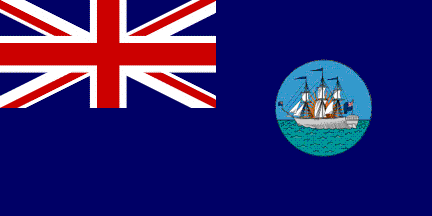
It is within this department that the Board of Trade sits and the Board of Trade has its own maritime ensign.  Although I am not sure if it is currently in use at sea I have noticed from pictures on Twitter that this flag is still used at various other department functions and I have read a news article that stated that the flag is flown from warships if the President of the Board is embarked.
Ensign of the Board of Trade
 The Department for International Trade is one of those departments that has its own insignia and the badge of the Board of Trade seems to be a part of it, I have included it in the banners for continuity.
Flag of the Secretary of State for International Trade & President of the Board of Trade
 There are currently five junior ministers within the department although two of them appear to be in relation to the current Secretary of State's twin role as Minister for Women & Equalities (which doesn't seem to have its own department)
1st Minister of State with no specific title

2nd Minister of State with no specific title
Minister for Investment

Minister for Equalities

Minister for Women

Department for Education

The insignia I thought for the Department of Education is a torch representing enlightenment on an open book which represents learning and manifestation. It is flanked by the national plants of the UK.
Flag of the Secretary of State for Education
There are currently  five junior ministers under the Education Secretary of State, two ministers of state and three parliamentary under secretaries
Minister for Universities

Minister for School Standards
Minister for Children and Families

Minster for Apprenticeships & Skills

Minister for the School System

Department for Work and Pensions 

I admit I found it difficult to think of appropriate symbolism for this but eventually settled on a book with a torch with a snake around it supported by the Royal Supporters. The book is closed which contrasts with an open book as a closed book is traditionally associated with counsel and can hence be representative of careers advice. The department mandate also includes apprenticeships which is a form of training so hence the torch of enlightenment. The Department is also responsible for Health & Safety at Work legislation and this is reflected by the snake which is in effect turning the torch into a Rod of Asclepius
Flag of the Secretary of State for Work and Pensions
there are five junior ministers in this department under the Secretary of State all of whom have a title
Minister for Disabled People, Health and Work

Minister for Employment

Minister for Pensions and Financial Inclusion
Minister for Welfare Delivery

Minister for Work and Pensions

Department for Environment, Food & Rural Affairs

The badge for this department features a flaming Grecian brazier representing the food part of the title. The rural element is represented by a heraldic crown usually only found in the heraldry of Scottish unitary authorities and that is the Wheat Sheaf Crown. The Wheat Sheaf Crown is used by Scottish councils in a similar manner as to how English and other European unitary authorities might use a mural coronet. I initially wanted to use a simple wheat sheaf, but being placed above the brazier thought it might look like it was catching fire! So instead decided to use this Scottish heraldic device instead. The wreath of oak leaves represents the environment. Trees being a prominent symbol of the environment and being used in the logos of  bodies like the environment Agency in general and oak being used specifically by organisations like the National Trust.
Flag of the Secretary of State for the Environment, Food and Rural Affairs
There are currently four junior ministers in this department under the Secretary of State, with one also being a minister in the Foreign & Commonwealth Office
Minister for the Pacific & the Environment

Minister for Rural Affairs & Bio Security
1st Parliamentary Under Secretary with no title

2nd Parliamentary Under Secretary with no title

Ministry of Housing, Communities & Local Government

The badge for this department is a cross design of the floral emblems of the UK entwined. I remember seeing this design on an old coin probably a Victorian shilling. Around this is a chain which along with the floral emblems represents local communities being linked together on a national scale. Unlike the other emblems which are topped with a royal crown this is topped with a mural coronet, which is reflective of a city's wall in ancient times and is generally used by unitary authorities hence representing local government and housing.
Flag of the Secretary of State for Housing, Communities and Local Government
There are only three junior ministers under the Secretary of State for this department.
Minister for Housing

Minister of State with no specific title
Minister for Local Government and Homelessness

Department for Transport

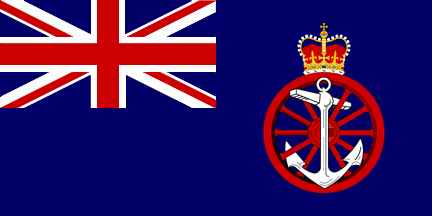
Like the Department for International Trade the Department of Transport had its own maritime ensign which featured a railway wheel and anchor:
Ensign of the Ministry of Transport
I am not sure if this flag is used at all in any capacity, however its badge makes a good base for the department's insignia, although I added a pair of wings so that land, sea and air transport is represented.
Flag of the Secretary of State for Transport
There are currently five junior ministers under the Secretary of State for Transport but strangely none of them seem to have any titles

1st Minister of State with no specific title

2nd Minister of State with no specific title
1st Parliamentary Under Secretary without a title

2nd Parliamentary Under Secretary without a title

3rd Parliamentary Under Secretary without a title

Northern Ireland Office

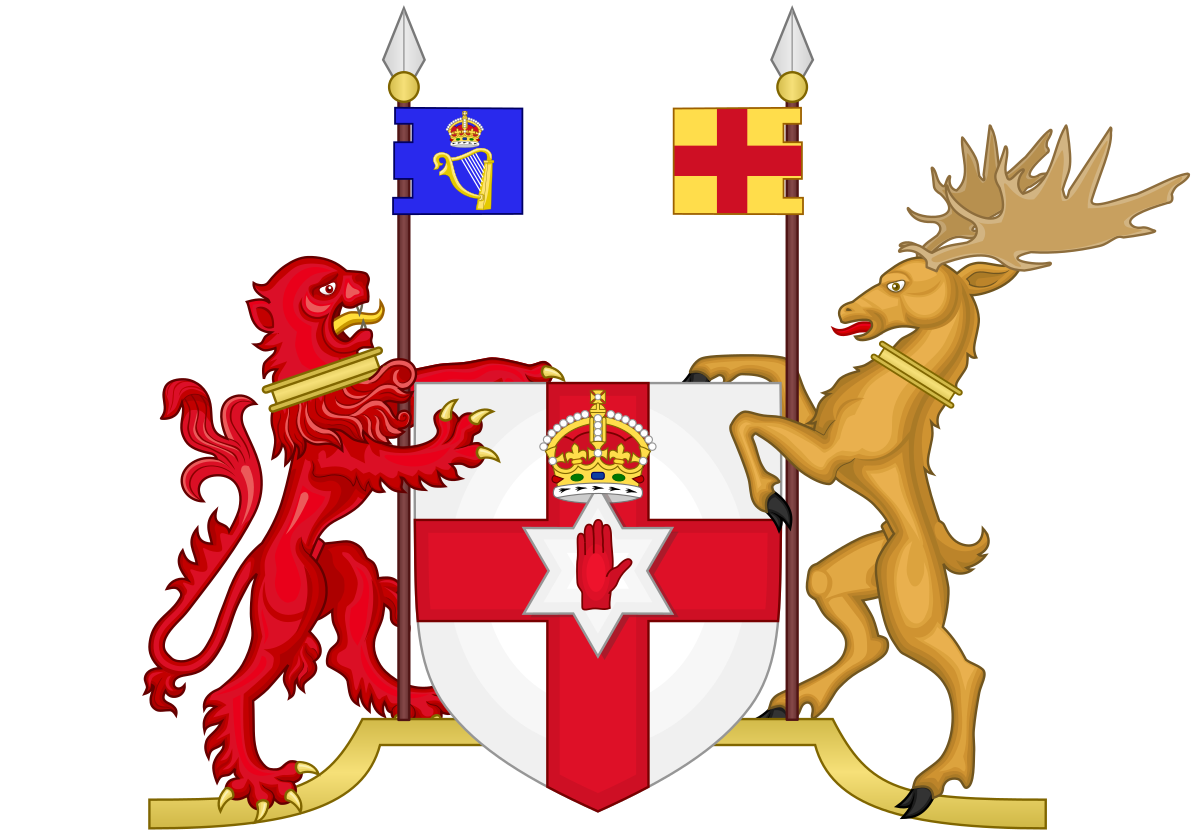
I initially started to sort of design an Irish variant of the Royal Coat of Arms similar to the Scottish replacing the Order of the Garter with the Order of St Patrick and replacing the Scottish Unicorn with an Irish elk like on the Northern Ireland coat of arms. However I stopped short of rearranging the shield and instead added an inner shield of the De Burgh arms like on the Great Seal of Northern Ireland (which I thought was more appropriate as the Secretary of State is also the Keeper of the Great Seal of Northern Ireland).
Flag of the Secretary of State for Northern Ireland
Like most of the regional departments there is only one junior minister in this department.
Minister of State with no specific title

Office of the Secretary of State for Scotland

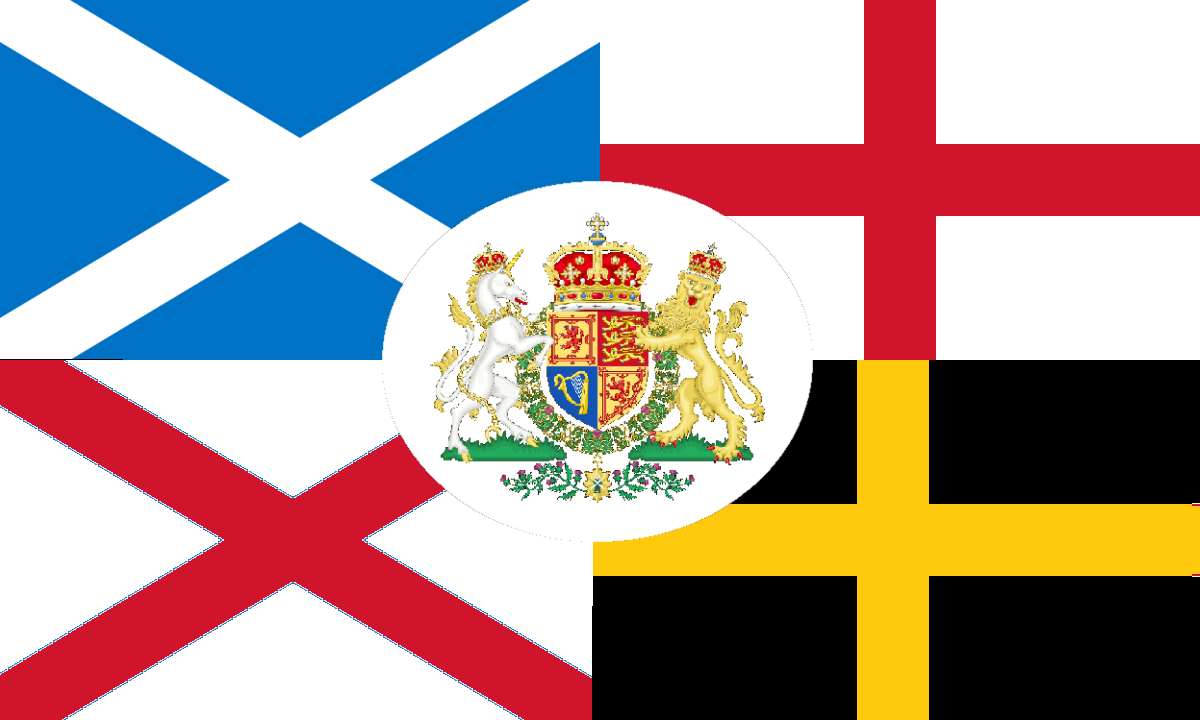
The Scotland Office use a Scottish variant of the Royal Coat of Arms as used by HM Government and I see no reason to change this.
Flag of the Secretary of State for Scotland
There is one Junior Minister in the Scotland Office
Minister for Scotland

Office of the Secretary of State for Wales

The Wales Office had until recently used the original Royal Badge of Wales. I am not sure why they stopped but I decided to bring it back.
Flag of the Secretary of State for Wales
Like the other regional departments there is one junior minister
Parliamentary Under Secretary with no title

Office of the Leader of the House of Lords

One of the two houses of Parliament the Leader of the Lords Office hence uses the Portcullis badge of the Palace of Westminster and the UK Parliament, coloured red which is the colour of the House of Lords. 
Flag of the Leader of the House of Lords
Deputy Leader of the House of Lords

Department for Digital, Culture, Media & Sport

This was a difficult badge to create as it had to have traditional heraldic images for modern concepts like digital technology. Starting with the arts, I decided to focus on music and hence used a lyre harp which is the symbol of musicians. Inside this is a beacon which represents broadcasting, behind this is two crossed lightning bolts representing digital technology. Above the beacon are two crossed quills which can represent both written journalism and visual art. In heraldry sport and sportsmanship is often represented by symbols of hunting and so at the very top is a bugle horn which as well as sport also doubles as another musical symbol.
Flag of the Secretary of State for Digital, Culture, Media & Sport
There are five junior ministers within the department at present all of whom have titles.

Minister of Digital and Culture
Minister for Media and Data
Minister for Digital Infrastructure

Minister for Sport, Tourism and Heritage

Minister for Civil Society and Digital, Culture, Media & Sport

Department for International Development

 It literally appears to be a copy of the Foreign & Commonwealth Office with the same people in the same roles. However since I did not know this when I designed the flags I thought I might as well share them anyway. I reused the symbolism of a globe but in order to distinguish it from the foreign office I used an armillary globe with the torch of enlightenment.
Flag of the Secretary of State for International Development
There are five junior ministers in this department who are also junior ministers in the Foreign Office.


Minister for Middle East and North Africa

Minister for Pacific & the Environment

Minister for Asia

Minister for South Asia and the Commonwealth
Minister for Africa

Minster for European Neighbourhood and the Americas

Minister for the Overseas Territories & Sustainable Development

Office of the Leader of the House of Commons

One of the two houses that make up the UK Parliament the flag of the Leader of the House of Commons is the same as that of the House of Lords but with the portcullis coloured green (the colour of the House of Commons)
Flag of the Leader of the House of Commons

Attorney Generals Office

The badge on the Flag of the Attorney General is the Sword and Scales of Justice with the Royal Arms imposed upon it.
Flag of the Attorney General
This flag is distinguished from the Advocate General by the non Scottish variant of the shield and the Cross of St George in the 1st quarter. Under the Attorney General is the Solicitor General who's flag also features the sword and scales of justice but with the St Edwards Crown imposed upon it.
Flag of the Solicitor General
 Last but by no means least is the Cabinet Office (there is still the office of HM's Advocate General for Scotland and the Office of UK Finance however both those offices have no junior ministers and their Secretaries of State have already been mentioned).

Cabinet Office

The Cabinet Office is the Prime Minister's office. Hence with a few exceptions its junior ministers use the Royal Coat of Arms as used by HM Government unless they have a flag for a relevant title.
The current Minister of the Cabinet Office is also the Chancellor of the Duchy of Lancaster. This is usually a ceremonial role given to a minister without a portfolio or title. The badge is of course the coat of arms of the Duke of Lancaster
Flag of the Chancellor of the Duchy of Lancaster
Another ceremonial title that is often given to a junior minister in the Cabinet Office is Paymaster General. The badge I designed for this is the lion passant from the Royal Crest standing on a key.
Flag of the Paymaster General
All the other junior ministers with the exception of the Minister for Defence People & Veterans (who uses the MOD flag) use the royal coat of arms.

1st Minister of State without a title

2nd Minister of State without a title

3rd Minister of State without a title

Parliamentary Under Secretary without a title
There are in addition three titles relating to the Privy Council that are usually held by members of the Government; Lord High Chancellor,  Lord President of the Council and Lord Privy Seal. At present these are held by Secretaries of State so there is no need for them to use a separate flag. However in case that should change in the future the holders of these offices could use the variant of the Royal Arms used by the Privy Council in a flag, that is the same as the Home Office but with a round shield.
Flag of the Lord High Chancellor
Flag of the Lord President of the Council

Flag of the Lord Privy Seal
That concludes the ministerial flags. I think this system works better than simply defacing Union Flags as by using the labels the same badge is able to be used more than once.