|
| St Patrick's Saltire flying on St Patricks day in Londonderry |
I said in Part 4, that St Georges Cross could arguably be said to be the first Irish national flag, in that it was the first emblem to be used by an authority governing the whole island. Well at the risk of contradicting myself, St Patrick's Saltire also called St Patrick's Cross (or Cross of St Patrick) was the first true national flag of Ireland, in that it was a uniquely Irish symbol, used to represent the Kingdom of Ireland as a unique entity, rather than part of England.
But first what is a saltire? The flag of Scotland is often called the saltire, and indeed it is a saltire. The term St Andrew's Cross and Saltire are often confused, a saltire is an 'X' shape cross, of which St Andrew's Cross is only one example of. (Although many proud Scots would claim their flag as the "original" saltire design). The St Patrick's Saltire is a red saltire on white field.
The earliest written reference, that specifically refers to a cross of St Patrick, is in 1783. However the red saltire or saltire gules has appeared on many Irish flags before then, although not always on a white field. It is unclear how the saltire became associated with the patron saint of Ireland, normally in Roman Catholic tradition only martyred saints are given heraldic crosses and unlike St Andrew of neighbouring Scotland, St Patrick was never killed because of his faith. Although this is just personal speculation, but it is my theory that the flag naturally became associated with St Patrick through its association with Ireland. It is certainly not the case as some have claimed that it was invented by the British establishment and conveniently called St Patrick's Cross so that an Irish banner could be incorporated into the Union Flag.
The earliest reference of a saltire as an Irish symbol is on a coin minted in 1480, This coin depicts two small saltires, one on each side of a shield bearing the Royal Arms of England.
 It may not be a coincidence that the arms of the powerful Earls of Kildare of Anglo-Irish-Norman decent is a red saltire on white field. Gerald Fitzgerald eighth Earl of Kildare was viceroy of Ireland under three kings (Edward IV, Henry VII and Henry VIII). It is very likely that his arms were born as a banner, or used in some way in a flag by his soldiers. Could this be the possibly origins of the 1st flag of Ireland? He was accused in 1467 that his banners and standards had been set up treasonably on Carlow Castle.
Perhaps the oldest picture of a red saltire is from 1576, on a map of Ireland. ("Hirlandia" by John Goghe) although it does not appear over Ireland itself (although it is on the Kildare arms placed on their territory) but on a picture of a ship engaged in battle with a ship flying St George's Cross. This has been interpreted as "an Irish pirate," although it may also be a Spanish ship, and the red saltire is intended to be the Cross of Burgundy flag of Spain. (England and Spain were enemies at this time). This is also thought to be the case regarding the saltires depicted over the allied Spanish and Irish rebel force, on a print of the 1601 battle of Kinsale. The possibility does remain however that these are Irish flags and not Spanish, as the Spanish Cross of Burgundy is barbed:

It should also be noted that the saltire also appears on Irish symbols where there is no Spanish influence whatsoever. A pre 18th Century seal of the Dean and Chapter of St Patrick's Cathedral Armagh features a red saltire. A saltire and a cross flag also feature on an uncoloured seal of Trinity College Dublin from 1612. These two flags have been taking as representing England and Ireland. Although as this is during the reign of James I, who was also James VI of Scotland, perhaps this saltire could be a St Andrew's Cross? After all James I did use the crosses of St George and Andrew combined (the first Union Jack). However 20th century heralds thought this unlikely and when Trinity college was regranted its coat of arms 1901, which it still uses today the saltre was the red cross of St Patrick:
 |
| recreation of the seal of Trinity College |
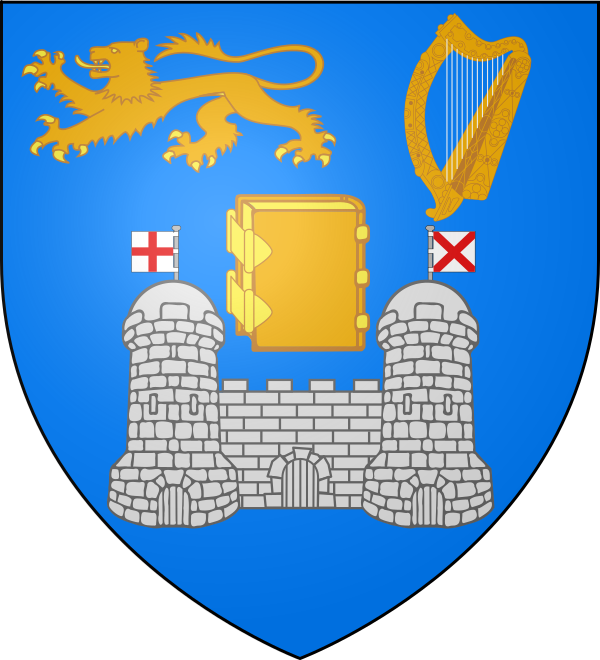 |
| Modern coat of arms used by Trinity College |
 The red saltire of Ireland has not always appeared on a white field either. There are a number of references, to a red saltire on a gold field. As mentioned in part 5 of this series the Catholic Confederates of the Confederation of Kilkenny are reported as marching under a saltire, and descriptions of their colours and unit flags describe each bearing a red saltire on a taffy (yellow) field in the flags canton. The great standard of Ireland that was born alongside those of Scotland and England at the funeral of Oliver Cromwell, is also said to have been a red saltire on a yellow or gold field. The flag of an Irish Brigade raised by the Earl of Antrim in the War of the Three Kingdoms was gold with a red saltire and crucifix in the canton. The flag of the King's own Regiment of the Kingdom of Ireland was also 'taffy' with a red saltire. The origins of all these flags however remain a mystery. The flag of Berwicks regiment in the Irish Brigade of the French Army had a red saltire on a green field going under a red St George's Cross:
It is not until the late 18th Century that we get specific references to St Patrick's Cross as the flag of Ireland. The first written reference which specifically calls the red saltire St Patrick's Cross is in a letter from Lord Temple the Lord Lieutenant of Ireland, forwarded to his superiors in London in January 1783 about the emblem of the new Illustrious Order of St Patrick:
While the order still technically exists although the last knight of St Patrick died in 1974 and none have been created since. The saltire was incorporated into the order's insignia and regalia and the Irish Crown Jewels (which mysteriously vanished in 1907)."And the said Badge shall be of Gold surrounded with a Wreath of Shamrock or Trefoil, within which shall be a Circle of Gold, containing the Motto of our said Order in Letters of Gold Viz. QUIS SEPARABIT? together with the date 1783, being the year in which our said Order was founded, and encircling the Cross of St Patrick Gules..."
 |
| regalia of the Order of St Patrick |
 Various flag charts and atlases show the red saltire on white as the flag of Ireland. These include; The Encyclopédie, ou Dictionnaire raisonné des sciences, des arts et des métiers (1769 edition), and Neptune Francois published in Amsterdam as early as 1693. This depicts a saltire on a white field, which in some hand coloured copies is red. Above and below are the French and Dutch words for Irish: Ieres and Irlandois. This particular version was copied by other flag book writers who mistranslated Ierse as Jersey, one possible explanation as to why the Jersey flag also features a red saltire, which like St Patrick's cross has unknown origins. Further evidence to this flag being used by the Irish at sea comes from a 1785 newspaper report from Waterford states about ships leaving for the colonies that:"Upwards of forty vessels are now in our harbour, victualling for Newfoundland, of which number thirteen are of our own nation, who wear the St Patrick's flag (the field of which is white, with a St Patrick's cross, and an harp in one quarter.)"
 |
| Encyclopédie, ou Dictionnaire raisonné des sciences, des arts et des métiers with St Patrick's Cross on the bottom left |
"the time was coming when another change was to be made in the Union Jack, and it was in 1801, under George III., that the red saltire cross of Ireland first joined the two sister crosses. For the immediately previous two hundred years the Irishman had gallantly contributed his prowess to the glories won under the two-crossed Jack, in which his nation had not been represented; but from this time onward his own Irish cross entered into its proper place in the national Union Jack, and received its acknowledged position as the emblem of the Irish kingdom."
After the Irish Free State gained its independence in 1921, it was discussed that the St Patrick's Saltire be dropped from the Union Jack.

"the removal of the cross of St. Patrick Cross after 120 years will transform the appearance of the flag...Other possible changes include the abolition of the title of the United Kingdom, and the removal of the harp from the Royal Standard and the Coat of Arms, and the substitution of the Ulster emblem"
This obviously was not the case and it remains in the British flag as the representation for Northern Ireland. In this regard, Sir James Craig, the Prime Minister of Northern Ireland remarked in December 1921 that he and his government were "glad to think that our decision (to remain part of the United Kingdom) will obviate the necessity of mutilating the Union Jack."
Although as late as 1961 a proposal was raised in the Dail (lower house of the Irish parliament) about asking the British Government to remove St Patrick's saltire from the UK flag. Frank Aiken TD the then minister for External Affairs declined to "waste time on heraldic disputes."
The St Patrick's Saltire remains in the Union Jack to this day as Northern Ireland's representation, despite it technically being an all island symbol.
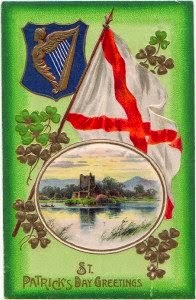
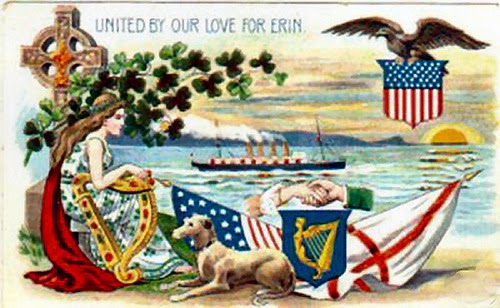
During the 19th and early 20th Centuries there are some suggestions that St Patricks Cross was used as a sub national flag of Ireland, although it appears the green harp flag was the most popualar flag of this period. An Irish American greetings card from this period depicts St Patrick's Saltire and Irish coat of arms with the caption St Patrick's Day Greetings. Another depicts it crossed with the American stars and stripes:
 |
| Irish Blueshirts with a red saltire flag |
 |
| Blueshirt flag |

In 1946 W F McCoy a former Northern Ireland Cabinet Minister advocated an independent Northern Ireland (from both the UK and Eire), or as he called it a Third Way. The flag often proposed for this "Ulster Nation" is a St Patrick's Saltire placed over St Andrews saltire, with a gold six pointed star and red hand of Ulster in the middle:

In 1970 the Commissioners of Irish Lights a joint all-island body responsibly for lighthouses and buoys, changed their house flag in 1970 from a St George Cross based design to a St Patrick's Saltire based design:

During the 2013 Northern Ireland All-Party talks, chaired by US envoy Richard Hass, It was suggested that an official regional NI flag be officially adopted.This was largely rejected by both Unionist and Republican parties, although the Unionist Minister of Enterprise Mrs Arlene Foster MLA did express mooted support for a readoption of St Patrick's Cross. Although no action was taking and the flag situation in Northern Ireland remains the same. Although there have been various suggestions for a Northern Ireland flag, from various sources that include a red saltire of St Patrick, this is one by my flags forum friend Leonardo Piccioni from Brazil:

Today St Patricks Cross is used unofficially by some NI national sport teams as well as some all island sports bodies, such as bowls. It is occasionally used to represent Northern Ireland as it is seen to be less controversial than other flags, for example this sign outside a pub in Romania just before the NI international football match there:

As such it is sometimes mistaken as only representing NI, which is not the case. It is also used in the St Patricks Day celebrations in Downpatrick, the supposed burial site of the saint:
As such it is sometimes mistaken as only representing NI, which is not the case. It is also used in the St Patricks Day celebrations in Downpatrick, the supposed burial site of the saint:

It is also used in the banner of the Grand Orange Lodge of Ireland (both north & south) as well as the arms of the Northern Ireland Law Society. It has been used by the Reform Movement a Republic of Ireland pressure group seeking closer ties with the UK. The badge of the Northern Ireland Police, and the coat of arms and banner if Queens University Belfast and the Royal College of Surgeons Ireland. It is can also be seen flying outside The Roman Catholic St Patrick's Cathedral in Armagh alongside the province flags, church flags and Vatican flag, truly its a shared symbol:
 |
| Irish Grand Orange Lodge Bannerette |
 |
| NI Police flag |
 |
| Heraldic Banner of Queens University Belfast |
 |
| Arms of the College of Surgeons |
 |
| St Patrick's Saltire Armagh Cathedral |
For more in this series see the links below or click the label History of Irish flags: