Saturday, 28 September 2013

Ministry of Defence (United Kingdom)

This is a post I have been meaning to do for quite a while. The Ministry of Defence (MoD) is the government department which is responsible for the armed forces. Its badge is below:
The anchor represents the Naval Service, the crossed swords represent the British Army, and the Hawk (not an eagle) represents the Royal Air Force. All these are toped by the crown of state. The MoD uses a tri-service flag :
 
File:Flag of the Ministry of Defence.png
 
This flag is a tricolour with each colour representing one of the armed services. Dark blue the Navy, Red the Army, and sky blue the Air Force. In the middle is the MoD badge with the individual components in the colour of its respective service. On a personal level I think this is rather ugly. These colours don't work well together without fimbriation and I don't think the badge is recognizable on a flag that is flying.
 
My solution is a new badge and flag. The new badge is below:
 
It is similar to the old one however the individual component. I replaced the hawk of the RAF with a pair of wings similar to the badge of a military pilot. The Navy's anchor goes through the wings and the Army's swords are behind. The Mod has no motto but I added one, which translates as "The military is only as strong as the institutions supporting it." Which is a quote from the author Michael DeLong. Unlike the MoD I won't use the entire badge on a flag. My tri-service flag is below:
 
Firstly the only the tri-service emblems and colours are on the flag leaving out the unnecessary clutter of the full badge. I changed the colours to red, white and blue. Unlike the current flag the colours are not arranged in seniority of service, but in what is more aesthetically pleasing from a vexilogical point of view. by putting the white in the centre it separates the red and blue, which the current flag doesn't.
 
The Red represents the army, I had thought of changing this to green to represent the Khaki colour of the Army's general service (No2) Dress, and because one of the nicknames of the army is "the green."
 
However the traditional colour is red, and the army is still known as the "thin red line" and the full dress uniform of most regiments is still red, although some units wear green or black.
 
The use of red also means the flag is in the national colours of the UK. White represents the Navy, although Naval uniform is only white in warm climates, the colour white in the navy can't be ignored. The Naval ensign is after all the white ensign.
The Blue of course represents the Royal Air Force.
The flag of the Secretary of State for Defence is the government minister who is in charge of the MoD. the flag I designed for him is below:
If features a Union Flag at the hoist, with the tri-service colours in the fly. The badge in the centre is the Westminster Gate, the symbol of the houses of parliament, of which the Secretary of State is naturally a member. The colour represents the house of parliament he is a member of in this case the House of Commons.
Below the Secretary of State for Defence is the Chief of the Defence Staff. This is the highest military position in the Armed Forces. The current CoDS flag was my inspiration for the personal flags here:
 
This flag fallows the same pattern as Secretary of State, but with the emblems of the armed forces and crown, the Chief of Staff is assisted by the Vice-Chief of the Defence Staff:
It is the same as Chief of the Defence Staff but minus the crown. There are also Deputy chiefs who are responsible for individual areas such as training, equipment, operations etc. The Flag for a Deputy Chief is below:


The heads of the army, navy and air force would use the rank flag of their respected service.
I hope you enjoyed this please feel free to comment.


Thursday, 26 September 2013

Giant's Causeway Railway

Some people might remember my Railway Heraldry post. It covered coats of arms for the main rail companies in Ireland and their jointly run express service. Well their are smaller, private railroads in the British Isles too. These are often industrial, or as in this case tourist and enthusiast orientated.

The Giant's Causeway currently has a rail link with the town of Bushmills. These too places were first linked by rail in 1887. It was an electric 3 ft (914 mm) gauge narrow gauge railway, operated by Giant's Causeway, Portrush and Bush Valley Railway & Tramway Company Ltd. Originally this rail system known as a tram, or tramway connected the seaside town of Portrush with the tourist attraction of the Giants Causeway with a station in the middle at Bushmills. This tram was mostly run by hydro electricity probably one of the first examples of hydro electric power in the world. I also believe it was only the second electric train in the UK (it was beaten by a couple of days by a train in the south of England). Sadly this company closed at the end of 1949. 
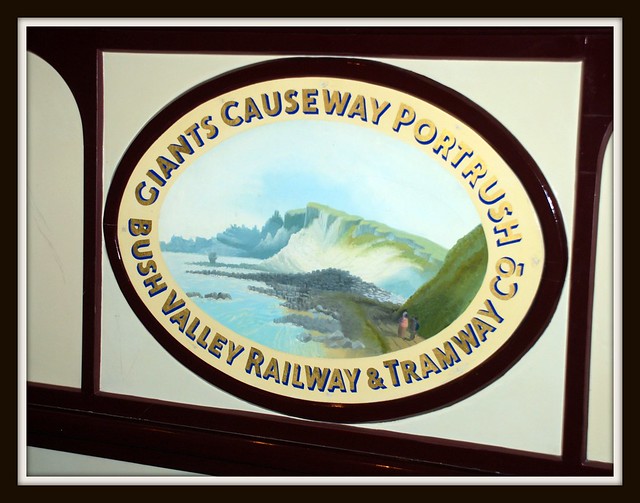
The original emblem used by the tramway  was this:
Unlike other historic railways in Ireland it doesn't have a coat of arms or coat of arms based design. It shows a couple walking along the path to the causeway, clearly hoping to attract passengers to take the same journey as the people in the picture. 
In 2002 a new company was set up and the rail track was rebuilt between the Causeway and Bushmills. This was built by enthusiasts (with a little help from an army helicopter when it came to rebuilding a bridge!) This company adopted the old badge but adjusting the text so it only reads Giants Causeway and Bushmills Railway Company. However I have been working on a new design:
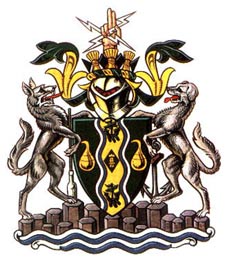
There are a number of things. Perhaps the most striking are the supporters. These depict the Irish and Scottish giants from the legend of the Giants Causeway. Although every wee Northern Irish boy was told it as a bedtime story for those who are not too familiar with it see here.They are standing on the base that has some Causeway stones. 
The shield is based on the County Antrim arms and the Moyle District council coat of arms.
Moyle Coat of Arms
The chief of the arms and lion rampant coming from the Antrim arms, while the shipstylised stills, and wolf crest coming from the Moyle District coat of arms. The Stylised Stills represent Bushmills which is famous for being the home of Old Bushmills Distillery which claims to be the oldest licenced Whisky distillery in the world and as well as being a working distillery producing Bushmills Irish Whisky, is also a tourist attraction. The ship represent the clan MacDonald which was an important family in ancient times who built the nearby Dunluce Castle. Although I have also put the eagle form their arms on mine. The lightning bolt on blue represent the historic implication of hydro electricity (even though today the trains are powered by steam and diesel its still something the railway can be proud of). 

The motto means beauty and heritage which is what most people who ride the train are going to see.

   
Feel Free to Comment for more info on anything in the above text here are some useful links


Tuesday, 13 August 2013

Mars Colony

I was reading an article about a program aimed at establishing a human colony on Mars by 2023. In fact they have even begun the process of recruiting potential colonists, (or one-way astronauts as they call them)! The project known as Mars One does seem to be well planned out:

 I admit I enjoy a little bit of science fiction from time to time, and would love to travel to Mars, but I am not too sure about living there permanently! You would need to either be very brave or crazy or both. But perhaps my contribution to Earth's first space colony can be a flag one.

My first design features a red flag (as Mars is the Red Planet this seemed appropriate). Towards the  hoist is a pair of hands which symbolise humanity. The hands are open, and holding the astrological symbol for mars (which is coincidentally the male symbol, which I think represents the shield and spear of the Roman God which the planet gets its name from). Inside this is the Astrological symbol for Earth the home planet of the colonists.
I did the detail in white so it stands out better on the red background. I also thought it might need a little more colour so I added some blue and green stripes (inspired from my Earth Flag design). Also symbolising the home planet.
Or alternatively the stripes can be horizontally:

Let me know what you think of these designs. If you are brave (or mad) enough to sign up as a one-way astronaut or are just curious their website is here.

Friday, 12 July 2013

Scottish Armed Forces Flags

What the armed forces would be like in an independent Scotland is one of the main points of debate in the upcoming referendum, and is something that keeps popping up on the news, despite their being very few details available. If you are not too failure with the debate you can watch a quick and simple news clip here.
Now this is not a post for or against independence, personally I wouldn't be too keen on the idea, but its up to  the Scots to decide. This is just some suggestions from a vexillological  point of view on what the flags of a Scottish Defence Force might look like.

Naval Service

First is the senior Service the Navy. The navy would mostly be responsible for protecting Scottish Fish stocks and oil rigs in the North sea so would mostly be patrol vessels with a small number of Frigates and Destroyers. The Naval ensign is like other commonwealth navies is white, and as the Scottish Nationalists are keeping the monarchy (for now anyway) it would be a Royal Navy and is defaced with the Royal Arms of Scotland.
The Navy Jack would be the national flag. The Naval Colour is an inverted St Andrews Cross with the Scottish Crown, cypher and an anchor:
The marines colour is based on the Army infantry colours which you will see in a moment. the badge of a globe and anchor is based on the USMC badge, globes and anchors common on Marines badges throughout the world. A trident is also featured, The Scottish Marines colours could carry some of the battle honours of the Royal Marines, and would be part of the Navy rather than a separate corps, it would probably consist of just one battalion: 

Air Force

Next is the Air Force. There is currently two RAF military airfields in Scotland, with one RAF control centre which controls air traffic for the whole region. There is also two search and rescue helicopter stations in Scotland (one RAF and the other Royal Navy). Presumably this would make up the Scottish Air Force. The Air Force ensign is based on other commonwealth nations:

I decided to use a dark blue for St Andrew's Cross as it stands out more against the light blue field. The roundel is based on the RAF roundel but with a thistle design. This fallows the example of Canada and Australia.


The Colour of the air Forces is based on the ensign however it has the Scottish Royal Cypher on it and an air force.
Squadron Standards were an after thought so I didn't design one for each potential squadron, but I did design a standard type of design:

Land Forces

I am no strategic expert but I have calculated colours for the units I think the Land Forces (Army) would need. But First the Army Flag, based very much on the non ceremonial British Army Flag, It incorporated crossed sword with the Crest of the National coat of arms on it. Unlike the British Army Flag it is on a saltier:
As Well as being the general flag of the Army it will also be the 'camp flag' of the Headquarters Corps, This is based on the British Adjutant General Corps which is responsible for pay, administration and all the office stuff needed for the day to day running of the army, among other things. The colours of this unit are below:
The Headquarters Corps colour fallows a standard pattern for the 'Corps' units, It consists of two colours which could also be used as an arm patch. It has the National flag in the canton. It features the crest in the army flag but with the motto "In Defens" (Defence) on it. The Queens/Kings colour also fallows a standard design of the National flag defaced with the Royal Arms and cypher, also of note is the top of the poles. On the Queen's Colour the top is a crown but on the regimental there is a thistle decoration. 

Next is the Military Police. The Camp Flag feature the horizontal colours of Crimson and Gold with a crowned  thistle badge.

The colours are similar:
The Military Police badge features the Scottish Police badge but emblazoned on two crossed swords to symbolise the military.

The Engineers and Mechanics Corps features two crossed axes on a lightning bolt that has a thisle emblazoned on it. 
The camp flag is a simplified version of the Regimental colour:

The Transport Corps Colours feature a lion rampant holding a wagon wheel:

The camp flag is again a simplified version of the colours:


The medical Corps colours features staff of Mosses medical badge.
The camp flag feature a red cross as this is more universally recognised and easier to identify in a theatre of operations.


Next is the backbone of any army, the infantry. The Nationalist party says it will retain the names of famous Scottish regiments, I think their will be one infantry Corps but each battalion would have a carry a name of the a past regiment. I think given budget constraints five battalions both regulars and reservists is enough, The camp flag for the infantry will be satire based with crossed swords and the battalion number for example: 
The ceremonial colours the infantry battalions will feature a saltire as the battalion colour and a Royal Banner as the Queens/Kings Colour, the battalion number will be in the canton in Roman numerals, The Queen's Colour will feature the Royal Cypher. Both Colours will bear selected battle hounors of their names sake's predecessors:
As their are six historic regiments and only five battalions I did what the British Army did and merged the Royal Scots with the Kings Own Scottish Boarders. The badges of each is in the fly. With a central cypher, thistle and Saint Andrew design in the middle.
The Second Battalion bears the name of the Highland Fusiliers:
The Historic badge of the Fusiliers is in the centre of the battalion colour.

The third battalion bears the name and badge of the Black Watch:
The fourth Battalion bears the name and badge of the Seafourth, Gordons & Camerons Higlanders also known simply as the Highlanders:
The Fifth Battalion bears the name and badge of the Argyll and Sutherland highlanders:
There is also a Scottish regiment of Royal Foot Guards (the Scots Guards) which are famous for guarding Buckingham palace as well as being operational soldiers. If this becomes part of the Scottish Defence Force I think it might keep its ceremonial duties and identity as a guards regiment. Its camp flag bears the guards colours of Blue, Red, Blue. And features the Scottish Crown. It is based on the flag of the UK Household Division (which the Scots Guards are currently part of):
The colours state it is the Royal Guards Regiment and bear the Scots Guards badge. (it also has a grenadier badge as all older the guards regiments were founded as grenadier regiments) It also says 3rd Foot Guards to demonstrate it was the third most senior Guards regiment in the army. The Queens Colour like the other infantry regiments is a Royal banner:

The Flags of the Artillery copy that of the infantry but bear cannons instead of swords:

Their are currently two Scottish Artillery regiments one is regular and one is reservist. I think this would more or less remain the same:
In the second Regiment Colour  I stated that they were reservists, this is the only colour that says the unit is resevists however I think most of the Scottish Armed forces would be made up of reservists.
Like the infantry the Regimental colour is the national flag and the Queen's Colour a Royal banner however their are some slight differences including no battle honours and only to Cyphers where there were four in the infantry colours.

Last but not least is the Armoured Regiments. There are currently two Scottish Armoured units. The Royal Scots Dragoon Guards and the 2nd battalion of the Royal Tank Regiment. These fallow the Calvary traditions so rather than a Regimental and Queens Colour they have a guidon and sovereign standard.
First is the 2nd battalion Royal Tank Regiment which would probably not keep its name as it could cause confusion with the British Regiment of which has one Scottish battalion. So it has become the Armoured Corps: It has a new badge (an armoured Fist) but keeps its old camp flag colours:
The guidon features a saltire defaced with the badge, and a selection of battle honours, the Sovereign standard features the Royal Arms inside the Royal Cyphers. I am not to familiar with cavalry traditions but I don't think these two flags be used together like infantry colours do.

Last but not least is the Royal Scots Dragoon Guards. Their camp flag is based on the unique design they wear in their caps. I think the best way is to show  you a picture, so here's a picture of some members of the regiment watching the regimental band, amongst other things you can see the distinctive breading in their caps:
And here is the camp flag design:
The colours feature the current badge which features the imperial French eagle the regiments predecessors (the Scots Greys) captured at the battle of Waterloo.
please feel free to comment, 


again I remind you this is not about the referendum or politics but vexillology.  
All these designs are by myself

Friday, 17 May 2013

Patrol vessel wearing Royal Standard


Last weekend saw events in Londonderry to mark the 70th Anniversary of the Battle of the Atlantic. Being the most western port in the UK, Derry was strategically very important. The Naval base, HMS Seaeagle was home to ships and personnel of at least seven nations. as well as the Royal Navy and Air Force, the Royal Canadian Navy and United States Navy and Marine Corps had bases in and around the city. The events saw two warships visit the city, the minesweeper HMS Bangor (named after an N.Ireland coastal town) and patrol vessel HMS Pursuer. A new statue of the 'international sailor' unveiled on the Seaeagle site and dedicated to 'all those of all nations who lost their lives.' This event happened on the Saturday by the Commodore and Chief of the Maritime Reserve Forces HRH Prince Michel of Kent. On Sunday a special service was held in St Columb’s Cathedral (which among the colours laid up in the building is a Canadian/British white ensign, RAF ensign and US ensign,) attended by veterans, cadets and representatives of the Merchant Navy and Navies of the UK, USA, Canada, Australia and Norway. After this wreaths were laid at the city war memorial and Prince Michel dropping a wreath in the River Foyle from the patrol vessel Pursuer. During this I got a picture of the vessel on the Foyle flying the Royal Standard used by members of the Royal Family:

HMS Pursuer carrying Prince Michel and wearing Royal Standard
 
Its a rare site to see a patrol boat wearing a Royal standard so I though I would share it. The Royal Standard used in this case is the version with an ermine boarder. This version is used by members of the Royal Family who have not been granted their own arms:
File:Royal Standard of members of the British Royal Family.svg
 
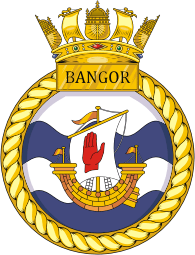
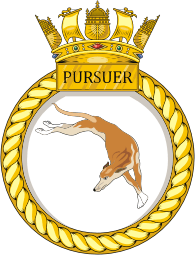
While I am talking about the events of last weekend I might as well show you the badges of the two Royal Navy ships in the city for the events. The ships badge of HMS Bangor and HMS Pursuer: 


hope you enjoyed this as it is quite rare to see warships fly Royal Standards, especially as Prince Michel is a Rear Admiral, and could have used the RN rank flag, which is normally used in cases like this:
Rear-Admiral Flag
Rear Admiral rank flag, rank flags are more commonly used on board ships rather than Royal Standards


All comments welcome


none of the flags are my designs the picture of HMS Pursuer is by me.