Tuesday, 13 August 2013

Mars Colony

I was reading an article about a program aimed at establishing a human colony on Mars by 2023. In fact they have even begun the process of recruiting potential colonists, (or one-way astronauts as they call them)! The project known as Mars One does seem to be well planned out:

 I admit I enjoy a little bit of science fiction from time to time, and would love to travel to Mars, but I am not too sure about living there permanently! You would need to either be very brave or crazy or both. But perhaps my contribution to Earth's first space colony can be a flag one.

My first design features a red flag (as Mars is the Red Planet this seemed appropriate). Towards the  hoist is a pair of hands which symbolise humanity. The hands are open, and holding the astrological symbol for mars (which is coincidentally the male symbol, which I think represents the shield and spear of the Roman God which the planet gets its name from). Inside this is the Astrological symbol for Earth the home planet of the colonists.
I did the detail in white so it stands out better on the red background. I also thought it might need a little more colour so I added some blue and green stripes (inspired from my Earth Flag design). Also symbolising the home planet.
Or alternatively the stripes can be horizontally:

Let me know what you think of these designs. If you are brave (or mad) enough to sign up as a one-way astronaut or are just curious their website is here.

Friday, 12 July 2013

Scottish Armed Forces Flags

What the armed forces would be like in an independent Scotland is one of the main points of debate in the upcoming referendum, and is something that keeps popping up on the news, despite their being very few details available. If you are not too failure with the debate you can watch a quick and simple news clip here.
Now this is not a post for or against independence, personally I wouldn't be too keen on the idea, but its up to  the Scots to decide. This is just some suggestions from a vexillological  point of view on what the flags of a Scottish Defence Force might look like.

Naval Service

First is the senior Service the Navy. The navy would mostly be responsible for protecting Scottish Fish stocks and oil rigs in the North sea so would mostly be patrol vessels with a small number of Frigates and Destroyers. The Naval ensign is like other commonwealth navies is white, and as the Scottish Nationalists are keeping the monarchy (for now anyway) it would be a Royal Navy and is defaced with the Royal Arms of Scotland.
The Navy Jack would be the national flag. The Naval Colour is an inverted St Andrews Cross with the Scottish Crown, cypher and an anchor:
The marines colour is based on the Army infantry colours which you will see in a moment. the badge of a globe and anchor is based on the USMC badge, globes and anchors common on Marines badges throughout the world. A trident is also featured, The Scottish Marines colours could carry some of the battle honours of the Royal Marines, and would be part of the Navy rather than a separate corps, it would probably consist of just one battalion: 

Air Force

Next is the Air Force. There is currently two RAF military airfields in Scotland, with one RAF control centre which controls air traffic for the whole region. There is also two search and rescue helicopter stations in Scotland (one RAF and the other Royal Navy). Presumably this would make up the Scottish Air Force. The Air Force ensign is based on other commonwealth nations:

I decided to use a dark blue for St Andrew's Cross as it stands out more against the light blue field. The roundel is based on the RAF roundel but with a thistle design. This fallows the example of Canada and Australia.


The Colour of the air Forces is based on the ensign however it has the Scottish Royal Cypher on it and an air force.
Squadron Standards were an after thought so I didn't design one for each potential squadron, but I did design a standard type of design:

Land Forces

I am no strategic expert but I have calculated colours for the units I think the Land Forces (Army) would need. But First the Army Flag, based very much on the non ceremonial British Army Flag, It incorporated crossed sword with the Crest of the National coat of arms on it. Unlike the British Army Flag it is on a saltier:
As Well as being the general flag of the Army it will also be the 'camp flag' of the Headquarters Corps, This is based on the British Adjutant General Corps which is responsible for pay, administration and all the office stuff needed for the day to day running of the army, among other things. The colours of this unit are below:
The Headquarters Corps colour fallows a standard pattern for the 'Corps' units, It consists of two colours which could also be used as an arm patch. It has the National flag in the canton. It features the crest in the army flag but with the motto "In Defens" (Defence) on it. The Queens/Kings colour also fallows a standard design of the National flag defaced with the Royal Arms and cypher, also of note is the top of the poles. On the Queen's Colour the top is a crown but on the regimental there is a thistle decoration. 

Next is the Military Police. The Camp Flag feature the horizontal colours of Crimson and Gold with a crowned  thistle badge.

The colours are similar:
The Military Police badge features the Scottish Police badge but emblazoned on two crossed swords to symbolise the military.

The Engineers and Mechanics Corps features two crossed axes on a lightning bolt that has a thisle emblazoned on it. 
The camp flag is a simplified version of the Regimental colour:

The Transport Corps Colours feature a lion rampant holding a wagon wheel:

The camp flag is again a simplified version of the colours:


The medical Corps colours features staff of Mosses medical badge.
The camp flag feature a red cross as this is more universally recognised and easier to identify in a theatre of operations.


Next is the backbone of any army, the infantry. The Nationalist party says it will retain the names of famous Scottish regiments, I think their will be one infantry Corps but each battalion would have a carry a name of the a past regiment. I think given budget constraints five battalions both regulars and reservists is enough, The camp flag for the infantry will be satire based with crossed swords and the battalion number for example: 
The ceremonial colours the infantry battalions will feature a saltire as the battalion colour and a Royal Banner as the Queens/Kings Colour, the battalion number will be in the canton in Roman numerals, The Queen's Colour will feature the Royal Cypher. Both Colours will bear selected battle hounors of their names sake's predecessors:
As their are six historic regiments and only five battalions I did what the British Army did and merged the Royal Scots with the Kings Own Scottish Boarders. The badges of each is in the fly. With a central cypher, thistle and Saint Andrew design in the middle.
The Second Battalion bears the name of the Highland Fusiliers:
The Historic badge of the Fusiliers is in the centre of the battalion colour.

The third battalion bears the name and badge of the Black Watch:
The fourth Battalion bears the name and badge of the Seafourth, Gordons & Camerons Higlanders also known simply as the Highlanders:
The Fifth Battalion bears the name and badge of the Argyll and Sutherland highlanders:
There is also a Scottish regiment of Royal Foot Guards (the Scots Guards) which are famous for guarding Buckingham palace as well as being operational soldiers. If this becomes part of the Scottish Defence Force I think it might keep its ceremonial duties and identity as a guards regiment. Its camp flag bears the guards colours of Blue, Red, Blue. And features the Scottish Crown. It is based on the flag of the UK Household Division (which the Scots Guards are currently part of):
The colours state it is the Royal Guards Regiment and bear the Scots Guards badge. (it also has a grenadier badge as all older the guards regiments were founded as grenadier regiments) It also says 3rd Foot Guards to demonstrate it was the third most senior Guards regiment in the army. The Queens Colour like the other infantry regiments is a Royal banner:

The Flags of the Artillery copy that of the infantry but bear cannons instead of swords:

Their are currently two Scottish Artillery regiments one is regular and one is reservist. I think this would more or less remain the same:
In the second Regiment Colour  I stated that they were reservists, this is the only colour that says the unit is resevists however I think most of the Scottish Armed forces would be made up of reservists.
Like the infantry the Regimental colour is the national flag and the Queen's Colour a Royal banner however their are some slight differences including no battle honours and only to Cyphers where there were four in the infantry colours.

Last but not least is the Armoured Regiments. There are currently two Scottish Armoured units. The Royal Scots Dragoon Guards and the 2nd battalion of the Royal Tank Regiment. These fallow the Calvary traditions so rather than a Regimental and Queens Colour they have a guidon and sovereign standard.
First is the 2nd battalion Royal Tank Regiment which would probably not keep its name as it could cause confusion with the British Regiment of which has one Scottish battalion. So it has become the Armoured Corps: It has a new badge (an armoured Fist) but keeps its old camp flag colours:
The guidon features a saltire defaced with the badge, and a selection of battle honours, the Sovereign standard features the Royal Arms inside the Royal Cyphers. I am not to familiar with cavalry traditions but I don't think these two flags be used together like infantry colours do.

Last but not least is the Royal Scots Dragoon Guards. Their camp flag is based on the unique design they wear in their caps. I think the best way is to show  you a picture, so here's a picture of some members of the regiment watching the regimental band, amongst other things you can see the distinctive breading in their caps:
And here is the camp flag design:
The colours feature the current badge which features the imperial French eagle the regiments predecessors (the Scots Greys) captured at the battle of Waterloo.
please feel free to comment, 


again I remind you this is not about the referendum or politics but vexillology.  
All these designs are by myself

Friday, 17 May 2013

Patrol vessel wearing Royal Standard


Last weekend saw events in Londonderry to mark the 70th Anniversary of the Battle of the Atlantic. Being the most western port in the UK, Derry was strategically very important. The Naval base, HMS Seaeagle was home to ships and personnel of at least seven nations. as well as the Royal Navy and Air Force, the Royal Canadian Navy and United States Navy and Marine Corps had bases in and around the city. The events saw two warships visit the city, the minesweeper HMS Bangor (named after an N.Ireland coastal town) and patrol vessel HMS Pursuer. A new statue of the 'international sailor' unveiled on the Seaeagle site and dedicated to 'all those of all nations who lost their lives.' This event happened on the Saturday by the Commodore and Chief of the Maritime Reserve Forces HRH Prince Michel of Kent. On Sunday a special service was held in St Columb’s Cathedral (which among the colours laid up in the building is a Canadian/British white ensign, RAF ensign and US ensign,) attended by veterans, cadets and representatives of the Merchant Navy and Navies of the UK, USA, Canada, Australia and Norway. After this wreaths were laid at the city war memorial and Prince Michel dropping a wreath in the River Foyle from the patrol vessel Pursuer. During this I got a picture of the vessel on the Foyle flying the Royal Standard used by members of the Royal Family:

HMS Pursuer carrying Prince Michel and wearing Royal Standard
 
Its a rare site to see a patrol boat wearing a Royal standard so I though I would share it. The Royal Standard used in this case is the version with an ermine boarder. This version is used by members of the Royal Family who have not been granted their own arms:
File:Royal Standard of members of the British Royal Family.svg
 
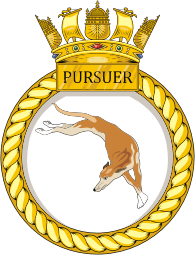
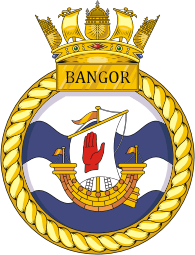
While I am talking about the events of last weekend I might as well show you the badges of the two Royal Navy ships in the city for the events. The ships badge of HMS Bangor and HMS Pursuer: 


hope you enjoyed this as it is quite rare to see warships fly Royal Standards, especially as Prince Michel is a Rear Admiral, and could have used the RN rank flag, which is normally used in cases like this:
Rear-Admiral Flag
Rear Admiral rank flag, rank flags are more commonly used on board ships rather than Royal Standards


All comments welcome


none of the flags are my designs the picture of HMS Pursuer is by me.


Saturday, 11 May 2013

UK State opening of Parliament and Flag

As Wednesday saw the ceremony of the State Opening of Parliament in the United Kingdom I think this is an appropriate time to publish my 'parliament in session' flag. But first I will give a brief background to the state opening of parliament and some items of particular vexilogical and heraldry interest.


First the ceremony itself in short is when the Queen reads a speech written by the government to parliament which outlines what it hopes to achieve in the parliament year. it is full of both Royalist and slightly Republican symbolism. For example this is one of very few occasions when the Queen actually wears the crown of state symbolising the authority of the crown, but also when Blackrod (the chief of security for parliament usually an ex military officer) is sent to summon the House of Commons to the House of Lords to hear the speech, the door is deliberately and ceremonially slammed shut and he has to wait to be invited in, thus symbolising the sovereignty of the people. If you like pomp and ceremony you can view it on Youtube.

Three of the four Royal Bodyguards take part in the ceremony. The Honourable Corps of Gentlemen at Arms, The Yeomen of the Guard and soldiers of the Household Division. (The Royal Company of Archers only take part in ceremonies in Scotland)

 The Gentlemen at arms are the most senior of the Sovereign Bodyguards (Gentlemen at Arms, Yeomen of the Guard and Royal Company of Archers). They are mostly if not all retired military officers. They are more senior as they are the 'closed guard' and are classed as gentlemen rather than yeomen. Their uniform is based on that of a heavy dragoon in the Victorian period. Their standard is seen during the ceremony and can be seen below:

This is in the style of a carvery guidon, however it is a lot bigger. It has the Cross of St George in the hoist, beside which is the cypher of the reigning monarch (this picture is not of the current standard) beside which is the corps name, beside which is the corps badge which is similar to the bade of the palace of Westminster (the name of the building which Houses of Parliament) except with a royal crown. In the fly are two of the three battle honours. To get an idea of the full size see below:

The Yeomen of the Guard are the oldest military corps still in existence despite the fact they are junior to the gentlemen at arms. They are often mistaken for the Yeomen Wardens of the Tower of London known as Beefeaters. An easy mistake as the ceremonial uniforms of both are exactly the same except for a cross belt worn by the guards. Like the gentlemen at arms the are made up of former members of the armed forces however any rank can join not just officers. Their colour which is also seen at the ceremony is below:
 Only the cypher changes, in the centre is the floral emblems of the Kingdoms of Scotland, England and Ireland. In each corner are the badges of houses (families) to sit on the throne. The House of Windsor at the bottom left, the House of Stuart at the top left. A crowned hawthorn bush and the letters HR, representing King Henry VII and the legend that the crown was discovered by the guard in a hawthorn bush following the Battle of Bosworth in the top right.  A white horse on a green mound surmounted by the crown, representing the House of Hanover in the bottom right. Two of the company's seven battle honours are also displayed. 
The Sovereigns bodyguards are ceremonial only and are made up of ex servicemen  The Household Division are made up of serving soldiers most of which be deployed wherever the United Kingdom is engaged in military operations. There are two brigades in the division the foot guards are the famous guards with the red tunics and bearskin caps that guard Buckingham Palace. They are made up of five regiments (Grenadier Guards, Coldstream Guards, Scots Guards, Irish Guards and Welsh Guards) who rotate between ceremonial duties (or public duties as they are known in the military) training exercises, security and combat operations. At Parliament this year the Welsh Guards were the guard of hounour outside, their Queen's Colour was also on parade and can be seen below:
Unlike other army regiments the regimental colour is a Union Flag, not the Queen's Colour. The Queens Colour of the Welsh Guards has a Royal Crown and dragon, underneath which is the regiments motto: "Cymru am Byth"  Welsh for 'Wales Forever' it is also emblazon with battle honours of which there are notably more than the cerimonaly guards as I already mentioned the Foot Guards are modern operation soldiers. Most are WW1 and WW2 battle hounours but the bottom one reads "Falkland Islands 1982" since this picture was taken I think ones for Afghanistan have also been awarded but I'm not too sure about that. 

The next brigade is the Horse Guards which as the name suggests are mounted. There is only one regiment of Horse Guard the household Calvery but this is split into two seperate units the Life Guards and the Blues & Royals each of which have a mounted (horse) and armoured (tanks) corps in which troopers rotate. Their sovereign Guidon is carried when escorting the monarch to parliament:

Also of note are the Kings of Arms who are responsible for keeping records of heraldic arms and granting arms in England, Northern Ireland and Wales. They take part in the ceremonial uniform which are unchanged since the middle ages with the Royal Arms and their chains and staffs of offices.

Well that is the ceremony out of the way. The Union Flag being replaced by the Royal Standard when the monarch arrives is naturally part of the ceremony. Traditionally the Union Flag was only flown over parliament when Parliament was in session  (when one or both of the two houses were meeting for debates, votes and lawmaking, not including committees or hearing). But the last Government led by Prime Minister Gordon Brown decided it should be flown everyday from Parliament buildings and 10 Downing Street. So it has lost its traditional communicative purpose. I recently seen an idea for a parliament in session flag to be used for this traditional purpose:
Presumably this will replace the UK flag on the Victoria Tower when used. Its a white ensign, which is in itself unusual. The charge on the fly is Coat of Arms of Simon De Montfort who called for the first elected Parliament in 1265 AD. Behind the arms, is a knights of the round table based upon the design at Winchester, that had 25 slots for 24 knights and one for the Lord or Sovereign.
I also had ago at a design:
I kept the white ensign design. However my design has a red, white and green cross design. This represents the two Houses of Parliament  The House of Lords (whose colour is red) and the House of Commons (whose colour is green) In the centre is a blue disc with the badge of the Palace of Westminster (the parliament building) 
The above flag is designed to replace the Union Flag on the Victoria Tower when used. However if a second flag pole was constructed for a parliament in session flag, or if it was used under the union flag, then their would be no need to replace the Union Flag so an ensign design with the national flag in the canton would not be necessary. In that case my alternative design is below:
It feature the Tudor Rose of England, Thistle of Scotland, Leek of Wales and Flax of Northern Ireland.Personally I think I like the ensign version but I would like know what you think.

All Comments welcome


Only the last two flags are of my design. 

Wednesday, 1 May 2013

Duke of Wellington Coat of Arms

Today is the 224th birthday of one of the greatest heroes in British Military History. The great Anglo-Irish soldier and statesman, Field Marshal His GraceArthur Wellesley, 1st Duke of WellingtonKGGCBGCHPCFRS,  better known as the Duke of Wellington. The man who defeated Napoleon at Waterloo, rose to commander and chief of the British Army, and was twice Prime Minister who's terms often saw various ground breaking reforms and inventions, such as Catholic Emancipation and the steam locomotive. So to reflect the day someone said I should make a post about his coat of arms so here they are:


File:Coat of Arms of the Duke of Wellington.svg
Blazon: Quarterly, I and IV gules, a cross argent, in each quarter five plates; II and III, Or, a lion rampant gules. For augmentation, an inescutcheon charged with the crosses of St. George, St. Andrew, and St. Patrick combined, being the union badge of the United Kingdom.

Crest: Out of a Ducal Coronet Or a demi Lion rampant Gules holding in the paws a Forked Pennon Argent flowing to the sinister charged with the Cross of St George the Ends Gules.

Supporters: On either side a Lion Gules gorged with an Eastern Coronet and chained Or.

Motto: Virtutis Fortuna Comes (Fortune is the companion of valour).

In modern English, the shield is divided into quarters, with the first and fourth having a cross on a red background, with five plates in each corner. The third and fourth quarters have a red lion rampant, and in the middle of the charge is a Union Flag in the form of a shield (Union Badge of the United Kingdom) What is not mentioned in the Order of the Garter. 
The crest has the cornet or crown of a duke, ontop of which is the helmet with another cornet ontop of which is a red lion with a pennant with St Georges Cross in the hoist. This crest was the design of the Duke of Wellington's Regiment, later amalgamated into the Yorkshire Regiment:
 
Left: Duke of Wellington's Regiment badge. Right: badge of the modern Yorkshire Regiment

The Supporters are two red lions with cornets and chains. 

I also belive that the se arms are/were also used under the titles Prince of Waterloo (Dutch title for Dukes of Welington) and Earl of Cowley (Wellington's paternal grandfather Richard Colley, a landlord who lived at Rahin near CarburyCounty Kildare, changed his surname to Wesley.)